Central Air Installation Cost in Los Angeles: 2026 Homeowner’s Price Guide
July 7, 2026 18 min read
Did you know that HVAC replacement costs in California are currently 20% to 30% higher than the national average? If you're feeling overwhelmed by the technical jargon of SEER2 ratings or the strict requirements of the 2026 Title 24 energy code, you aren't alone. It's a lot to process, especially when you just want a reliable system that won't quit during the next record-breaking heat wave. We understand that your home is your sanctuary, and the central air installation cost los angeles residents pay should reflect both high-quality craftsmanship and long-term energy savings.
We believe you deserve total transparency before you make such a significant investment in your home's comfort. This guide offers a clear look at what drives your total investment, including local permit fees, mandatory HERS testing, and how to maximize thousands in LADWP rebates. We'll also explain how the shift to low-GWP refrigerants like R-32 or R-454B impacts your choice of equipment. By the end of this guide, you'll have the tools to hire a local expert with complete peace of mind and a realistic plan for your home.
Key Takeaways
- Understand why California's specific energy standards and local labor rates make regional pricing significantly higher than what you'll find on national estimate websites.
- Get a realistic look at the central air installation cost los angeles homeowners face in 2026, including how system tonnage and SEER2 efficiency ratings impact your final quote.
- Learn about the mandatory requirements of a legal installation, such as Title 24 compliance and HERS testing, to ensure your system passes inspection.
- Discover how to offset your upfront investment by leveraging federal tax credits and local utility rebates from providers like LADWP and Southern California Edison.
- Identify the common red flags in "lowball" quotes so you can choose a contractor who prioritizes long-term reliability and proper craftsmanship.
The Real Cost of Central Air Installation in Los Angeles (2026)
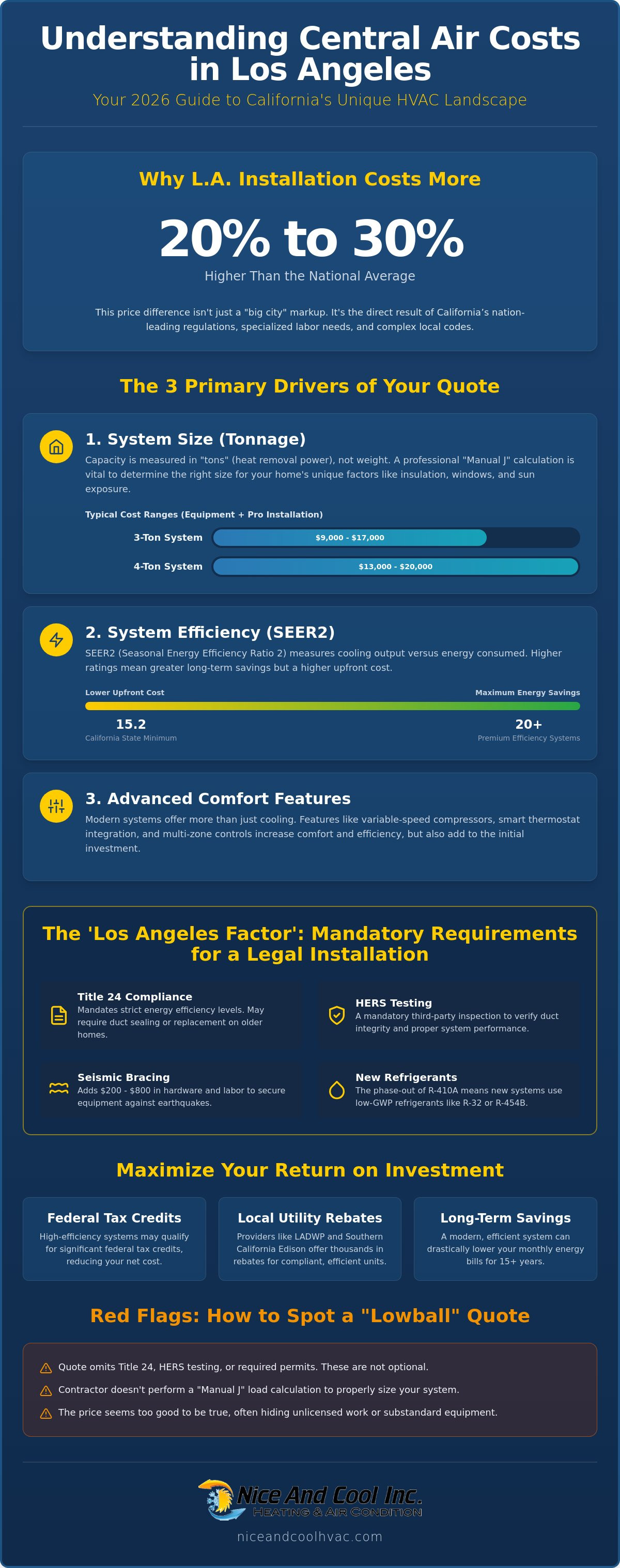
If you have spent any time browsing national home improvement websites, you might see price estimates that feel surprisingly low. The reality is that the central air installation cost los angeles homeowners encounter is often 20% to 30% higher than the national average. This isn't just a "big city" premium; it is the direct result of California’s rigorous energy standards, the transition to new refrigerants, and the specialized labor required to meet local building codes. Understanding the central air installation cost los angeles requires looking past the equipment itself and evaluating the entire environment where the system will live.
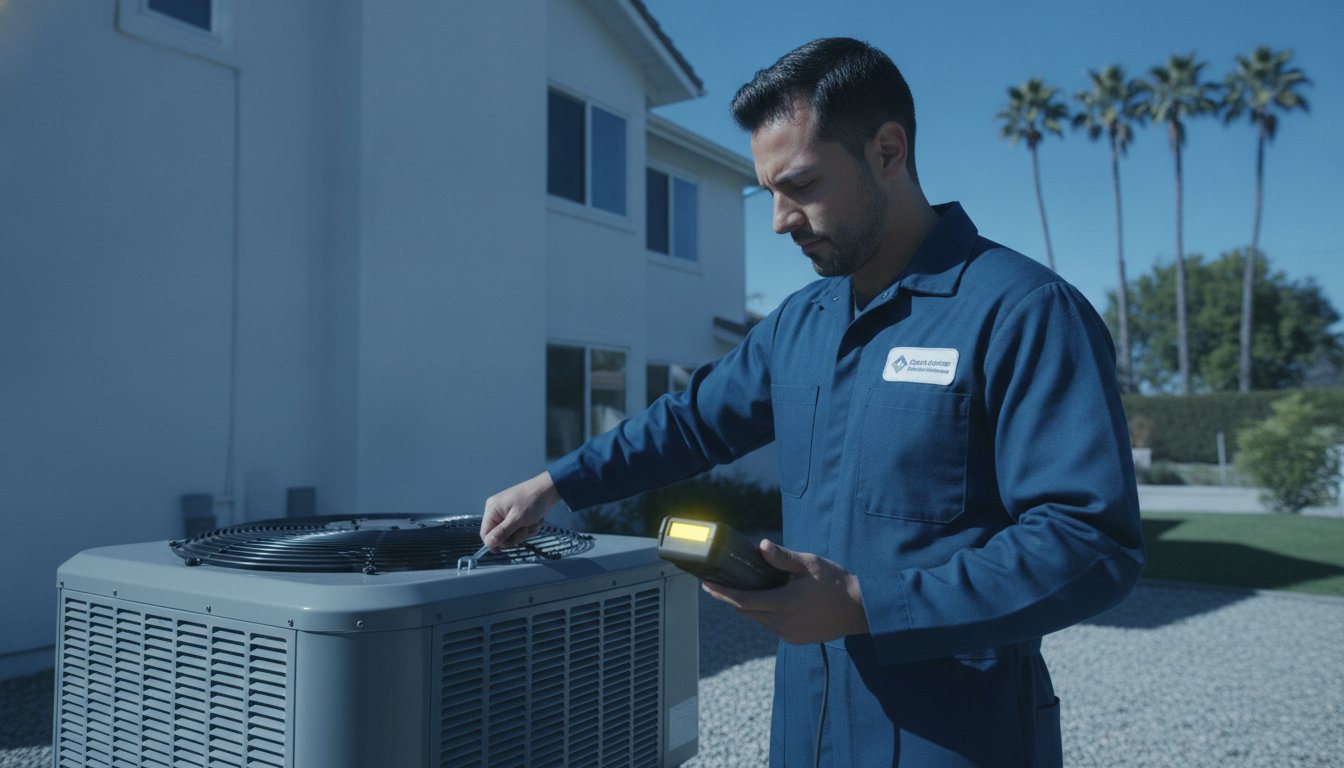
In 2026, a standard installation involves more than just the outdoor unit. It includes the indoor coil, the refrigerant lines, and often a new furnace or heat pump to ensure the whole system communicates correctly. For a comprehensive look at the technology involved, you can explore the fundamentals of Heating, ventilation, and air conditioning (HVAC). These systems are now more complex than ever, requiring a tailored approach to ensure they handle our specific climate while remaining compliant with state law.
Why Los Angeles Prices Differ from National Averages
Local prices reflect the unique regulatory environment of Southern California. As of June 9, 2026, the Los Angeles Department of Building and Safety (LADBS) applies a 10% General Plan Maintenance Surcharge to permit fees, on top of existing surcharges. Beyond permits, California’s Title 24 standards mandate specific efficiency levels that aren't required in other states. If you are installing a system today, it must meet a minimum SEER2 rating of 15.2. Additionally, Los Angeles building codes require seismic bracing for HVAC equipment, which can add $200 to $800 in specialized hardware and labor to ensure your system stays secure during an earthquake.
Replacement vs. New Installation: Defining Your Project
The scope of your project is the biggest factor in your final quote. Whether you are swapping an aging unit or designing a system for a new addition, the requirements change significantly. A simple replacement assumes your existing ductwork is sized correctly and in good condition. However, if your home has older, leaky ducts, Title 24 may require them to be sealed or replaced entirely to pass HERS testing. You should also consider the following factors that can impact the complexity of your project:
- Ductwork Integrity: If your ducts lose more than a certain percentage of air, they must be repaired to meet 2026 standards.
- Electrical Upgrades: Modern high-efficiency systems might require a dedicated circuit or a panel upgrade.
- Accessibility: Units located in tight crawlspaces or on steep roofs require more man-hours and specialized safety equipment.
- Refrigerant Transition: With the phase-out of R-410A, new systems using R-454B or R-32 require specific components and handling procedures.
Taking the time to assess these details upfront prevents "sticker shock" later. A professional evaluation will determine if you need a straightforward swap or a full system overhaul to keep your home comfortable for the next decade.
The 3 Primary Drivers of Your HVAC Quote
Every quote for a central air installation cost los angeles homeowners receive is as unique as the property itself. While the equipment brand matters, the three most significant drivers of your final price are the capacity of the unit, its efficiency rating, and the specific comfort features you choose to include. Understanding these variables helps you move from being a confused shopper to a confident homeowner who knows exactly what they're paying for.
Sizing Your System: The Tonnage Factor
In the HVAC industry, capacity is measured in "tons," which refers to how much heat a system can remove from your home in one hour. If your home is 1,500 square feet, you might assume you need a 3-ton unit, but it's not a simple one-to-one ratio. A proper Manual J calculation considers your insulation, window types, and sun exposure. The price jump between sizes is notable; for instance, a 3-ton system typically ranges from $9,000 to $17,000, while a 4-ton system can move into the $13,000 to $20,000 bracket depending on its efficiency. Whether you live in a coastal bungalow or a multi-story home in the hills, this calculation ensures you don't overpay for capacity you don't need.
Efficiency Standards: Understanding SEER2 in 2026
In 2026, the minimum efficiency rating for new systems is 15.2 SEER2. If you prioritize a low initial investment, then a standard 15.2 SEER2 system is a reliable choice. However, moving to a higher rating like 18 or 20 SEER2 will increase your upfront costs while significantly lowering your monthly utility bills. These high-efficiency units are often the best choice for handling the intense San Fernando Valley heat. To help offset the higher cost of premium equipment, you can explore California's Home Energy Rebates. These programs reward homeowners who choose high-efficiency options that reduce the strain on our local power grid.
The Role of Comfort Features
Beyond the basic box, the technology inside the unit dictates your daily experience. Single-stage compressors are either 100% on or completely off, which can lead to slight temperature swings. Variable-speed models are more like a dimmer switch, adjusting their output to match the exact cooling needs of your home. These features impact the total central air installation cost los angeles contractors provide because they require more sophisticated components. You might also consider:
- Zoning Systems: These allow you to cool only the rooms you are using, which saves money in larger homes.
- Smart Thermostats: Modern systems integrate with your home network to optimize cooling schedules automatically.
- Variable-Speed Blowers: These provide quieter operation and better humidity control compared to standard fans.
If you're ready to see how these factors apply to your specific home, we offer professional Air Conditioning Installation services that prioritize both comfort and long-term value.
The 'Los Angeles Factor': Regulations and Hidden Costs
Living in Los Angeles means dealing with a unique set of building codes that don't apply in most other parts of the country. When you are looking at the central air installation cost los angeles contractors provide, a significant portion of that quote covers mandatory state and local compliance. These aren't just "red tape" fees; they're designed to ensure your system actually performs at the efficiency level promised by the manufacturer. If a contractor offers a quote that seems too good to be true, they might be skipping these critical legal steps.
Beyond the equipment, you have to account for the City of Los Angeles permit process. As of 2026, a standard HVAC replacement permit carries a base fee of approximately $98.10. However, that's rarely the final number. You also have to factor in a 3% DSCS surcharge, a 6% Systems Development surcharge, and a 10% General Plan Maintenance Surcharge. These fees fund the safety inspections that protect your property value and your family's safety. While these costs add up, they're a necessary part of a professional, legal installation.
Compliance Costs: Title 24 and HERS Testing
California’s Title 24 standards are among the strictest in the nation. For 2026, the law requires HERS (Home Energy Rating System) verification for almost every HVAC replacement. This involves an independent, third-party inspector who visits your home to perform a duct leakage test. They're checking to make sure your ducts aren't leaking more than 5% to 15% of your conditioned air into your attic or crawlspace. In Los Angeles County, a HERS field inspection typically costs around $350, though a full suite of testing for complex systems can range from $295 to $595. To help offset these mandatory costs, many homeowners utilize California Energy Commission rebates to upgrade to even more efficient systems that pay for themselves over time.
Infrastructure Challenges in Older Homes
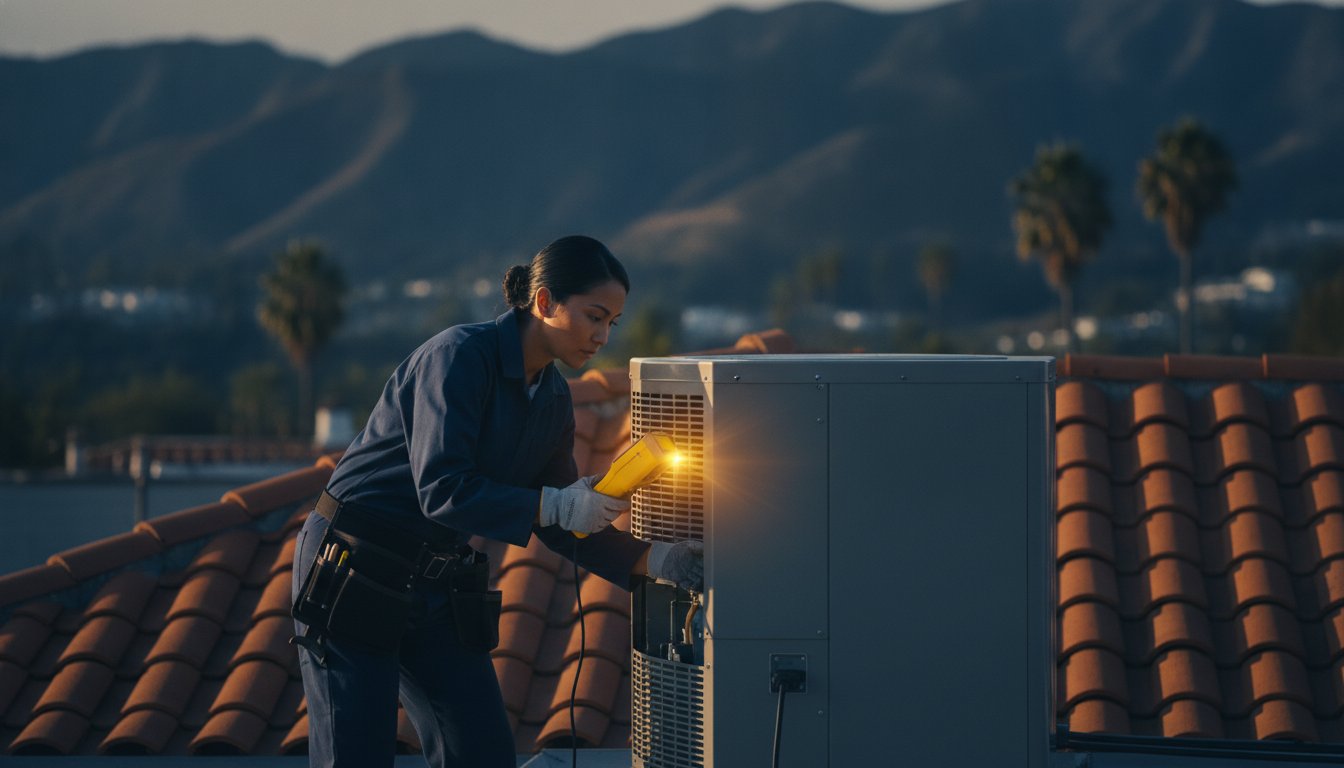
Many Los Angeles neighborhoods feature historic homes that weren't originally designed for modern climate control. These properties often present "hidden" infrastructure challenges that can impact your central air installation cost los angeles baseline. If your home still operates on an older 100-amp electrical panel, it likely won't support a high-efficiency 4-ton or 5-ton system. A panel upgrade is a frequent and necessary addition to many local projects. We also see many homes from the 1950s and 60s with transite or asbestos-wrapped ductwork. If these materials are present, they must be safely removed by a certified abatement team before any new work begins. Finally, the physical location of your unit matters. A rooftop installation in a dense neighborhood like Silver Lake or West Hollywood requires more specialized labor and safety equipment than a standard backyard installation in the Valley.
Maximizing ROI: Rebates, Tax Credits, and Energy Savings
While the initial central air installation cost los angeles homeowners see can be significant, the net cost is often much lower after applying state and federal incentives. We believe in helping our neighbors find every possible way to offset their investment. In 2026, the financial landscape for home cooling has shifted heavily toward rewarding energy efficiency. If you choose a system that exceeds minimum standards, then you can effectively "buy down" your total price through tax credits and cash-back programs that weren't available just a few years ago.
Current Rebates and Incentives in 2026
The Energy Efficient Home Improvement Credit (Section 25C) remains a powerful tool for Los Angeles residents. This federal program provides a tax credit of 30% of the total cost for qualifying energy-efficient upgrades. For those opting for high-efficiency heat pumps, the annual credit is capped at $2,000, while standard central air units that meet specific SEER2 requirements can qualify for up to $600. These credits reset every year, which is helpful if you're planning multiple home improvements.
Local utilities also offer substantial support to keep our grid stable during summer peaks. The LADWP "Cool LA" program provides rebates based on the tonnage and efficiency of your new unit. For example, systems with a 15.2 SEER2 rating qualify for a $100 per ton rebate, while those hitting 16.0 SEER2 or higher receive $120 per ton. If you are considering a transition to all-electric cooling, qualifying high-efficiency heat pumps can receive rebates up to $2,500 per ton from LADWP. You can verify the most current rebate amounts and application deadlines by visiting the LADWP official website or checking their "Cool LA" portal.
Energy Savings vs. Upfront Investment
The real value of a modern system shows up in your monthly Southern California Edison or LADWP bill. Older systems often operate at a SEER rating of 10 or lower, meaning they use nearly twice the electricity of a new 2026-compliant model. If you choose a variable-speed system, then your unit can run at lower speeds for longer periods, which is much cheaper than the constant on-and-off cycling of older technology. This precision cooling significantly reduces "electric bill anxiety" during July and August heat waves.
Beyond monthly savings, central air is a baseline expectation for Los Angeles property values. Real estate experts in Southern California consistently report that a modern, permitted HVAC system is one of the few home improvements that offers a high return on investment at the time of sale. To help you decide which technology fits your budget, take a look at our guide on Choosing the Right AC Unit for Your Los Angeles Home.
If you want to maximize these savings while ensuring your home stays perfectly cool, our team can help you navigate the paperwork for our professional Heat Pump Services and installations.
Comparing Quotes: How to Spot Value and Avoid Scams
When you begin collecting estimates, you might notice a wide gap between the highest and lowest bids. While it's tempting to choose the lowest number, the central air installation cost los angeles homeowners pay for a "budget" job often doubles within the first few years due to repairs. A lowball quote usually means the contractor is skipping the mandatory permits and HERS testing we discussed earlier, or they're using technicians who aren't covered by worker's compensation. If a deal feels too good to be true, then it likely leaves you vulnerable to future liability and system failure.
We believe that a professional HVAC proposal should be a transparent roadmap for your home’s comfort. It isn't just a price tag; it's a commitment to craftsmanship and safety. Whether you are looking for a basic replacement or a high-efficiency heat pump, the quality of the installation is the single most important factor in how long your system lasts and how much it costs to run. Choosing a partner who prioritizes local codes and long-term reliability ensures your peace of mind during our intense Southern California summers.
The HVAC Quote Checklist
Before you sign a contract, you should verify that every detail is in writing. A comprehensive proposal protects you from "hidden fees" that can crop up mid-project. Use this checklist to evaluate your potential contractors:
- License and Insurance: Verify the contractor holds an active C-20 license and carries both liability and worker’s compensation insurance.
- Ductwork Assessment: Ensure the quote includes a written inspection of your existing ducts to confirm they can handle the airflow of a new system.
- Warranty Specifics: Look for a clear breakdown of the manufacturer’s parts warranty versus the contractor’s labor guarantee.
- Included Compliance: The quote should explicitly mention permit fees, seismic bracing, and HERS verification testing.
Why Local Expertise Matters
Los Angeles is a city of microclimates, and a system that works in the coastal fog of Playa Del Rey may not be the right fit for the dry heat of the San Fernando Valley. A local specialist understands these geographic nuances and tailors your equipment to your specific neighborhood. Our team at Nice and Cool Inc. takes immense pride in being a family-oriented business with deep roots in the community. We don't just install a box and disappear; we offer the Nice and Cool Club Maintenance Plan to ensure your system remains dependable for its entire lifespan.
The best way to get an accurate central air installation cost los angeles estimate is through a professional site visit and a proper load calculation. This ensures your system is perfectly sized for your home’s unique footprint. If you're ready for a partner who values honesty and high standards, we're here to help. Get a transparent, professional quote from Nice and Cool Inc. today.
Investing in Your Home's Long-Term Comfort
Managing the central air installation cost los angeles homeowners face in 2026 requires balancing upfront equipment prices with long-term energy savings. By now, you understand that a legal, permitted installation involves more than just a new unit. It's about ensuring Title 24 compliance and maximizing every available rebate from the Inflation Reduction Act and local utilities like LADWP. These steps protect your property value and ensure your system actually delivers the efficiency you paid for.
At Nice and Cool Inc., we've been serving the Los Angeles community since 2005. We specialize in navigating complex local regulations and providing expert Title 24 compliance so your system is safe and efficient from day one. Our Nice and Cool Club Maintenance Plan is designed to protect that investment, giving you the reliability you need during our hottest months. If you're ready to take the next step toward a cooler home, we invite you to Schedule Your Professional AC Installation Quote with our team today. You don't have to tackle these technical decisions alone. We look forward to helping you create a comfortable sanctuary for your family that lasts for years to come.
Frequently Asked Questions
How much does a new central air unit cost for a 1,500 sq. ft. home in LA?
A 1,500 square foot home typically requires a 3-ton system, which often carries a market price range between $9,000 and $17,000 in Southern California. Your final central air installation cost los angeles quote depends on whether you choose a base 15.2 SEER2 model or a premium variable-speed unit. Factors like ductwork condition and electrical panel capacity will also influence the total investment for a home of this size.
Is it cheaper to install central air in the winter in Los Angeles?
Equipment prices remain relatively stable year-round, but scheduling your installation during the winter or early spring can offer significant advantages. HVAC contractors in Los Angeles are often less busy during cooler months, which may lead to more flexible scheduling and faster project completion. While you might not see a massive drop in equipment costs, avoiding the "summer rush" ensures you have your choice of installation dates before the first heat wave hits.
Does the city of Los Angeles require a permit for AC installation?
Yes, the City of Los Angeles requires a permit for all central air conditioning installations and replacements. This requirement ensures that your system meets current safety codes, including seismic bracing and electrical standards. A permit also triggers the mandatory HERS testing mentioned earlier in this guide, which verifies that your system is operating at the high efficiency level required by California's Title 24 energy code.
What is the average lifespan of a central air system in Southern California?
The average lifespan for a central air system in Southern California is typically 12 to 15 years. While our mild winters don't strain heating components, our intense summer heat waves can put significant stress on compressors and outdoor coils. You can often extend this lifespan toward the 20-year mark by staying consistent with annual maintenance and keeping your outdoor unit clear of debris and coastal salt spray.
Are heat pumps more expensive to install than traditional central AC?
Heat pumps often have a higher upfront equipment cost compared to traditional air conditioners, but the net investment is frequently lower after incentives. Because heat pumps provide both heating and cooling, they qualify for much higher rebates from LADWP and the federal government. If you factor in the potential $2,000 federal tax credit and local utility cash-back programs, a high-efficiency heat pump often becomes the most cost-effective long-term choice for Los Angeles homes.
How much can I save on my electric bill with a new 16 SEER2 unit?
Upgrading to a 16 SEER2 unit can reduce your cooling-related electricity usage by approximately 30% to 50% if you are replacing a system that is 15 years or older. Most older Los Angeles homes operate on systems with a SEER rating of 10 or lower. By moving to the modern 16 SEER2 standard, you use significantly less power to achieve the same level of comfort, which directly lowers your monthly LADWP or SCE bill.
What happens if I install an AC without a permit in LA County?
Installing a system without a permit in Los Angeles County can lead to heavy fines, legal complications, and issues with your homeowner's insurance. If you decide to sell your home, a home inspector will likely flag the unpermitted work, which can delay or even derail the sale until the system is brought up to code. It's always safer and more cost-effective to ensure your contractor pulls the proper permits from the start.
How long does a typical central air installation take from start to finish?
A typical central air installation in Los Angeles takes between one and three days to complete. A straightforward "change-out" where we replace an existing unit usually takes a single day of labor. However, if your project requires new ductwork, electrical panel upgrades, or complex rooftop access, the timeline may extend to three days. We always provide a clear schedule during the initial site visit so you can plan accordingly.
Frequently Asked Questions
Local prices reflect the unique regulatory environment of Southern California. As of June 9, 2026, the Los Angeles Department of Building and Safety (LADBS) applies a 10% General Plan Maintenance Surcharge to permit fees, on top of existing surcharges. Beyond permits, California’s Title 24 standards mandate specific efficiency levels that aren't required in other states. If you are installing a system today, it must meet a minimum SEER2 rating of 15.2. Additionally, Los Angeles building codes require seismic bracing for HVAC equipment, which can add $200 to $800 in specialized hardware and labor to ensure your system stays secure during an earthquake.