Energy Efficient Heat Pump Rebates in California: The 2026 Homeowner’s Resource Guide
June 15, 2026 18 min read
You might think the window for massive savings closed when the federal tax credits expired at the end of 2025, but for many Los Angeles homeowners, the best opportunities are actually just hitting their stride. While it's true that the federal 25C credit is gone and statewide funds like HEEHRA are currently waitlisted, your local utility providers have stepped up with some of the most aggressive energy efficient heat pump rebates California has ever seen. If you are replacing an aging gas furnace with a qualifying all-electric system in 2026, then you could be eligible for up to $10,000 or more in direct incentives that drastically lower your upfront costs.
We understand that navigating these shifting deadlines and eligibility rules feels like a full-time job. It's frustrating to worry about missing out on a program just because a funding pool dried up or a deadline passed. This guide provides total clarity on the 2026 landscape. We'll walk you through the active LADWP and SCE programs, verify if your LA home qualifies, and help you select a system that delivers long-term comfort while paying for itself through lower bills and high-value local rebates.
Key Takeaways
- Understand why local utility programs from LADWP and SCE have become the primary source of savings following the expiration of major federal tax credits in 2026.
- Learn the "rebate stacking" strategy to combine multiple local incentives, potentially securing over $10,000 for your new system installation.
- Discover the specific eligibility criteria for energy efficient heat pump rebates California homeowners must meet to ensure their application is approved.
- Identify why choosing a participating certified contractor is a mandatory requirement for most utility-sponsored rebate programs and state waitlists.
- Gain a clear roadmap for transitioning from gas to electric with confidence, focusing on high-efficiency systems that offer the fastest return on investment.
The 2026 Landscape of California Heat Pump Incentives
California is currently pursuing an ambitious goal to install 6 million heat pumps by 2030, which makes 2026 a pivotal year for homeowners in the LA Basin. If you are still relying on an aging gas furnace for your home comfort, then you are part of a massive statewide shift toward electrification. This transition isn't just about meeting environmental targets; it's about providing local families with a more reliable and efficient way to stay comfortable year-round. To understand why these systems are the focus of such heavy investment, it helps to learn How Heat Pumps Work. Unlike traditional furnaces that burn fuel to create heat, these systems move heat from one place to another with incredible precision.
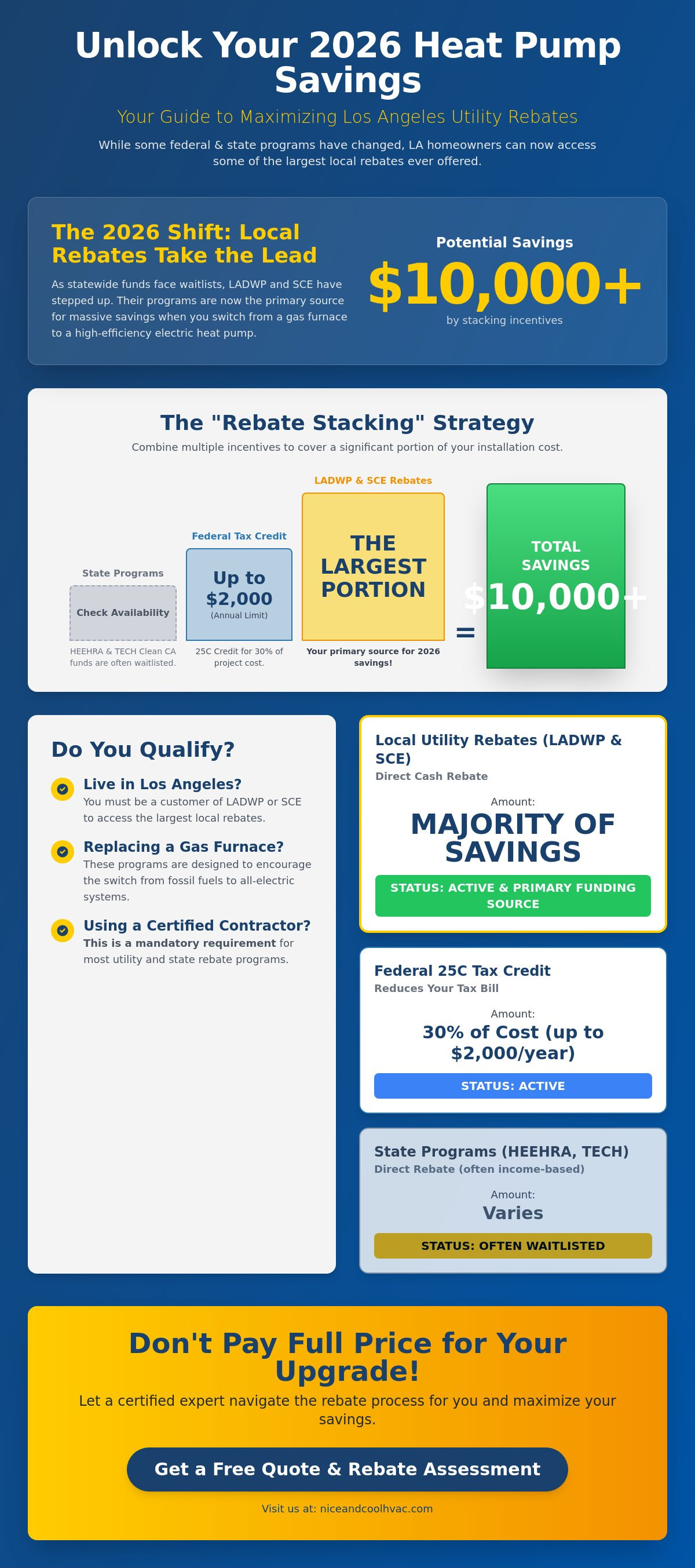
Securing energy efficient heat pump rebates California offers requires a strategy often called "stacking." This means you can combine incentives from federal, state, and local utility layers to cover a significant portion of your installation costs. In 2026, the landscape has become more competitive. Many statewide programs have seen record-breaking participation, leading to reserved funds and waitlists. Whether you are looking at federal tax credits or local utility checks, timing your application correctly is the difference between saving thousands or paying full price. This guide helps you identify which layers of funding are still active so you can maximize your return on investment.
What is the TECH Clean California Program?
TECH Clean California is a statewide initiative focused on making residential retrofits easier and more affordable. It specifically targets single-family homes and multi-family units to encourage the switch from gas-powered appliances to electric alternatives. In 2026, the program works closely with the "Switch Is On" campaign to provide resources and education for homeowners. Because TECH Clean California incentives are often distributed through participating contractors, working with a specialist who understands the 2026 filing requirements is essential. If the program’s single-family funds are fully reserved, then staying informed through these campaigns ensures you are first in line when new cycles of funding open up.
Federal vs. State: Understanding the Funding Sources
It is important to distinguish between federal incentives from the Inflation Reduction Act (IRA) and California state funds. Federal support typically arrives as a tax credit, which reduces the amount of tax you owe at the end of the year. State-administered rebates, such as HEEHRA, are designed to provide more immediate relief, though they are often subject to stricter income-based eligibility and availability windows. If you want to capture the best energy efficient heat pump rebates California provides in 2026, then you must track these different timelines. While federal credits offer a steady baseline of support, state rebates are often first-come, first-served, making early planning a necessity for any major home upgrade.
Federal Tax Credits: The 25C Incentive for Energy Efficiency
While state-level programs often fluctuate based on budget availability, the federal government offers a stable foundation for your home upgrades. The 25C federal tax credit, officially known as the Energy Efficient Home Improvement Credit, provides a direct way to reduce your tax liability. If you install a qualifying system in 2026, then you can claim 30% of the total project cost. This includes both the equipment and the labor required for the setup. It is a reliable way to offset the initial investment while securing energy efficient heat pump rebates California homeowners need for long-term savings.
There are specific limits you need to keep in mind to maximize this benefit. For heat pumps, the annual credit is capped at $2,000. This is a significant amount, but it’s important to remember it is an annual limit. If you have multiple energy projects planned, then spreading them across different tax years might be a strategic way to capture more credits. This specific incentive is reserved for primary residences where you live most of the year. If you own a rental property, it typically won't qualify for this residential credit, though other commercial pathways might exist to help you secure the best energy efficient heat pump rebates California provides.
SEER2 and HSPF2 Requirements for Federal Credits
Not every heat pump on the market qualifies for the 25C credit. To be eligible, the system must meet the "Energy Star Most Efficient" criteria for the current year. These standards are based on SEER2 and HSPF2 ratings, which measure how much energy the system uses to cool and heat your home. If you choose a system with lower efficiency ratings, then you risk losing out on the $2,000 credit entirely. Expert heat pump installation is vital here. A professional can verify that the specific model and match-up of indoor and outdoor units meet the federal benchmarks required for your tax documents.
Electrical Panel Upgrade Credits
Modern heat pumps are powerful, and they often require more electrical capacity than older Los Angeles homes can provide. If your home was built before 1970, your existing electrical panel might need an upgrade to support the new system. The good news is that the federal government offers an additional $600 credit specifically for panel upgrades when they are performed in conjunction with an energy-efficient upgrade. This helps bridge the gap for homeowners transitioning away from gas. If you need assistance choosing a system that fits your home's electrical capacity and qualifies for these credits, our specialists at Nice and Cool Inc. are here to provide a tailored assessment.
Local Utility Rebates: SCE and LADWP Specifics
Local utility programs often provide the most direct financial relief for homeowners. While federal tax credits reduce what you owe in April, utility rebates often arrive as a check in the mail or a direct credit on your monthly bill. If you live in the Southern California Edison (SCE) service area, then your path to savings looks different than someone in Los Angeles Department of Water and Power (LADWP) territory. Understanding these local distinctions is the key to capturing the best energy efficient heat pump rebates California has to offer in 2026. These programs are designed to reward homeowners who help stabilize the local grid by choosing high-efficiency equipment.
SCE and LADWP have different philosophies when it comes to distributing these funds. SCE leverages a marketplace model that prioritizes instant discounts and distributor-level incentives. Their "Comfortably California" program works behind the scenes with equipment suppliers to lower prices before the unit even reaches your home. In contrast, LADWP’s Consumer Rebate Program (CRP) is highly focused on performance. For example, LADWP currently offers rebates that can reach up to $2,500 per ton for qualifying all-electric systems. If you are replacing a gas-powered furnace with a high-efficiency heat pump, then you could see a massive reduction in your net costs. You can also monitor California's IRA Rebate Programs to see how state-level funding might be funneled through these local providers to maximize your home's energy efficiency.
Southern California Edison (SCE) Programs
The SCE Marketplace is a powerful tool for homeowners seeking point-of-sale discounts. If you are looking for smart thermostats to pair with your new system, then you can find instant credits that lower the price at checkout. These smart devices are more than just a convenience; they are often a requirement for "Demand Response" programs. Enrolling in these programs allows the utility to manage grid load during peak heat, often rewarding you with additional bill credits that increase your total savings. By participating, you are not just saving money; you are helping your neighbors by reducing the risk of local power outages.
LADWP and Local Municipal Utility District (MUD) Incentives
If you reside in areas like Burbank, Glendale, or Pasadena, then you are likely served by a Municipal Utility District (MUD) rather than a major investor-owned utility. These local districts operate independently and often have their own unique funding pools for energy efficient heat pump rebates California residents can access. It is vital to verify your provider's current 2026 status through their specific online portals, as their rules for heat pump water heaters and HVAC systems can differ from LADWP. Navigating these portals early ensures you have all the necessary documentation ready before your installation begins.
The Rebate Stacking Strategy: Maximizing Your ROI
Mastering the math behind energy efficient heat pump rebates California offers is the most effective way to lower your project’s net cost. Many homeowners believe they must choose between a federal credit or a local utility check, but the reality is more rewarding. You can often layer a local utility rebate from LADWP or SCE with the federal 25C tax credit to cover a massive portion of your upgrade. If you follow a specific order of operations, then you can significantly reduce your out-of-pocket expenses. Most local utility incentives are applied at the time of purchase or shortly after installation, while the federal tax credit is claimed when you file your annual tax returns.
Calculating your true net cost involves looking at the total project price minus any instant discounts, mail-in rebates, and tax savings. If your installation costs a specific amount and you secure a $2,500 per ton LADWP rebate plus a $2,000 federal tax credit, then your actual investment drops significantly. This calculation doesn't even account for the monthly energy savings you'll see on your utility bills. By stacking these funds, you turn a high-efficiency upgrade into a financially savvy decision that adds value to your property. This approach ensures your system pays for itself much faster than a standard replacement would.
Income-Qualified Bonuses (HEEHRA)
The Home Electrification and Appliance Rebates (HEEHRA) program provides even deeper savings for households meeting specific income requirements. These incentives are based on the Area Median Income (AMI) for Los Angeles. If your household income is below 80% of the AMI, then you may be eligible for rebates up to $8,000. For moderate-income households between 80% and 150% of the AMI, the rebate typically covers 50% of the cost. Verifying your status requires providing income documentation to state-authorized portals. It's best to handle this step before you sign a contract to ensure the funds are still available for your specific tier.
Rebate-Ready System Checklist
To ensure your application isn't rejected, your new system must meet strict technical criteria. If any of these requirements are missing, then your rebate could be denied.
- Requirement 1: Your equipment must have a valid AHRI Certified reference number that matches the efficiency standards for 2026.
- Requirement 2: The unit must be properly sized for the Los Angeles climate to prevent short-cycling and energy waste.
- Requirement 3: You must use a licensed contractor for your ac installation los angeles ca, as DIY setups are disqualified from almost all programs.
If you want to see exactly how these numbers apply to your specific home, reach out to our team at Nice and Cool Inc. for a detailed rebate breakdown and estimate.
Why Professional Installation is Key to Rebate Approval
Choosing the right equipment is only half the battle when you are looking to secure energy efficient heat pump rebates California utility providers offer. While it might be tempting to consider a DIY setup for a small unit, self-installed systems are almost universally ineligible for federal and state incentives. Most programs, including TECH Clean California and LADWP initiatives, require that the installation be performed by a licensed professional. This ensures the system meets strict safety codes and performance standards. If you attempt a self-installation, then you risk losing out on thousands of dollars in savings that could have covered the cost of professional labor.
The TECH Clean California program specifically requires a "Participating Contractor" to handle the project. This means the company must be vetted and registered with the state to ensure they follow specific installation protocols. At Nice and Cool Inc., we take pride in being more than just installers; we act as your rebate advocates. We handle the complex paperwork and documentation required for LA residents, ensuring every AHRI reference number and proof of purchase is submitted correctly. To keep your new system running at peak efficiency long after the check arrives, we also offer the Nice and Cool Club Maintenance Plan, which provides the routine care needed to protect your long-term investment.
The Role of the Licensed HVAC Contractor
Precision is mandatory for rebate approval. A licensed contractor must perform a Manual J Load Calculation to determine the exact heating and cooling needs of your home. If a system is oversized or undersized, then it won't operate efficiently, and your rebate application could be flagged or denied. Our hvac service los angeles team ensures that every component is commissioned properly to meet the 25C federal tax credit requirements. This professional commissioning involves testing refrigerant levels and airflow to guarantee the system hits the high SEER2 and HSPF2 ratings promised by the manufacturer.
Next Steps for Your Los Angeles Home
If you are unsure where to start, then a rebate-readiness assessment is your best first step. Whether you are dealing with a total system failure or just noticing higher bills, we can help you identify if you need air conditioning repair los angeles or if a full heat pump replacement is the more cost-effective choice for 2026. Transitioning to an electric system is a major decision for your home’s comfort and value. We are here to make that transition as smooth and affordable as possible by matching you with the best energy efficient heat pump rebates California currently has available. Contact Nice and Cool Inc. for a customized rebate estimate today!
Take the Next Step Toward a More Efficient LA Home
Transitioning to an all-electric home is a significant upgrade that offers both immediate comfort and long-term financial benefits. By mastering the art of stacking local utility incentives with federal tax credits, you can unlock the full potential of energy efficient heat pump rebates California provides in 2026. Success depends on choosing a system that meets the latest efficiency standards and ensuring your installation is handled by a certified specialist. These steps protect your investment and ensure your applications are approved without delay. It's a strategic move that pays for itself through lower bills and improved property value.
Nice and Cool Inc. has served as a family-owned local specialist since 2005. We possess deep expertise in TECH Clean CA and SCE programs, and we handle the complex rebate documentation and filing so you don't have to worry about the details. If you are ready to upgrade your comfort while maximizing your savings, then our team is here to guide you through every step of the process. Claim Your 2026 Heat Pump Rebates with Nice and Cool Inc. We look forward to helping you build a more sustainable and cost-effective home environment for years to come.
Frequently Asked Questions
Can I combine the Federal Tax Credit with California state rebates in 2026?
Yes, you can stack federal and local incentives to maximize your savings. If you qualify for both, then you apply the utility rebate first to lower the purchase price and claim the federal tax credit on your remaining liability. This stacking strategy is the most effective way to capture the energy efficient heat pump rebates California offers in 2026. It ensures you receive both immediate financial relief and long-term tax benefits.
What is the maximum rebate I can get for a heat pump in Los Angeles?
The maximum rebate depends on your utility provider and the size of your system. If you are an LADWP customer, you can receive up to $2,500 per ton, which can total $12,500 for a 5-ton system. SCE customers may receive different amounts, such as $1,144.80 per ton for certain ductless configurations. These local incentives are currently among the highest in the state for homeowners transitioning to all-electric systems.
Do I need to upgrade my electric panel to qualify for these rebates?
You don't always need a panel upgrade to qualify for a rebate, but many older Los Angeles homes require one to handle the new electrical load. If your installation requires a panel upgrade, then the federal government provides a separate $600 tax credit to help offset that specific cost. We recommend a professional assessment to determine if your current electrical system can safely support a high-efficiency heat pump without these modifications.
Is there an income limit for California heat pump rebates?
Income limits only apply to specific state and federal rebate programs like HEEHRA. If your household income is below 80% of the Area Median Income, then you may qualify for the highest rebate tiers. However, most utility-based energy efficient heat pump rebates California residents use, such as those from LADWP or SCE, are available to all customers regardless of their annual earnings. This makes high-efficiency upgrades accessible for every homeowner.
What SEER2 rating does my heat pump need to qualify for the 25C tax credit?
To qualify for the 25C tax credit, your system must meet "Energy Star Most Efficient" standards. For split systems in our region, this typically requires a SEER2 rating of 16 or higher. Because these standards are technical and depend on the specific combination of indoor and outdoor units, it is best to have a professional verify that your chosen equipment meets the IRS requirements before you move forward with the installation.
How long does it take to receive my rebate check in California?
Most utility rebate checks arrive within 6 to 12 weeks after your final documentation is approved by the provider. If you are claiming the federal tax credit, then you will receive that benefit as a reduction in your tax liability when you file your annual tax return. Staying organized with your receipts and AHRI certificates ensures there are no unnecessary delays in processing your local utility application through portals like LADWP or SCE.
Are ductless mini-split systems eligible for the same rebates as central heat pumps?
Yes, ductless mini-split systems are eligible for many of the same programs as central ducted systems. In some cases, the rebate per ton for a ductless system can actually be higher, especially if you are replacing a gas wall furnace. Whether you choose a central unit or a multi-zone mini-split, professional installation remains a mandatory requirement for securing these funds and ensuring the system operates at its rated efficiency levels.
What happens if I install the heat pump myself; can I still claim the rebates?
If you install the system yourself, you will be ineligible for almost all 2026 rebate programs. Most incentives require proof of installation by a licensed contractor to ensure the system is sized correctly and operates safely. If you want to guarantee your rebate approval, then hiring a professional who understands the specific filing requirements for Los Angeles is a necessary step. DIY installations lack the certified documentation that utility providers demand.
Frequently Asked Questions
TECH Clean California is a statewide initiative focused on making residential retrofits easier and more affordable. It specifically targets single-family homes and multi-family units to encourage the switch from gas-powered appliances to electric alternatives. In 2026, the program works closely with the "Switch Is On" campaign to provide resources and education for homeowners. Because TECH Clean California incentives are often distributed through participating contractors, working with a specialist who understands the 2026 filing requirements is essential. If the program’s single-family funds are fully reserved, then staying informed through these campaigns ensures you are first in line when new cycles of funding open up.