Did you know that the air inside your Los Angeles home can be up to five times more polluted than the air outside? It's a startling reality for many Southern California families, especially since we spend an average of 87% of our time indoors. If you've noticed chronic sneezing, itchy eyes, or rapid dust accumulation on your furniture, you're likely seeing the common signs of poor indoor air quality in home environments. Whether you're dealing with lingering cooking odors or the invisible remnants of wildfire smoke, your living space should be a place of relief, not a source of irritation.
We believe every neighbor deserves a clean air sanctuary where they can breathe easy. This 2026 guide will show you how to identify hidden indicators of unhealthy air and share professional HVAC strategies to protect your household. You'll gain a clear understanding of MERV 13 filtration requirements under current California codes and learn how modern ventilation can reduce allergy triggers. We'll explore ten specific warning signs and the proactive steps you can take to ensure your home meets the latest efficiency and safety standards.
Key Takeaways
- Learn how to spot the subtle physical and environmental signs of poor indoor air quality in home settings to protect your family's health.
- Understand why MERV 13 filtration is the current standard for California residences and how to maintain your filters during LA's dustiest months.
- Discover why mechanical ventilation is a safer alternative to opening windows when dealing with local smog or wildfire smoke.
- Find out how whole-home air purification systems provide more comprehensive protection than standalone portable units.
- See how proactive maintenance through the Nice and Cool Club prevents your HVAC system from becoming a source of indoor pollution.
Identifying the Signs of Poor Indoor Air Quality in Your Home
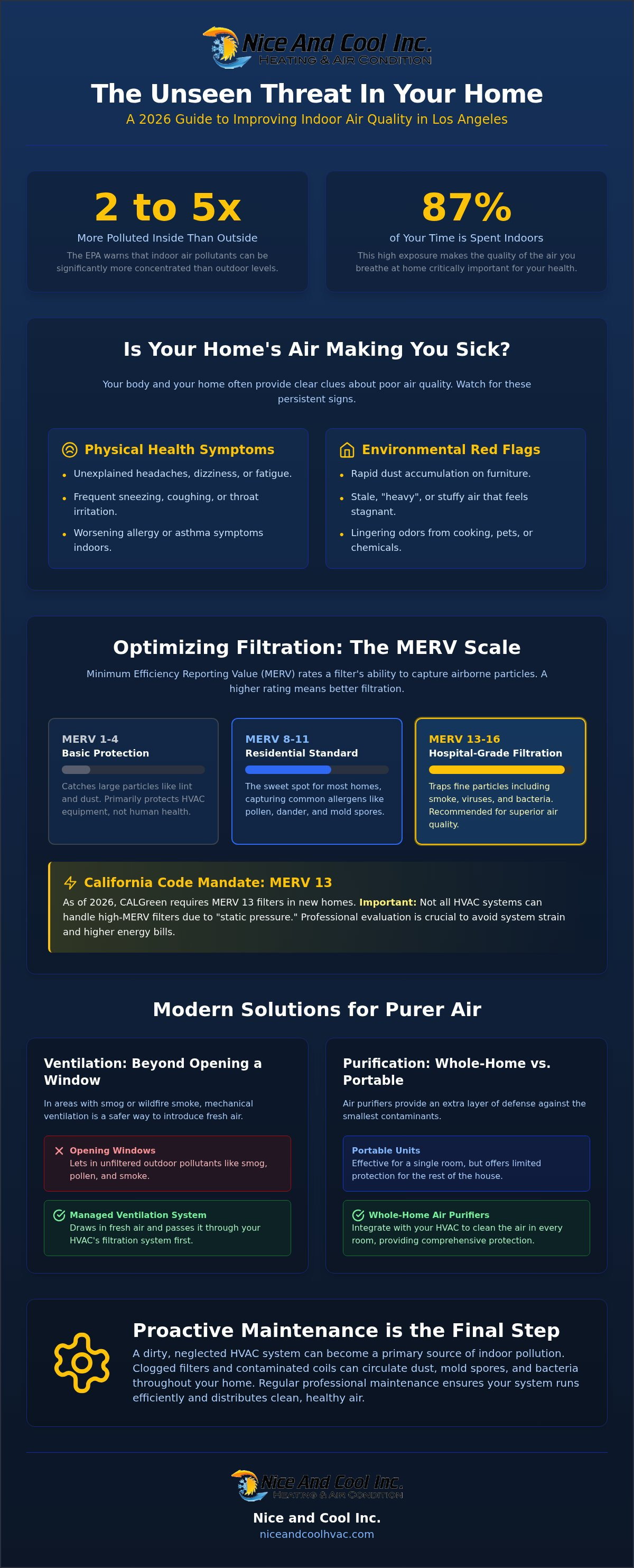
Indoor Air Quality, or IAQ, refers to the health and comfort levels of the air within your residence. While many Los Angeles homeowners focus on the smog levels reported on the morning news, the Environmental Protection Agency (EPA) reports that indoor air is typically two to five times more polluted than the air outdoors. For a comprehensive overview of indoor air quality and the various pollutants that can affect your living space, it's helpful to view your home as a managed environment where air needs to be cleaned and cycled constantly.
In Southern California, we face a specific challenge. Our homes are built tightly to meet strict energy efficiency standards, which is great for your utility bill but can trap contaminants inside. Whether it's seasonal wildfire smoke or daily urban exhaust, these particles enter your home and have nowhere to go. This leads to what experts call "Sick Building Syndrome," a condition where the building's environment directly causes acute health or comfort issues for the people inside.
Physical Health Symptoms to Watch For
Your body is often the most sensitive tool for detecting signs of poor indoor air quality in home environments. If you experience unexplained headaches, dizziness, or a heavy sense of fatigue that seems to lift the moment you step outside, your indoor air may be the cause. Many neighbors find themselves dealing with frequent sneezing, coughing, or throat irritation that only occurs when they're relaxing in the living room. If your asthma or allergies seem to flare up despite being in a controlled indoor setting, it's a strong indicator that your air contains high levels of triggers like pet dander, mold spores, or dust mites.
Environmental Red Flags in Your Living Space
You can often see or smell the signs of poor indoor air quality in home spaces if you know where to look. If you notice a visible layer of dust accumulating on your furniture within 48 hours of a thorough cleaning, your HVAC filtration isn't performing its job. Stale or "heavy" air that feels difficult to breathe is another common warning sign. You might also notice lingering odors from cooking, pets, or cleaning chemicals that refuse to dissipate. These environmental indicators suggest that your home is suffering from poor circulation and inadequate filtration, requiring professional Indoor Air Quality Solutions to restore a healthy balance.
Optimizing Filtration: MERV Ratings and Your HVAC System
Your HVAC filter serves as the primary gateway for your home's air. It performs a vital double duty; it protects the sensitive internal components of your air conditioner from debris while trapping the airborne particles that contribute to signs of poor indoor air quality in home environments. In Los Angeles, the frequency of replacement depends heavily on the time of year. During our peak wildfire seasons or high-pollen months, how often you should change your furnace filter might increase to once every 30 days to maintain optimal efficiency and health.
As of 2026, the California Green Building Standards Code (CALGreen) requires air filters with a Minimum Efficiency Reporting Value (MERV) of 13 or higher for mechanically ventilated buildings. However, there's a common "Static Pressure" myth that suggests simply installing a high-MERV filter is always the best choice. In reality, a filter that is too dense for your specific blower motor can restrict airflow. This leads to equipment strain, higher energy bills, and potential system failure. Professional sizing is essential to ensure your system can handle hospital-grade filtration without sacrificing performance. For a deeper look at managing these factors, consult A Guide to Indoor Air Quality from the CPSC.
If your family is noticing the physical signs of poor indoor air quality in home areas, upgrading to a whole-home media cleaner is a logical next step. These systems are significantly more effective than standard 1-inch filters because they provide more surface area to capture contaminants without creating the same level of airflow resistance.
The MERV Rating Comparison: Choosing the Right Grade
- MERV 1-4: These provide basic protection for AC components by catching large lint and dust particles. They are largely ineffective for improving human health.
- MERV 8-11: This range is the standard residential "sweet spot." These filters are designed to capture common allergens like pollen, dust dander, and mold spores.
- MERV 13-16: These provide hospital-grade filtration capable of trapping smoke particles and viruses. They often require specific equipment modifications to ensure proper air pressure.
Ductless Mini-Splits as an IAQ Solution
If you're looking to bypass the issues of traditional systems, ductless mini-split systems offer a significant advantage. Because they don't rely on a network of ducts, they eliminate the hidden reservoirs where dust and bacteria often accumulate over time. Modern indoor air handlers feature multi-stage filtration built directly into the unit, allowing for zoned cooling that prevents the cross-contamination of air between different rooms. If you're ready to breathe easier, our team can help you find the right Indoor Air Quality Solutions for your specific space.
Managed Ventilation: Breathing Better in Los Angeles
If you've noticed signs of poor indoor air quality in home environments, your first instinct might be to crack open a window. In many parts of the country, this natural ventilation is a great way to flush out stale air. However, Los Angeles homeowners face a unique challenge known as the "LA Dilemma." Opening your windows in the San Fernando Valley or near the 405 often invites more pollution in than it lets out. You need fresh air to stay healthy, but the outdoor air isn't always fresh.
Mechanical ventilation offers a controlled solution to this problem. It is the process of exchanging stale indoor air for filtered, conditioned outdoor air using dedicated equipment. This system ensures that the air entering your living space has been scrubbed of the very pollutants that cause respiratory irritation. This is especially vital during "June Gloom," when high coastal humidity can linger in your home. If this moisture isn't managed, it creates a breeding ground for mold, which is one of the most persistent signs of poor indoor air quality in home settings.
The Risks of Unfiltered Outdoor Air
Living near major freeways like the I-10 or the 405 means your outdoor air is often rich in PM2.5 and ozone. "Airing out" the house can actually increase your exposure to these traffic related pollutants. During the autumn months, Santa Ana winds push dust and desert allergens through even the smallest gaps in "leaky" older homes. If the outdoor air quality index (AQI) is high, it's best to keep windows closed and switch your HVAC system to "recirculation mode." This prevents the intake of raw outdoor air until conditions improve. While the EPA explains MERV ratings primarily for standard filters, these grades are just as important for any intake point where outdoor air enters your home.
Advanced Ventilation Technologies
Modern "tight" homes are built for energy efficiency, but they require active help to breathe. Energy Recovery Ventilators (ERVs) are an excellent solution for these properties. An ERV pulls in fresh air while exhausting stale air, transferring heat and moisture between the two streams to keep your home comfortable. Whole-home fans can also be used safely, provided you only run them on clear-air days when the AQI is low. Don't forget the importance of your local exhausts. Properly vented kitchen and bathroom fans are your first line of defense against volatile organic compounds (VOCs) and excess moisture that can degrade your air quality over time.
Whole-Home Air Purification Technologies
While portable air purifiers are a common recommendation on internet forums, they often fall short in a large Los Angeles residence. These standalone units are typically noisy. They consume extra floor space. Most importantly, they only treat the air in a single room. If you've already identified signs of poor indoor air quality in home areas, a whole-home system is a much more efficient choice. These technologies integrate directly into your central HVAC. This provides a "set-it-and-forget-it" solution that cleans the air in every room simultaneously. The most effective way to implement these upgrades is during a professional air conditioning installation; this ensures your entire system is balanced for both temperature and purity from day one.
Air scrubbers take purification a step further by actively neutralizing pollutants. Unlike standard filters that wait for particles to pass through them, air scrubbers send out scrubbing agents. These agents attack contaminants in the air and on surfaces throughout your house. This active approach is a game changer for families who want to ensure their environment is truly a clean air sanctuary.
Electronic Air Cleaners and Ionizers
Electronic air cleaners use ionization to tackle microscopic particles that standard filters might miss. By adding a small electrical charge to these particles, the system makes them "heavy" enough to be captured easily by your high-efficiency filters. If you share your home with multiple pets, this technology is essential for managing the constant influx of dander and hair. It transforms your HVAC from a passive air mover into an active cleaning tool that targets the specific signs of poor indoor air quality in home environments caused by our furry friends.
UV Germicidal Lights for Biological Control
Biological contaminants like mold and bacteria require a different strategy. Your AC evaporator coil is dark and damp. This makes it the perfect breeding ground for organic growth. UV germicidal lights are installed near this coil to disrupt the DNA of viruses, bacteria, and mold spores before they can enter your ductwork. This process effectively eliminates "dirty sock syndrome," which is that persistent musty smell often associated with older systems. By neutralizing these biological threats at the source, you can maintain long-term confidence in your home's safety. If you're ready to upgrade your home's defenses, our team can help you select the right Indoor Air Quality Solutions for your lifestyle.
Sustaining Air Purity: The Maintenance Connection
Identifying the signs of poor indoor air quality in home environments is just the first step toward a healthier lifestyle. Long-term air purity requires a commitment to routine care, as a neglected HVAC system can quickly transition from a comfort provider to a source of pollution. Over time, dust, pet dander, and outdoor pollutants settle deep within your blower assembly and ductwork. If these components aren't cleaned regularly, your system simply recirculates these particles every time the fan kicks on, negating the benefits of even the best filters.
Your system's condensate drain also plays a vital role in managing indoor humidity. If this drain becomes clogged or sluggish, moisture builds up within the dark interior of your unit. This stagnant water is a prime breeding ground for mold and bacteria, which can then be distributed throughout your house. Professional coil cleaning is a necessary part of a health-first maintenance strategy. It removes deeply embedded allergens and organic materials that standard filters can't reach. When our technicians perform a deep clean, they're removing the hidden reservoirs where biological triggers thrive, ensuring your system remains a dependable partner in your family's health.
Seasonal Prep for Los Angeles Wildfire Season
Los Angeles families face specific challenges during our recurring wildfire seasons. If a smoke event occurs near your neighborhood, you should replace your air filters immediately afterward, regardless of how recently you installed them. Fine ash and soot can saturate a filter in just a few days, significantly reducing its ability to trap new contaminants. It's also a great time to check your duct integrity. If your ducts have small leaks or gaps, the system might pull dusty, unconditioned air from your attic or crawlspace directly into your bedrooms. During severe outdoor air emergencies, we recommend creating a "clean room" strategy. By using high-MERV filters and keeping specific zones sealed, you can provide a reliable sanctuary for your loved ones until the outdoor air clears.
The Nice and Cool Club Maintenance Plan
We designed the Nice and Cool Club as a proactive health-maintenance strategy rather than a simple mechanical check-up. Our technicians perform regular inspections of your specialized IAQ equipment to ensure your UV lights, ionizers, and whole-home purifiers are functioning at peak performance. This routine care prevents the "emergency" air quality drops that often happen when a component fails without warning. Membership provides peace of mind with 24/7 priority service, which is a significant advantage for busy Los Angeles families. It's about building a relationship with a local specialist who understands our community's unique smog and smoke challenges. By prioritizing routine care, you ensure that your home remains a clean air sanctuary for years to come.
Creating a Healthier Future for Your Los Angeles Home
Your home should be the one place where you don't have to worry about the quality of the air you breathe. By learning to recognize the common signs of poor indoor air quality in home environments, you've already taken the most important step toward a healthier living space. Professional strategies like upgrading to MERV 13 filtration or installing whole-home air scrubbers provide a level of protection that standalone units simply can't match. These systems work silently to remove the microscopic pollutants that trigger allergies and fatigue.
Since 2005, our family-owned team has specialized in tailoring these solutions for neighbors throughout Los Angeles County. Our expert technicians are highly specialized in IAQ and high-efficiency heat pumps, ensuring your system is both powerful and precise. Through the Nice and Cool Club Maintenance Plan, you can maintain year-round health and avoid the sudden drops in air purity that often follow a neglected system. It's about achieving lasting peace of mind for your family.
You deserve a home that feels as fresh as it is comfortable. We're here to help you turn that vision into a reality.
Frequently Asked Questions
Is it better to leave the HVAC fan on "Auto" or "On" for better air quality?
Setting your fan to "On" provides continuous air filtration, which can help mitigate signs of poor indoor air quality in home settings. However, this keeps the fan motor running constantly. If your AC has just finished a cooling cycle, leaving the fan on might blow moisture off the evaporator coil back into your house. We generally recommend the "Auto" setting for humidity control unless you have a high-efficiency variable-speed motor designed for continuous circulation.
Can indoor plants actually improve my home’s air quality significantly?
While indoor plants are beautiful, they don't provide a significant improvement to your home's air quality. You would need hundreds of plants in a single room to match the purification power of a single high-efficiency HVAC filter. In some cases, overwatered plants can actually introduce moisture and mold into your environment. If you want to address real pollutants, it's better to rely on professional filtration and mechanical ventilation strategies.
How do I know if my air ducts need professional cleaning or replacement?
You should consider professional attention if you see puffs of dust exiting vents or visible mold growth on the registers. If your home was built more than 20 years ago, your ducts might have significant leaks that pull in attic dust. We often find that replacement is more cost-effective than cleaning for older, poorly insulated ducts. Our technicians can perform a pressure test to determine whether a simple cleaning or a full upgrade is necessary.
What is the difference between a HEPA filter and a MERV 13 filter?
The main difference is the level of particle capture. A HEPA filter traps 99.97% of particles as small as 0.3 microns, while a MERV 13 filter is the residential standard for trapping smoke and bacteria. Most standard residential HVAC systems don't have the blower power to push air through a dense HEPA filter. If you want HEPA-level results, we typically install a bypass system or a specialized whole-home media cleaner designed for high-pressure airflow.
Do whole-home air purifiers help with cooking smells and pet odors?
Yes, whole-home air purifiers are highly effective at neutralizing organic odors from pets and cooking. Systems that include activated carbon or ionization technology don't just trap particles; they break down the volatile organic compounds (VOCs) that carry smells. This is a much better solution than using air fresheners that simply mask odors with chemicals. If you notice lingering smells, an air scrubber can actively clean the air throughout every room in your house.
What should I do to my AC system when there is a wildfire nearby?
During a wildfire, you must close all windows and doors to prevent ash from entering. Set your HVAC system to "recirculate" so it doesn't pull in raw, smoky outdoor air. If you have a high-MERV filter, it will help trap the fine particulate matter (PM2.5) that often bypasses standard filters. Once the smoke clears, remember to replace your filter immediately, as it will likely be saturated with soot and ash from the event.
How often should I professionally service my IAQ equipment?
We recommend having your IAQ equipment inspected at least once a year, typically during your standard AC tune-up. UV germicidal lights usually require a new bulb every 12 to 24 months to remain effective at killing mold and bacteria. If you're a member of the Nice and Cool Club, these checks are included in your routine care. Regular service ensures that electronic cleaners and ionizers are actually functioning and not just drawing power.
Will a higher-efficiency air filter make my electric bill go up?
A higher-efficiency filter will not significantly increase your electric bill if it is properly sized for your system. However, if you install a very thick filter in a system that wasn't designed for it, the blower motor has to work much harder to move air. This extra strain can lead to higher energy consumption and potential equipment failure. Our team ensures that your signs of poor indoor air quality in home are addressed without compromising your system's efficiency.
Frequently Asked Questions
Setting your fan to "On" provides continuous air filtration, which can help mitigate signs of poor indoor air quality in home settings. However, this keeps the fan motor running constantly. If your AC has just finished a cooling cycle, leaving the fan on might blow moisture off the evaporator coil back into your house. We generally recommend the "Auto" setting for humidity control unless you have a high-efficiency variable-speed motor designed for continuous circulation.