15 Critical Questions to Ask Before Installing a Heat Pump in 2026
June 27, 2026 18 min read
Did you know that as of January 1, 2026, California's updated Title 24 code essentially makes heat pumps the default choice for home comfort? While this shift is great for the environment, knowing the right questions to ask before installing a heat pump is the only way to ensure your investment actually pays off. It's understandable if you're worried about high electric bills from an incorrectly sized unit or feel confused by the new SEER2 and HSPF2 efficiency standards.
We believe you deserve total peace of mind and a system tailored specifically to your home's needs. Whether you're trying to escape the noise of an old air conditioner or looking to maximize the $2,500 per ton rebate currently offered by the LADWP, we're here to help you get it right the first time. This article promises to give you the clarity you need to hire a trustworthy professional and secure long-term savings.
We've compiled a list of fifteen critical questions that cover everything from the transition to lower GWP refrigerants like R-454B to the necessity of a Manual J load calculation. By the time you finish reading, you'll be ready to choose a system that provides quiet, year-round comfort without any expensive surprises.
Key Takeaways
- Learn how to assess your home's electrical capacity to determine if you need a panel upgrade before making the switch to electric heating and cooling.
- Discover the essential technical questions to ask before installing a heat pump to ensure your system is precision-sized for Southern California's unique climate.
- Understand the impact of Time-of-Use (TOU) utility rates and how to calculate the long-term return on investment for your new high-efficiency equipment.
- Identify the critical standards for vetting local installers so you can feel confident that your system is built with craftsmanship that lasts for decades.
- Explore how a proactive maintenance plan serves as insurance for your comfort, preventing the most common causes of system neglect and failure.
Essential Suitability Questions: Is a Heat Pump Right for Your LA Home?
Choosing a new HVAC system is a significant decision for any Los Angeles homeowner. In our unique Mediterranean climate, where winters are mild and summers are often scorching, a heat pump acts as a highly efficient dual-purpose solution. Unlike a traditional furnace that burns fuel to create warmth, a heat pump is an energy-transfer system rather than a heat-generation system. If you want to understand the physics behind this process, you can read more about What is a Heat Pump? to see how it moves thermal energy from one place to another. Because our local temperatures rarely drop below freezing, these systems operate at peak performance almost every day of the year.
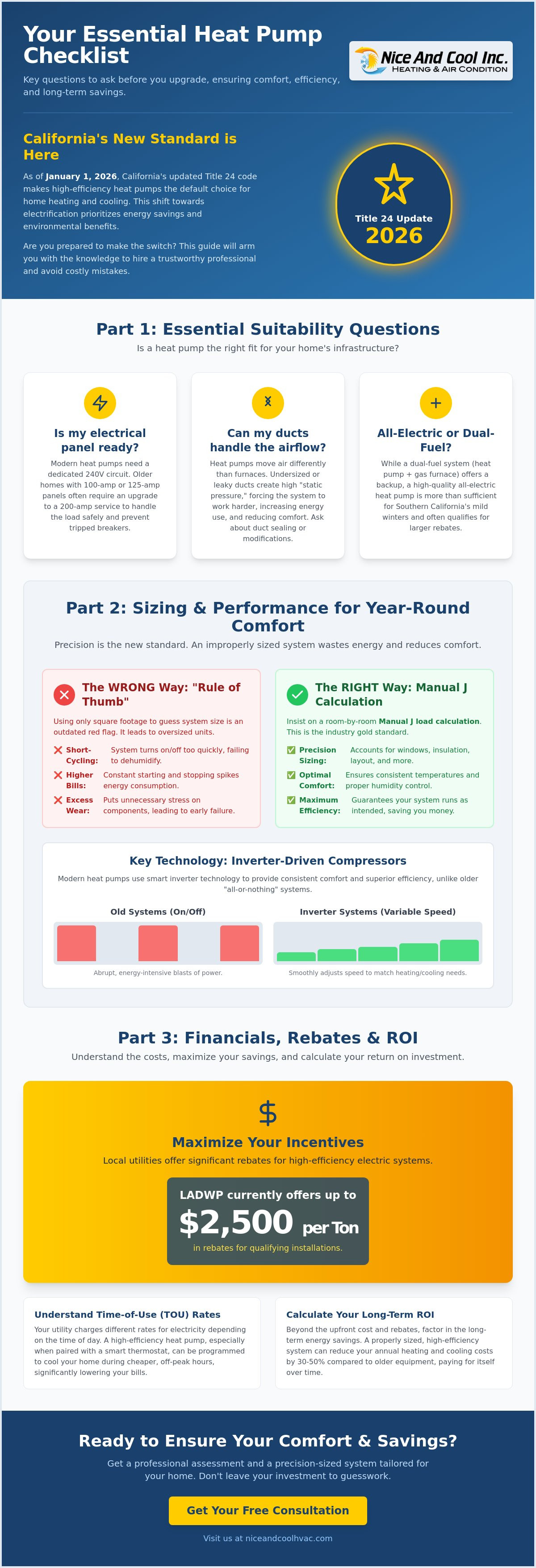
One of the first questions to ask before installing a heat pump is whether your home's infrastructure is actually ready for the change. You must check your electrical panel early in the process. Most modern heat pumps require a dedicated 240V circuit and can pull a significant amount of power. If your home still uses an older 100-amp or 125-amp panel, you will likely need an upgrade to a 200-amp service to handle the new load safely. If you skip this step, you might face frequent tripped breakers or even safety hazards once the system starts running during a summer heatwave.
Evaluating Your Existing Ductwork
Ask: "Can my current ducts handle the airflow requirements of a high-efficiency heat pump?" This is vital because heat pumps typically move a different volume of air than older gas furnaces. We often use the term "static pressure" to describe the resistance your ductwork puts on that moving air. Think of it like blowing air through a straw; if the straw is pinched or too small, it takes much more effort to get the air through. If your ducts are undersized or leaky, your new unit will work harder, consume more energy, and wear out faster. You may need professional duct sealing or minor modifications to ensure every room stays comfortable.
Heat Pump vs. Dual-Fuel (Hybrid) Systems
Ask: "Should I keep my gas furnace as a backup for the few cold nights in LA?" While all-electric units are the prescriptive default under the 2026 Title 24 standards, a dual-fuel or hybrid system keeps a gas furnace as a secondary heat source. This setup can provide peace of mind if you're worried about extreme weather, but in most Los Angeles County neighborhoods, a high-quality all-electric system is more than sufficient. Beyond performance, you should consider which system qualifies for the best incentives. Currently, all-electric installations often qualify for the highest local utility rebates, such as the $2,500 per ton offering from the LADWP, making them a very attractive long-term investment.
Performance and Sizing: Ensuring Year-Round Comfort
Gone are the days when a contractor could simply glance at your house and guess the system size. In 2026, precision is the new standard. One of the most important questions to ask before installing a heat pump is how the technician determined the specific capacity your home needs. If they rely on a "rule of thumb" based on square footage, consider it a major red flag. This outdated method often leads to oversized systems that short-cycle. Short-cycling occurs when a unit turns on and off too rapidly. It never runs long enough to properly dehumidify your home, which leaves you feeling clammy even if the temperature seems correct. This constant toggling also spikes your energy bills and puts unnecessary stress on the internal components.
Modern heat pumps utilize inverter-driven compressors to solve this problem. These smart components vary their speed to match the exact cooling or heating demand of your home at any given moment. Since Los Angeles temperatures can fluctuate significantly between a cool morning in Santa Monica and a hot afternoon in the Valley, an inverter system provides consistent comfort. It runs at a low, steady pace rather than the "all-or-nothing" blast of older models. This results in a quieter home and a much more stable indoor environment. If you want to explore high-efficiency options for your home, our team can help you compare Heat Pump Services that fit your specific budget and comfort goals.
The Necessity of a Manual J Load Calculation
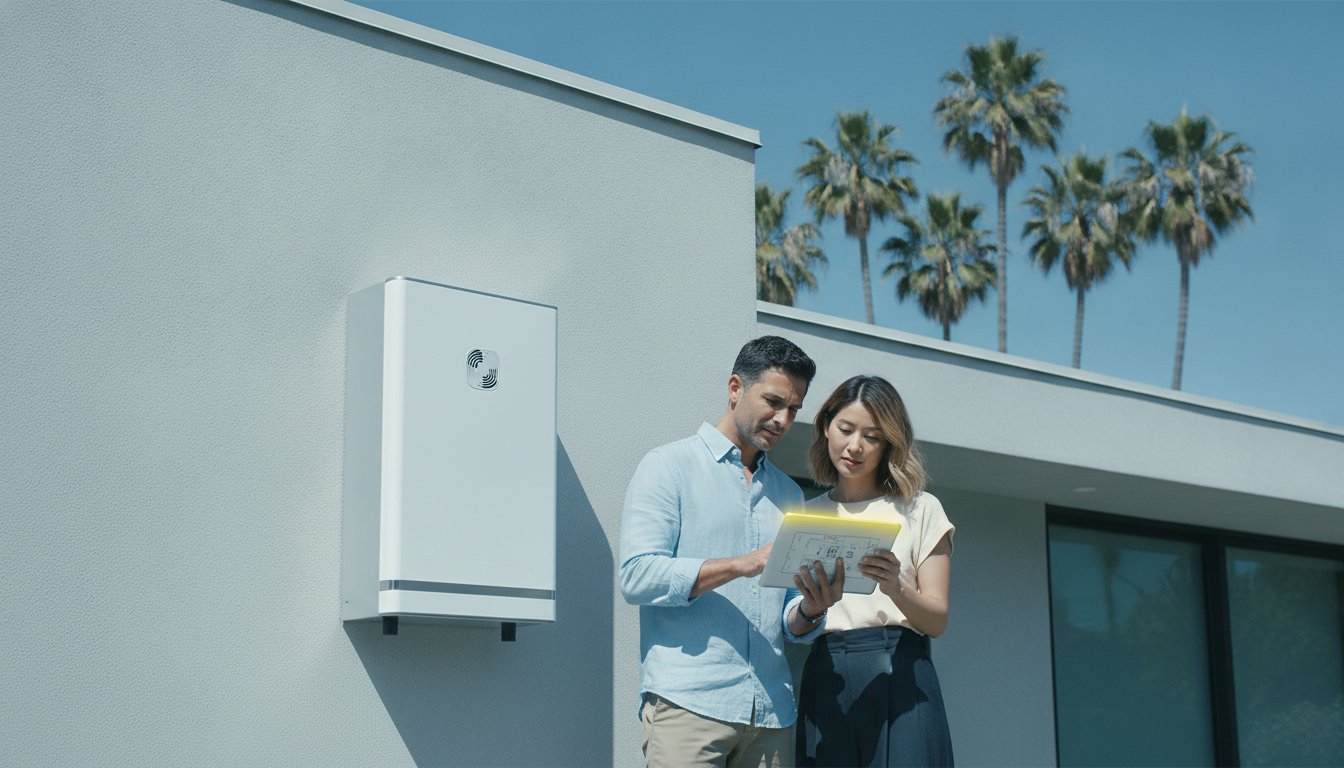
Ask: "Will you perform a room-by-room Manual J calculation before providing a quote?" This calculation is the gold standard for accuracy in the HVAC industry. It accounts for your home's unique orientation to the sun, the quality of your insulation, ceiling heights, and the number of windows in each room. A professional heat pump installation always begins with this data-driven approach. It ensures the BTU capacity is perfectly tailored to your living space, preventing the efficiency losses and discomfort associated with poor sizing.
Deciphering 2026 Efficiency Ratings: SEER2 and HSPF2
Ask: "What are the specific SEER2 and HSPF2 ratings for this proposed model?" As of 2026, California requires higher minimum efficiency floors than in previous years. SEER2 measures cooling efficiency, while HSPF2 measures heating performance under more realistic pressure conditions. The current state minimum for a new heat pump installation is 15.2 SEER2 and 7.8 HSPF2. In a high-cost energy market like Los Angeles, where electricity rates can be significant, opting for ratings above these minimums often yields a faster return on investment through lower monthly utility bills. Understanding these numbers helps you verify that you're getting a modern, high-performance system rather than older inventory.
Financial Questions: Navigating Costs, Rebates, and ROI
Think of your new HVAC system as a long-term investment in your home's value and your family's comfort. While the initial purchase price is the number most people focus on, the true value lies in the operational savings over the next ten to fifteen years. One of the smartest questions to ask before installing a heat pump is for a projected "total cost of ownership" estimate. This calculation should account for local electricity rates, which for the Los Angeles Department of Water and Power (LADWP) sit at approximately 23.8¢/kWh. Since Southern California utilities often use Time-of-Use (TOU) rates, your savings will depend on when you run your system, making high-efficiency equipment even more valuable during peak afternoon hours.
You also need to account for regional costs that can catch homeowners off guard. In California, these include mandatory building permits, which typically range from $300 to $700, and HERS (Home Energy Rating System) testing. This testing is a legal requirement to verify that your system meets the efficiency standards promised by the manufacturer. Ask your contractor if these fees are included in the initial quote or if they will appear as separate line items later. If you understand these details upfront, you can prevent budget creep and ensure your project stays on track without any financial surprises.
Maximizing Local LA Rebates (LADWP & SCE)
Ask: "Which specific models on your quote qualify for the current LADWP or SCE rebates?" This is a high-stakes question because the LADWP currently offers a generous rebate of up to $2,500 per ton for qualifying installations. To secure this money, your system must have an AHRI (Air-Conditioning, Heating, and Refrigeration Institute) matching certificate. This document proves that the indoor coil and outdoor unit are designed to work together at a specific efficiency level. Our Nice and Cool Club helps members track their system's performance and maintenance history, which is vital for protecting these high-efficiency investments and ensuring they continue to meet rebate-level standards.
Incentives Beyond the Purchase Price
Ask: "Are there federal tax credits still available for this install, or should we focus on manufacturer rebates?" It is a common misconception that all federal credits are permanent. The popular Section 25C and 25D tax credits expired at the end of 2025. Unless new legislation is passed for 2026, you should look toward stacking manufacturer promotions with local utility incentives. You must also verify who handles the paperwork. Some contractors will manage the entire rebate application process for you, while others leave the administrative burden on the homeowner. Knowing this responsibility beforehand saves you from missing out on thousands of dollars due to a missed deadline or an incomplete form.
Vetting Your Installer: Questions to Ensure Quality Craftsmanship
You can purchase the most advanced, high-efficiency equipment on the market, but if the installation is flawed, the system will never reach its potential. Think of a heat pump as a precision-tuned instrument. If it isn't calibrated correctly for your specific home, you'll face the same high bills and comfort issues we discussed earlier. This is why choosing the right partner is just as important as choosing the right model. When you interview contractors, look for the neighborly warmth and accountability that only a family-owned local business can provide. Unlike national franchises that prioritize volume, a local team relies on its reputation within the Los Angeles County community.
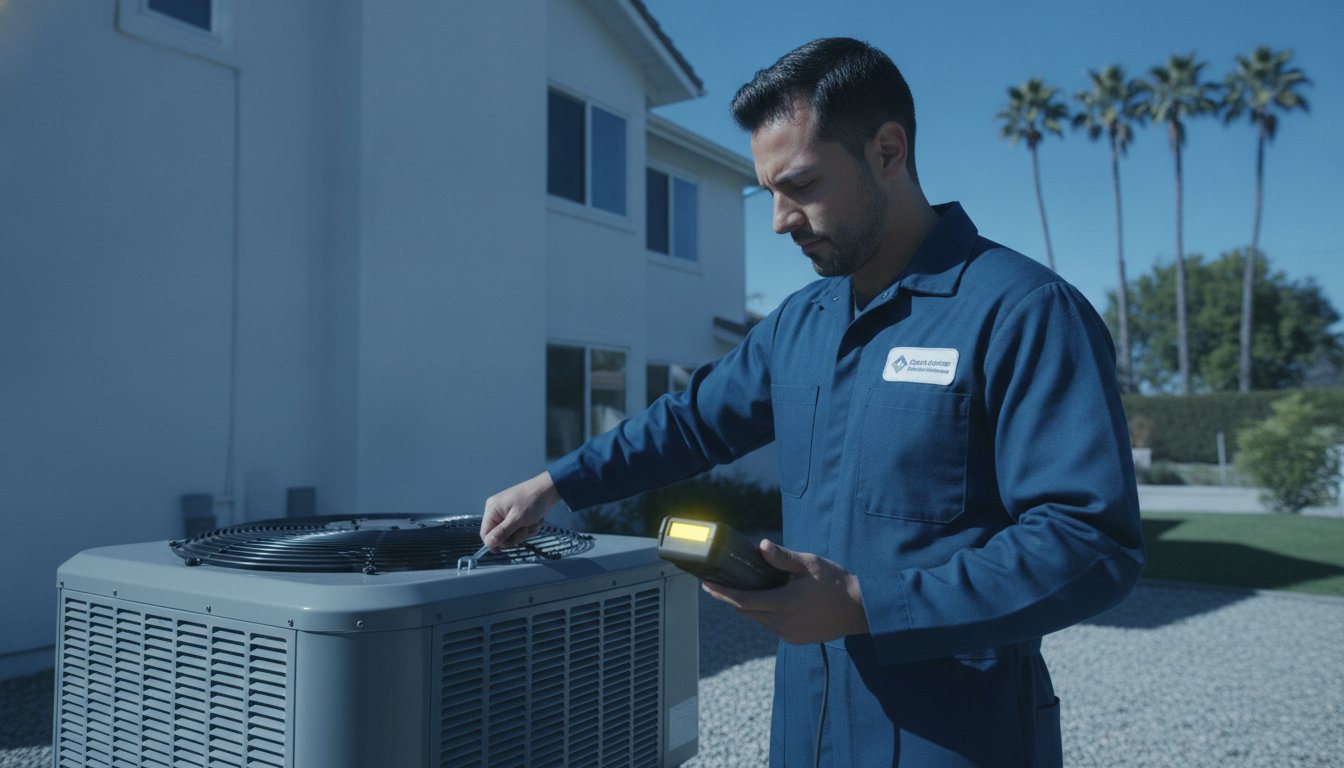
One of the non-negotiable questions to ask before installing a heat pump is whether the technicians are NATE certified. This certification ensures that the people working in your home have the specialized training required to handle modern refrigerant cycles and complex electrical components. In an industry where technology changes every year, you need a specialist who understands the latest 2026 standards. If you are ready to work with a team that treats your home like their own, we invite you to learn more about our HeatPump Installation services.
Experience with Inverter and Low-Ambient Technology
Ask: "How many inverter-driven heat pumps has your team installed in the last 12 months?" Inverter technology is standard for 2026, but it requires different commissioning steps than old-school, single-speed air conditioners. Technicians must be trained to set up the communication between the thermostat and the variable-speed compressor. Inquire about specific manufacturer training they have received. If a contractor hasn't kept up with these technical advancements, your system might never run at the efficiency levels promised on the box.
Labor Warranties and Post-Installation Support
Ask: "What is your specific labor warranty, and does it differ from the manufacturer’s parts warranty?" While a manufacturer might cover a compressor for ten years, they won't pay for the technician's time to replace it. A one-year labor warranty is the bare minimum in our industry, but a truly reliable specialist will offer five to ten years of coverage. This shows they stand behind their craftsmanship. You should also ask about their policy for after-hours support. If your system fails during a record-breaking July heatwave in the Valley, you need to know exactly who will show up to fix it and how quickly they can arrive.
Long-Term Reliability: Planning for Future Maintenance
Once your new system is up and running, the relationship with your HVAC specialist shouldn't end. We believe in a proactive partnership mindset where we work together to protect your home. Think of regular maintenance as insurance for your high-efficiency equipment. It's a simple truth in our industry that the number one cause of system failure isn't a factory defect; it's dirt and neglect. When dust builds up on coils or filters become clogged, the system has to work twice as hard to move the same amount of air. This extra strain leads to higher utility bills and premature wear on the compressor. Our Nice and Cool Club Maintenance Plan is designed to stop these problems before they start, giving you total peace of mind through every season.
If you want your system to last fifteen years or more, you need a plan that goes beyond simple filter changes. Understanding the technical questions to ask before installing a heat pump will help you choose a partner who values long-term reliability as much as you do. A dedicated specialist doesn't just install a box and walk away; they help you build a roadmap for consistent care that keeps your manufacturer’s warranty valid and your home perfectly comfortable.
Setting Up a 2026 Maintenance Schedule
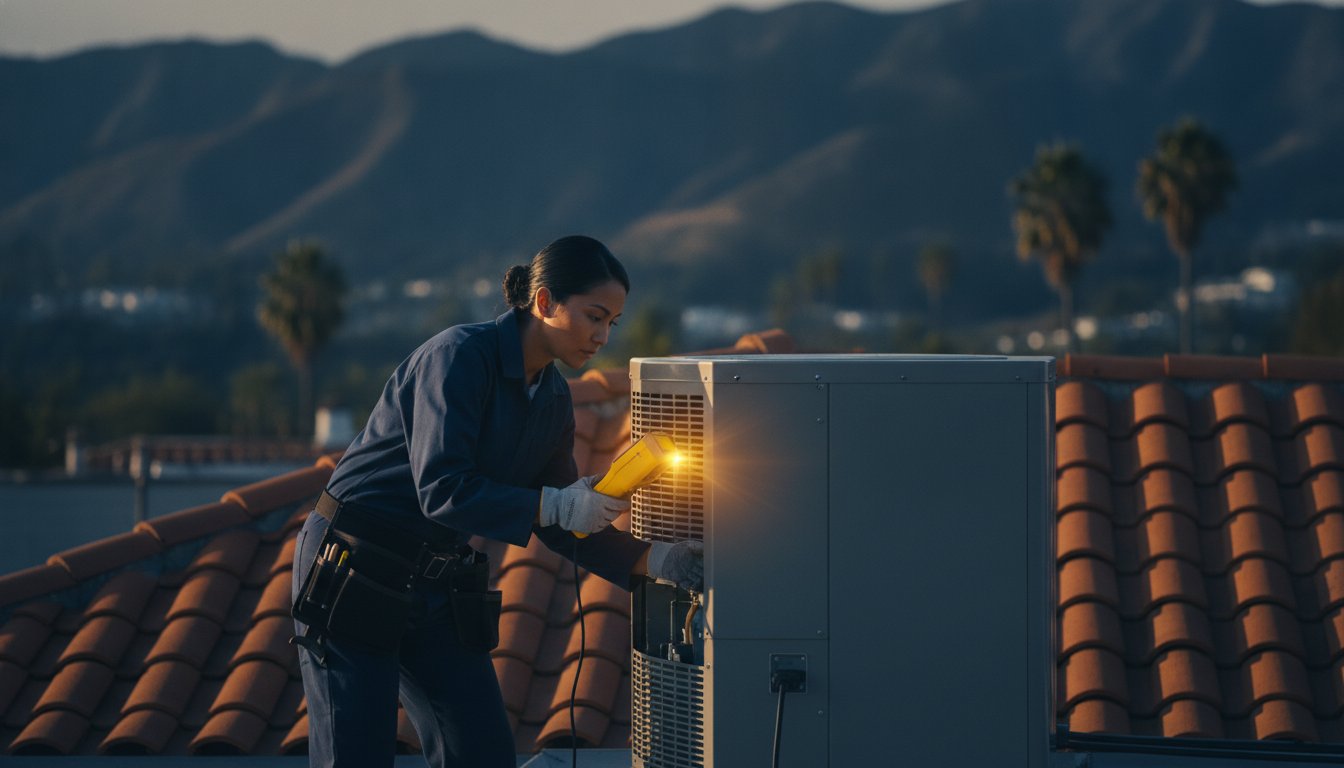
Ask: "What does a typical bi-annual maintenance visit include for this specific model?" In Los Angeles, where we use our systems for cooling in the summer and heating in the winter, two visits per year are essential. A thorough technician will check the refrigerant charge to ensure there are no leaks and clean the condensate drains to prevent water damage. They should also tighten all electrical connections and inspect the thermostat's communication with the inverter compressor. Consistent care like this is often a requirement for keeping your warranty in good standing. If you can't provide proof of professional maintenance, a manufacturer might deny a claim for a major part replacement later on.
Finalizing the Installation Timeline
Ask: "How long will the installation take, and what is the plan for protecting my home during the process?" A professional installation usually takes one to two days depending on the complexity of your ductwork. You should know the logistics upfront, including where the crew will park and how they plan to dispose of your old unit. A quality team will use drop cloths to protect your floors and perform a thorough cleanup before they leave. They should also provide a "tutorial" on your new thermostat so you know how to set schedules and maximize your energy savings from day one. If you're ready to upgrade your home comfort with a team that values craftsmanship and community, contact Nice and Cool Inc. today for a tailored consultation.
Take the Next Step Toward Smarter Home Comfort
Investing in a heat pump is one of the most effective ways to lower your energy bills and embrace a more sustainable lifestyle in Southern California. By preparing the right questions to ask before installing a heat pump, you've already taken the most important step toward ensuring your system is sized correctly and installed with precision. Success depends on a combination of high-efficiency technology, accurate load calculations, and a dedicated maintenance partnership like our exclusive Nice and Cool Club Maintenance Plan. These elements work together to provide long-term peace of mind and consistent performance.
We've been a family-owned and operated business since 2005, and our expert technicians are proud to serve homeowners across all of Los Angeles County. We understand the specific climate challenges of our region and are here to help you navigate the latest 2026 standards with confidence. Whether you're looking for a quieter home or trying to maximize local utility rebates, we're ready to provide the dependable craftsmanship you deserve. Schedule your professional heat pump consultation with Nice and Cool Inc. today! We look forward to helping you achieve total comfort in your home.
Frequently Asked Questions
Do I need to replace my furnace to install a heat pump?
You don't necessarily have to remove your furnace if you choose a dual-fuel or hybrid system, which uses the furnace as a backup heat source. However, California’s 2026 Title 24 standards now treat all-electric heat pumps as the prescriptive default for home comfort. Transitioning to a full heat pump system often simplifies your home's energy profile and qualifies you for higher local utility rebates, such as the $2,500 per ton incentive from the LADWP.
How much can I actually save on my LA electric bill with a heat pump?
Your actual savings depend on your previous heating source and how you manage your Time-of-Use (TOU) electricity rates. Since heat pumps are significantly more efficient than traditional electric furnaces, homeowners typically see a drop in monthly heating costs. In Los Angeles, where the electricity rate is approximately 23.8¢/kWh, switching from an older gas furnace can provide more stable long-term energy costs as gas prices continue to fluctuate.
Is a heat pump quiet enough for a bedroom window installation?
Modern inverter-driven heat pumps are remarkably quiet and typically operate at sound levels between 45 and 58 decibels. This is roughly equivalent to a quiet conversation or a light rainfall in your backyard. If the outdoor unit is installed near a bedroom window, you'll likely notice it's much quieter than a traditional air conditioner that clatters to life with a loud, sudden kick every time it starts a cycle.
What happens if it gets below freezing in Los Angeles?
You don't need to worry about the rare freezing night in Southern California because modern heat pumps are designed to extract heat even in temperatures well below 32 degrees. While their efficiency might dip slightly during extreme cold, they'll continue to keep your home warm and reliable. This performance in varied temperatures is one of the key points to consider when reviewing questions to ask before installing a heat pump.
How long does a typical heat pump installation take?
A standard installation typically takes between one and two days to complete from start to finish. If your project requires extensive ductwork modifications or an electrical panel upgrade to 200-amp service, it might take a bit longer. Our team works efficiently to minimize any disruption to your daily routine while ensuring every electrical connection and refrigerant line is double-checked for long-term safety and performance.
Are there specific permits required for heat pumps in LA County?
Yes, Los Angeles County requires a building permit for all new heat pump installations to ensure the system meets local safety and electrical codes. These permits can cost between $300 and $700 depending on your specific city. Additionally, a HERS (Home Energy Rating System) inspection is mandatory to verify the unit's efficiency, which is a critical step for finalizing your permit and qualifying for utility rebates.
Can I use my existing Nest or Ecobee thermostat with a new heat pump?
You can usually use your existing smart thermostat, but it might not unlock the full efficiency of a high-end inverter system. While Nest and Ecobee are compatible with most models, a manufacturer-specific "communicating" thermostat often provides better control over variable-speed compressors. This allows the system to make tiny micro-adjustments to the airflow, which results in better indoor comfort and lower monthly energy usage.
What is the difference between a standard heat pump and a cold-climate heat pump?
Standard heat pumps are perfect for the Los Angeles Mediterranean climate, while cold-climate models are built with specialized compressors for regions that stay below zero for weeks. Since our local winters are mild, a high-efficiency standard model will provide all the warmth your family needs. It's one of the common questions to ask before installing a heat pump when comparing different technical specifications for your specific neighborhood.
Frequently Asked Questions
Ask: "Can my current ducts handle the airflow requirements of a high-efficiency heat pump?" This is vital because heat pumps typically move a different volume of air than older gas furnaces. We often use the term "static pressure" to describe the resistance your ductwork puts on that moving air. Think of it like blowing air through a straw; if the straw is pinched or too small, it takes much more effort to get the air through. If your ducts are undersized or leaky, your new unit will work harder, consume more energy, and wear out faster. You may need professional duct sealing or minor modifications to ensure every room stays comfortable.