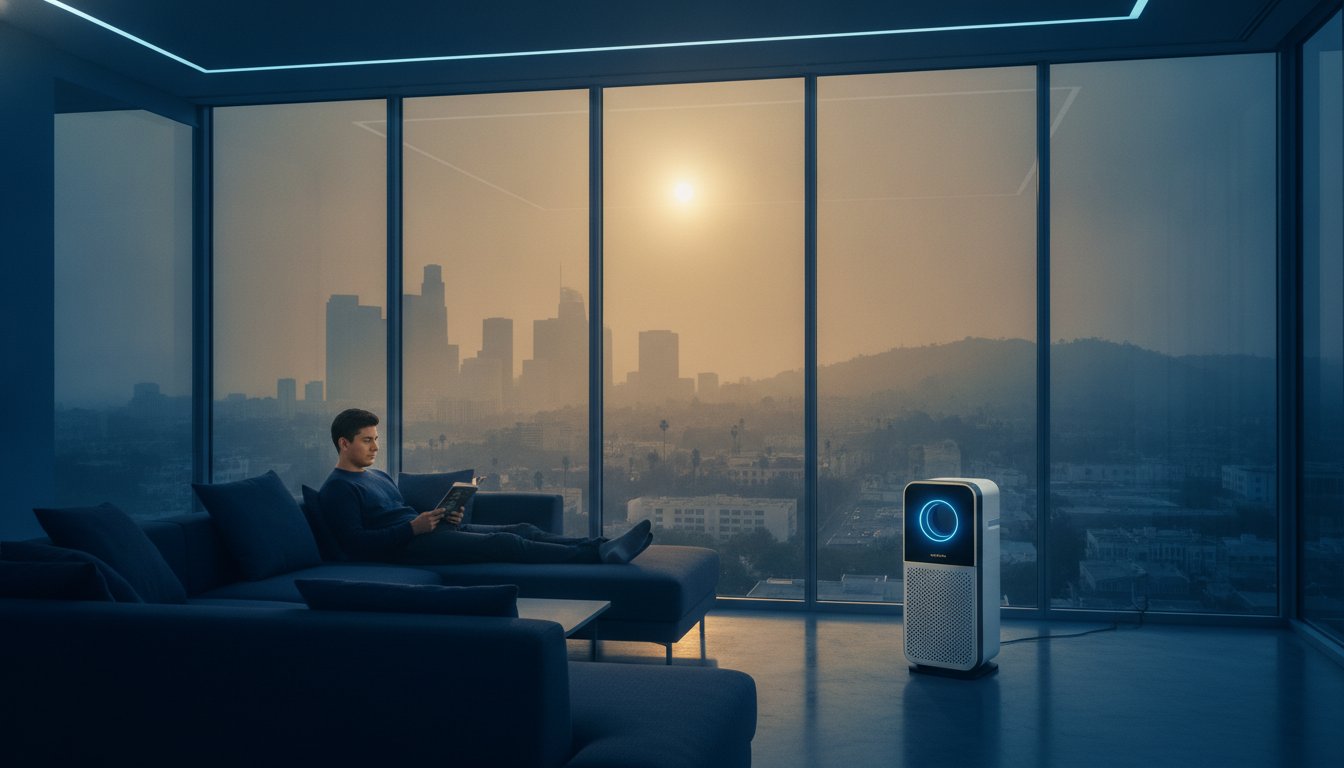
Your air purifier might be making your LA smog problem worse. Most standard units are built to handle dust and pet dander, not the complex chemical cocktail that settles over Los Angeles on a hazy summer afternoon. If you've been running a purifier and still waking up with headaches, still wiping a grey film off your furniture, or still feeling that familiar tightness in your chest when the Santa Ana winds shift, the filter inside your unit is almost certainly the reason why.
That frustration is completely valid. Finding the right indoor air quality solutions for Los Angeles smog is genuinely confusing, especially when filter ratings like MERV-13 and True HEPA seem to promise the same thing but perform very differently against ozone and nitrogen dioxide. You deserve a straight answer, not a spec sheet.
This guide cuts through the noise. You'll learn exactly why LA's smog demands a dual-stage approach combining HEPA filtration with activated carbon, how to match that strategy to your existing AC system, and what to look for so your home handles everything from daily smog to wildfire smoke season without you having to think about it.
Key Takeaways
- LA's unique geography traps a specific blend of nitrogen oxides, ozone, and VOCs near ground level — and most standard purifiers aren't built to handle that chemical mix.
- Effective indoor air quality solutions for Los Angeles smog require a dual-stage approach: a True HEPA filter to capture physical particles and activated carbon to neutralize gases and odors.
- Your existing HVAC ductwork can be upgraded into a whole-home air scrubber — often a more cost-effective solution than stacking portable units in every room.
- A MERV-13 filter paired with your AC's "Fan On" setting is one of the simplest ways to keep air circulating and cleaning even when you're not actively cooling your home.
- A professional IAQ audit measures the actual pollutant levels inside your specific home, so any filtration strategy is built around real data rather than guesswork.
Why Los Angeles Smog Requires a Specific Filtration Strategy
Smog is, at its core, a combination of smoke, fog, and chemical pollutants that react together in the atmosphere to create something far more complex than any single ingredient. Understanding that complexity is the starting point for protecting your home. To learn more about Los Angeles smog and its composition, Wikipedia provides a solid grounding in the photochemical processes that make LA's air uniquely challenging compared to other major cities.
The reason LA homeowners face a different problem than those in, say, Chicago or Denver comes down to a geographical quirk that works against you every single day. The Los Angeles Basin is essentially a natural bowl. The San Gabriel, Santa Monica, and San Bernardino mountain ranges form a three-sided wall that traps air at ground level, while a layer of warmer air above acts as a lid, preventing pollutants from rising and dispersing. Traffic emissions, industrial output, and consumer products all release nitrogen oxides and volatile organic compounds (VOCs) that have nowhere to go. They sit. They concentrate. And then they drift through your windows, your door gaps, and your HVAC return vents.
This is precisely why effective indoor air quality solutions for Los Angeles smog can't be a one-size-fits-all purchase. The pollutant mix here isn't primarily dust or pollen. It's a chemical cocktail that standard filters simply weren't designed to address.
The most critical physical threat within that cocktail is PM2.5, fine particulate matter measuring 2.5 microns or smaller. These particles are so small they bypass your nose and throat entirely, lodging deep in lung tissue. A filter that reliably stops pet hair and larger dust particles might still allow PM2.5 to pass straight through, which explains why so many LA residents run a purifier and still feel the effects of a smoggy day indoors.
The Role of Ground-Level Ozone in LA Air
When sunlight hits the nitrogen oxides and VOCs trapped in the Basin, a photochemical reaction produces ground-level ozone. This isn't the protective ozone layer high in the atmosphere; it's a lung irritant that forms right where you live and breathe. What makes this particularly relevant for homeowners is that certain air purifier technologies actively worsen the problem. Ionic or "ionizer" purifiers generate ozone as a byproduct of their cleaning process, which can elevate indoor ozone levels on the very days outdoor concentrations are already high. For this reason, the California Air Resources Board (CARB) certifies air cleaning devices specifically for safe use in California homes. If a purifier isn't CARB-certified, it shouldn't be running in a Los Angeles home.
Wildfire Particulates: The New Normal for LA Homeowners
Wildfire smoke introduces a separate layer of complexity on top of everyday urban smog. Standard smog is primarily a product of combustion and photochemical reactions from traffic. Wildfire smoke adds a dense concentration of ultrafine carbon particles, ash, and partially burned organic compounds that behave differently from typical PM2.5. These particles are sticky. They embed in carpet fibers, settle into ductwork, and can off-gas secondary pollutants for months after a fire event has passed. The Santa Ana winds compound this by pulling dry, smoke-laden air from inland areas and pushing it directly into coastal communities that might otherwise see cleaner days. Seasonal wildfire events are no longer a rare disruption; they're a recurring factor that any serious indoor air quality solution for Los Angeles smog needs to account for year-round.
HEPA vs. Activated Carbon: The Science of Neutralizing Smog
Think of your filtration system as a two-person team. One member catches what you can see; the other neutralizes what you can't. Neither one can do the other's job, and in a city like Los Angeles, you genuinely need both working together. That's the core principle behind every effective indoor air quality solution for Los Angeles smog, and it's the distinction that separates a system that actually works from one that just looks good on a spec sheet.
HEPA filtration is the net. It physically intercepts particles as air passes through a dense mat of randomly arranged fibers. Activated carbon is the sponge. It draws gaseous pollutants into its porous surface through a process called adsorption, locking them in place rather than letting them circulate back into your breathing space. Run only a HEPA filter, and every ozone molecule and VOC passes straight through. Run only carbon, and every particle of soot and PM2.5 does the same. The smog problem in Los Angeles is both physical and chemical, so the solution has to be too.
Understanding HEPA Efficiency
The "99.97% at 0.3 microns" rating on a True HEPA filter has a specific meaning worth unpacking. The 0.3-micron threshold is actually the hardest particle size to capture, because particles both larger and smaller are easier to intercept through different physical mechanisms. A filter that meets that standard handles the most difficult case first, which means it performs at least as well against the ultrafine soot particles common in LA air. The critical distinction here is between "True HEPA" and "HEPA-type" labeling. True HEPA is a tested performance standard. HEPA-type is a marketing phrase with no standardized definition and no guaranteed capture rate. If a product doesn't specify True HEPA, assume it doesn't meet the threshold.
One practical trade-off worth knowing: denser HEPA media creates more airflow resistance, which can increase the load on your HVAC blower motor. In a properly sized system, this is manageable, but it's a reason to have a professional assess compatibility before upgrading your whole-home filtration rather than simply swapping in the highest-rated filter you can find.
The Power of Activated Carbon
That familiar exhaust smell that drifts into LA homes on a slow afternoon? That's a mixture of nitrogen dioxide, VOCs, and combustion byproducts that no HEPA filter touches. Activated carbon works by attracting those gaseous molecules into millions of microscopic pores within each pellet, effectively pulling the odor and the chemical out of circulation simultaneously. You can check real-time Los Angeles air quality data on days when ozone and VOC levels spike, and those are precisely the days when a carbon filter is doing the heaviest lifting.
Two things matter most when evaluating carbon filtration: bed depth and pellet form. A thick bed of loose carbon pellets offers far more surface area than a thin carbon-coated pre-filter, which is often little more than a layer of carbon dust bonded to mesh. That thin coating saturates quickly, sometimes within weeks during a heavy smog period, while a proper carbon bed in a residential unit typically lasts several months before its adsorption capacity is exhausted. Carbon filters do wear out faster than HEPA filters in high-smog environments, which is worth factoring into your maintenance schedule.
By 2026, the residential filtration standard in high-pollution metro areas has shifted toward dual-stage systems combining a minimum True HEPA core with a substantive activated carbon stage, rather than treating either as optional. If you're unsure whether your current setup meets that bar, the indoor air quality specialists at Nice and Cool can assess your existing system and recommend a whole-home upgrade that addresses both the particle and gas-phase threats specific to your neighborhood.
Whole-Home IAQ Systems vs. Portable Purifiers: Which Is Best for LA?
Most air quality guides stop at the portable purifier aisle. That's a real gap, because for Los Angeles homeowners, the most powerful filtration asset you might already own is sitting in your utility closet: your central HVAC system. The ductwork running through your walls can move hundreds of cubic feet of air per minute, and with the right upgrades, that entire network becomes a whole-home air scrubber working silently in the background. Portable units have their place, but treating them as the primary solution for indoor air quality solutions Los Angeles smog problems is like mopping the floor while the faucet's still running.
The honest answer to "which is best?" is that it depends on your living situation, your budget, and how comprehensively you want to solve the problem. Here's how to think through that decision clearly.
The Benefits of HVAC-Integrated Air Purification
A whole-home system solves a problem portable units can't: pollutant pockets. Hallways, bathrooms, and bedrooms without a dedicated portable unit accumulate the same PM2.5 and ozone as every other space in your home; they just don't get treated. An HVAC-integrated approach pulls air from every room through a central filtration stage, so the air quality in your back bedroom matches the air quality in the living room where your portable unit sits.
The practical benefits extend beyond coverage:
- No floor clutter. A whole-home system requires no bulky machines taking up square footage in every room.
- Consistent noise levels. Central systems filter air through the existing blower motor, which runs at a steady, low hum. Portable units cycle through fan speeds that can disrupt sleep on high-smog nights when you need them running hardest.
- Seamless integration. If you're already planning or have recently completed an air conditioning installation in Los Angeles, upgrading to a higher-grade filtration stage at the same time is far more cost-effective than retrofitting later.
On the cost side, whole-home systems carry a higher upfront investment than a portable unit. But filter replacement math often favors the central approach over time. Running multiple portable units means buying filters for each one, typically on different replacement schedules. A single central filter stage, maintained through a plan like the Nice and Cool Club, consolidates that cost and removes the guesswork around when each unit is due.
When to Choose a Portable Purifier
Renters who can't modify ductwork, or homeowners who need targeted filtration in a specific room, have a strong case for a portable unit. A home office that accumulates cooking VOCs from a nearby kitchen, or a bedroom close to a busy street, can benefit from a dedicated portable running alongside the central system.
If you're sizing a portable unit for an LA apartment, the CADR rating (Clean Air Delivery Rate) is the number that matters most. CADR measures how quickly a unit delivers filtered air in cubic feet per minute for smoke, dust, and pollen separately. As a general rule, the unit's smoke CADR should be at least two-thirds of the room's square footage. Smoke CADR is the most relevant metric for urban smog conditions, since it reflects performance against the fine particles most similar to combustion byproducts.
The EPA guidance on HEPA and activated carbon air purifiers makes clear that portable units are genuinely effective within their rated room size, but coverage drops sharply beyond that boundary. That's the defining limitation. A portable unit is a strong complement to a whole-home filtration strategy, especially during wildfire season when you want a second line of defense in the room where you sleep. It's not, however, a replacement for addressing the air moving through your entire home every time the AC cycles on.
The most resilient approach to indoor air quality solutions for Los Angeles smog combines both: a properly upgraded central system handling the baseline load across every room, with a well-sized portable unit covering any high-exposure spaces where you spend the most time.

Maximizing Your HVAC System to Combat Outdoor Pollution
Your central air system is already moving hundreds of cubic feet of air through your home every hour. The question isn't whether it's filtering that air; it's whether it's filtering it well enough for what Los Angeles actually throws at you. With the right filter rating, the right settings, and a sealed building envelope, your HVAC becomes one of the most powerful indoor air quality solutions for Los Angeles smog available to you without buying a single additional appliance.
Start with the filter. A MERV-13 filter is the minimum recommended rating to reliably capture smog-sized particles, including the PM2.5 that bypasses lower-rated media entirely. MERV-13 media intercepts particles down to roughly 0.3 to 1 micron, which covers the combustion byproducts and fine soot that define LA's air on a bad afternoon. Anything rated below that threshold is essentially letting the most harmful fraction of the smog cocktail pass straight through your system and back into your breathing space.
One setting most homeowners overlook is the "Fan On" mode on their thermostat. In standard "Auto" mode, your blower only runs when the system is actively cooling or heating. Switch it to "Fan On," and the blower runs continuously, cycling air through your filter even when the temperature inside is already comfortable. On high-ozone days when you'd rather keep windows closed, this keeps air circulating and cleaning around the clock without any additional equipment.
Sealing your home's envelope matters just as much as what's inside your filter housing. Weather stripping around doors, window seals, and gaps where utility lines enter the building are all entry points for outdoor pollutants. Smog doesn't wait for an open window; it infiltrates through every unsealed gap it can find. Addressing those leaks directly reduces the volume of contaminated air your filtration system has to process in the first place.
Selecting the Right MERV Filter
MERV-16 might seem like a logical upgrade from MERV-13, but denser filter media creates significantly more airflow resistance. In older LA homes with HVAC systems that weren't engineered for high-resistance filtration, pushing the blower motor against a MERV-16 filter can reduce airflow enough to freeze the evaporator coil, causing system damage and, ironically, worse air distribution. Filter thickness compounds this; a four-inch media bed at MERV-13 typically offers better airflow balance than a one-inch MERV-16. A professional assessment ensures your system can handle the upgrade without trading one problem for another.
The Importance of Duct Integrity
Leaky ductwork is a hidden source of pollution that most homeowners never consider. When ducts running through an unconditioned attic or crawlspace have gaps or disconnected joints, the negative pressure created by the blower pulls air from those spaces directly into your living areas. Attic air in LA can carry concentrated particulates, insulation fibers, and outdoor smog that bypassed your filter entirely because it entered the system downstream of it. Signs that your ducts may be contributing to poor air quality include rooms that never seem to cool evenly, a musty or dusty smell when the system starts, and higher-than-expected utility bills. The Indoor Air Quality Solutions team at Nice and Cool can assess duct integrity and seal problem areas, closing off one of the most overlooked pathways for outdoor pollution to enter your home unfiltered.
If you're unsure whether your current filter rating and duct condition are working together effectively, schedule an IAQ assessment with Nice and Cool to get a clear picture of what your system is actually delivering.
Professional IAQ Solutions with Nice and Cool Inc.
Everything covered in this guide, from dual-stage filtration to duct integrity to MERV ratings, is only as useful as the baseline data underneath it. Without knowing what's actually in your air, any filtration strategy is an educated guess. That's where a professional IAQ audit changes the conversation entirely. Rather than selecting a filter based on a neighbor's recommendation or a product review, you're building a system around measured pollutant levels specific to your home, your neighborhood, and your HVAC setup.
Nice and Cool Inc. has been providing indoor air quality solutions for Los Angeles smog since 2005, and that two-decade history in LA County means our technicians understand the difference between air quality challenges in, say, El Monte versus Santa Monica. Proximity to the 710 or the 405 isn't just a commute inconvenience; it's a meaningful variable in how much nitrogen dioxide and ultrafine particulate matter infiltrates your home on a daily basis. Our IAQ audits account for that context, so the recommendation you receive is specific, not generic.
Our Tailored Approach to LA Air
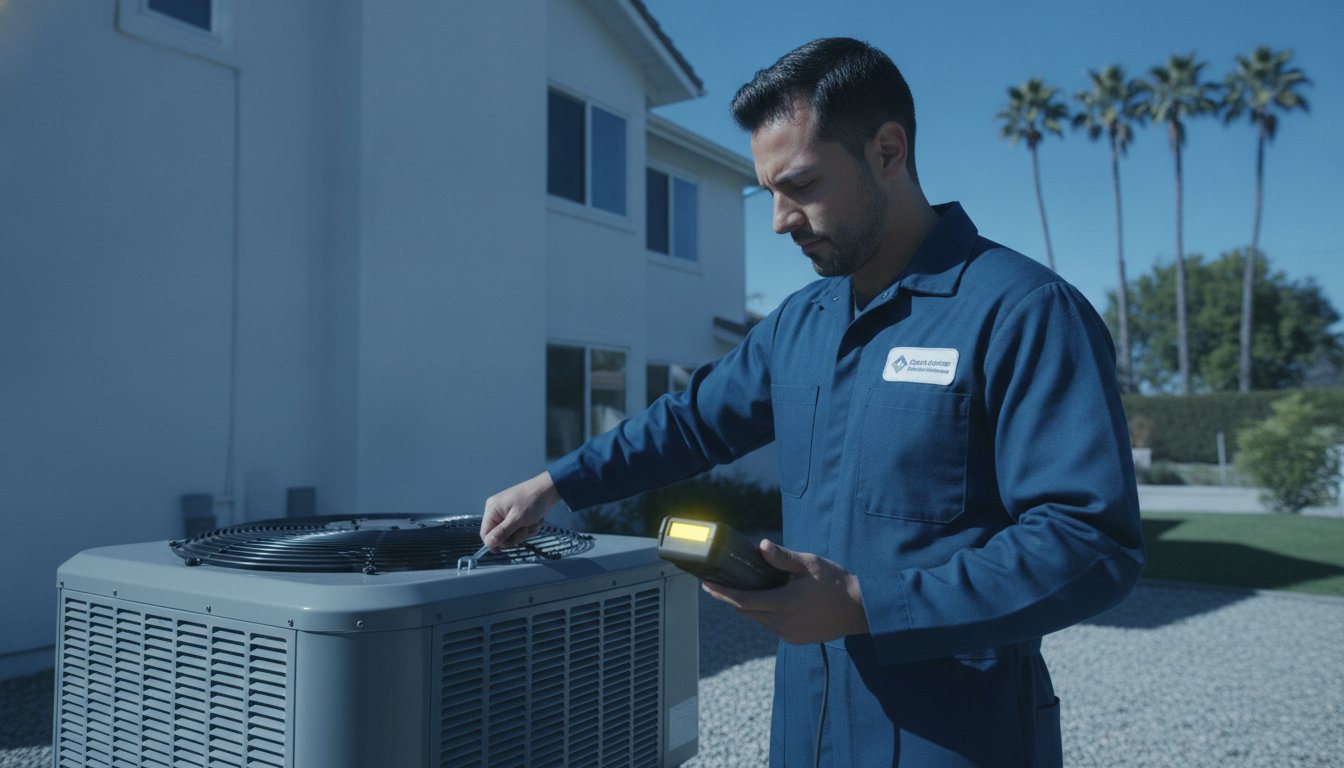
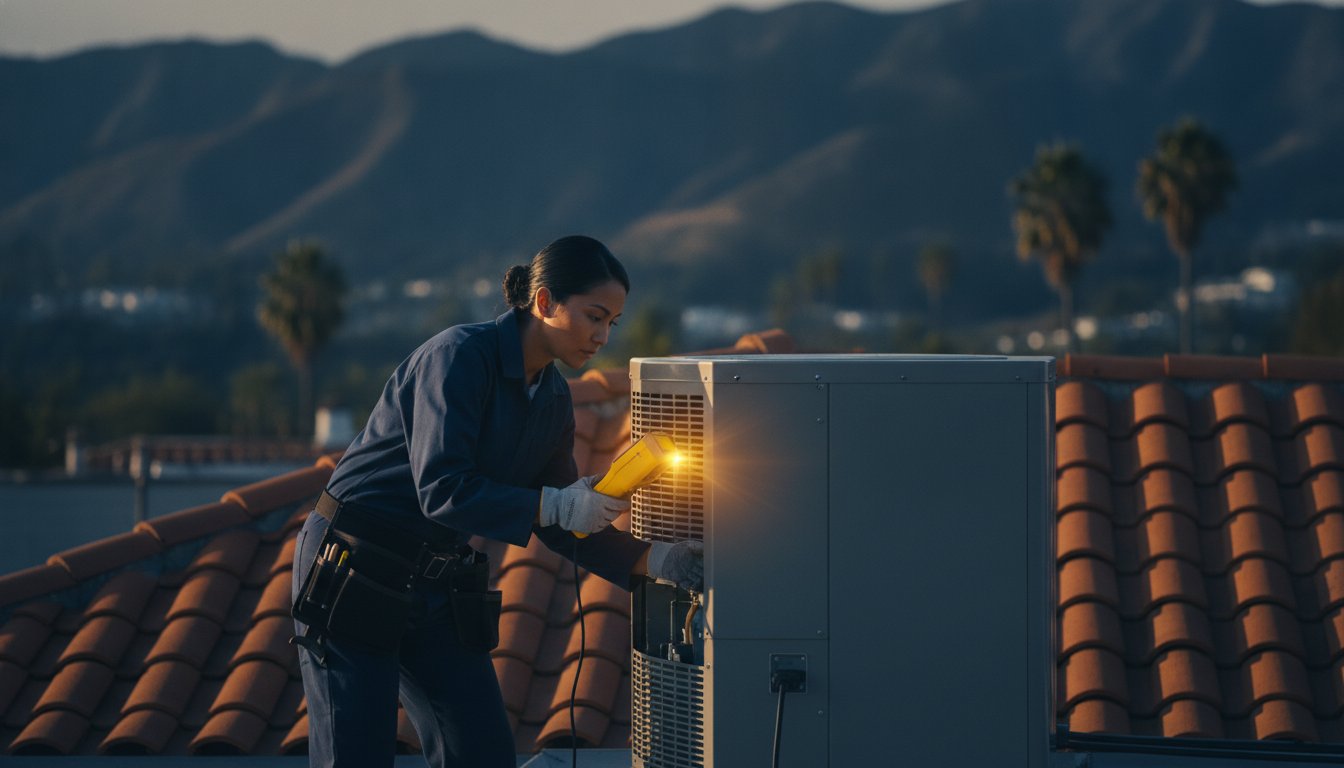
When our technicians assess your home, they're looking at three things together: your current filter rating, your duct condition, and your building envelope. If your HVAC system is a few years old, upgrading to a higher-grade filtration stage needs to be done carefully. A filter that's incompatible with your existing blower motor can reduce airflow, stress components, and in some cases affect your equipment warranty. Our team ensures any IAQ upgrade is installed in a way that works with your system rather than against it, protecting both your air quality and your investment. For homeowners who've recently completed an HVAC service in Los Angeles, integrating a whole-home IAQ upgrade at the same time is often the most cost-effective path forward.
Next Steps for Cleaner Air
One of the most overlooked factors in long-term air quality is filter replacement timing. A saturated carbon filter doesn't just stop working; it can off-gas trapped pollutants back into your air. The Nice and Cool Club maintenance plan addresses this directly. Members receive scheduled filter care on a consistent cycle, so the system protecting your family is never quietly failing in the background. It removes the guesswork, the forgotten reminders, and the risk of breathing through media that stopped performing weeks ago.
Clean air in an LA home isn't a one-time purchase. It's a system that needs to be right-sized, properly installed, and consistently maintained. If you're ready to move from guessing to knowing, schedule your indoor air quality audit with Nice and Cool Inc. today and get a clear picture of exactly what your home needs.
Your Next Step Toward Cleaner Air Starts Here
Los Angeles smog isn't a problem you can solve with a single purchase and forget about. The most effective indoor air quality solutions for Los Angeles smog combine the right filtration technology, a properly maintained HVAC system, and a consistent replacement schedule that keeps your filters performing when you need them most.
The three things to carry forward from this guide: particle filtration and gas-phase filtration work together, not separately; your central HVAC system is your most powerful air quality asset; and a saturated filter is often worse than no filter at all. Each of those points has a practical fix, and none of them require starting from scratch.
Nice and Cool Inc. has been helping Los Angeles County homeowners breathe easier since 2005. Whether you're ready for a full IAQ audit or simply want to know if your current setup is doing its job, our specialists can give you a clear, honest answer. The Nice and Cool Club Maintenance Plan keeps your filters on schedule so clean air stays consistent, not seasonal.
Breathe easier, schedule your professional LA air quality audit today. Your home should be your cleanest air, not your worst.
Frequently Asked Questions
Can a standard AC filter remove smog?
No, a standard AC filter can't effectively remove smog. Most basic filters are rated MERV-8 or lower, which means they capture large particles like hair and visible dust but allow PM2.5, ozone, and combustion byproducts to pass straight through. Those are precisely the pollutants that define LA smog. You need a minimum MERV-13 filter to start intercepting the particle fraction that actually damages lung tissue.
Gas-phase pollutants like nitrogen dioxide and VOCs are a separate problem entirely. No MERV-rated filter, regardless of its rating, touches those. That's why a carbon stage is essential alongside any particle filter in a high-smog environment.
What is the best MERV rating for Los Angeles air quality?
MERV-13 is the practical sweet spot for most LA homes. It reliably captures particles down to the PM2.5 range without creating the airflow resistance that higher-rated filters can impose on older blower motors. Jumping straight to MERV-16 sounds appealing, but if your system wasn't engineered for that level of restriction, you risk reduced airflow, frozen coils, and uneven cooling throughout the house.
Filter thickness matters as much as the MERV number. A four-inch MERV-13 media bed typically outperforms a one-inch MERV-16 in both filtration balance and airflow compatibility. A professional assessment of your specific system is the most reliable way to confirm which rating your setup can handle safely.
How often should I change my air filter during wildfire season in LA?
During active wildfire events, check your filter every two to three weeks rather than following your standard replacement schedule. Wildfire smoke loads filters with dense concentrations of ultrafine carbon particles and ash that saturate media far faster than everyday urban smog does. A filter that normally lasts three months can become clogged enough to restrict airflow within weeks during a heavy smoke period.
Your carbon filter will reach capacity even faster than the HEPA stage during wildfire season, since it's simultaneously absorbing smoke odor compounds and combustion gases. Replacing a saturated carbon filter promptly matters; a fully loaded carbon bed can begin releasing trapped pollutants back into your air rather than holding them.
Do air purifiers help with the smell of smog inside the house?
Yes, but only if the unit includes a substantive activated carbon stage. The exhaust smell that drifts into LA homes is a mixture of nitrogen dioxide, VOCs, and combustion byproducts that are entirely gaseous. HEPA filtration doesn't address odors at all; it only intercepts physical particles. Activated carbon adsorbs those gas-phase molecules, which eliminates both the chemical and the smell simultaneously. This is one of the core reasons that effective indoor air quality solutions for Los Angeles smog require both filtration types working together.
The depth of the carbon bed determines how well this works in practice. A thin carbon-coated pre-filter will reduce odors briefly before saturating, while a proper carbon bed maintains performance for several months under typical conditions. If your purifier's only carbon component is a pre-filter mesh, it's not doing meaningful gas-phase work on a bad smog day.
Is a whole-home air purifier better than multiple portable units?
For most LA homeowners, a whole-home approach delivers broader and more consistent results. Portable units are limited to their rated room size, which means hallways, bathrooms, and any room without a dedicated unit accumulates the same pollutants as everywhere else. A central system treats air from every room as it cycles through your HVAC, so coverage isn't dependent on where you placed a machine.
That said, the two approaches aren't mutually exclusive. A well-upgraded central system handling the baseline load across your entire home, paired with a portable unit in a high-exposure room like a bedroom near a busy street, gives you the most resilient setup. The right combination depends on your living situation, your ductwork, and how comprehensively you want to address the problem.
What is a CARB-certified air purifier and why does it matter in California?
CARB certification means the California Air Resources Board has tested and approved the device as safe to operate in California homes without generating harmful ozone levels as a byproduct. Ionic purifiers and some UV-based units produce ozone during normal operation, which can elevate indoor ozone concentrations on the same days outdoor levels are already dangerously high. In LA, that's a real compounding risk, not a theoretical one.
If a portable air purifier isn't CARB-certified, it shouldn't be running in a California home. The certification isn't a marketing badge; it's a safety baseline. Before purchasing any unit, confirm the CARB certification number is listed, which you can cross-reference on the CARB website to verify it's current and legitimate.
Can an air purifier reduce the amount of dust on my furniture?
It can, but the degree depends on the filter quality and how well your system circulates air throughout the room. A True HEPA filter captures the fine particulate matter that settles as household dust, including the grey film that LA residents often notice on furniture during high-smog periods. If your purifier is undersized for the room or positioned poorly, air circulation gaps will leave corners and surfaces collecting particles the unit never processes.
Duct integrity plays a role here too. If your HVAC ducts have gaps that pull unfiltered air from attic spaces, that particulate enters your living areas downstream of any filter. Addressing both the filtration quality and the pathways that bypass it gives you a noticeably cleaner result on surfaces, not just in the air you breathe.
How much does it cost to add a professional air purifier to my existing HVAC?
We don't publish pricing here because costs vary significantly based on your existing system's age, filter housing configuration, duct condition, and the specific IAQ upgrade that's right for your home. Quoting a number without assessing your setup would be doing you a disservice. What we can say is that integrating a whole-home IAQ upgrade during a scheduled HVAC service visit is typically more cost-effective than retrofitting it as a standalone project later.
The Nice and Cool Club Maintenance Plan also factors into long-term cost. Keeping filters on a consistent replacement schedule prevents the kind of system strain and air quality degradation that leads to bigger expenses down the line. If you'd like a clear picture of what your specific home needs and what it would involve, scheduling an IAQ audit with Nice and Cool Inc. is the right first step.
Frequently Asked Questions
No. Standard fiberglass filters aren't designed to stop microscopic chemical smog. They're built to keep large debris like hair and lint out of your HVAC equipment, not to protect your lungs from fine pollutants. If you want to remove smog particles, you need a high-efficiency filter with a dense enough weave to intercept microscopic particulates before they circulate through your home.