Can a New HVAC System Reduce Dust? How Modern Air Conditioning Cleans Your Home
June 24, 2026 18 min read

What if the secret to a cleaner home wasn't a better vacuum, but a more intelligent air conditioner? If you feel like you're trapped in an endless cycle of dusting only to see a grey film settle back on your surfaces by the next morning, you aren't alone. Whether you're struggling with aggravated allergies or you're simply tired of the constant upkeep, it's frustrating to feel like your home is never truly clean. Most people assume dust is an unavoidable part of life, but the real culprit is often an aging system that circulates particles instead of removing them.
You can significantly reduce dust in home with new HVAC system technology that acts as a whole-home air scrubbing terminal. We want to show you how a modern installation goes beyond simple cooling to actively filter, trap, and eliminate household irritants. This article explores the impact of MERV-13 filtration standards and high-efficiency airflow on your indoor environment. You'll discover how upgrading your equipment provides a cleaner living space, lower allergy triggers, and the confidence that you're making a long-term investment in your family's health and comfort.
Key Takeaways
- Learn why aging HVAC units often act as "dust factories" by recirculating particles instead of trapping them.
- Discover how you can effectively reduce dust in home with new HVAC system technology, such as variable-speed motors that provide constant air filtration.
- Understand the critical role of ductwork sealing in preventing Los Angeles smog and outdoor pollutants from bypassing your filtration system.
- Get a practical seasonal maintenance checklist tailored to help Los Angeles homeowners manage air quality during Santa Ana winds and wildfire seasons.
- See how integrating UV lights and advanced air purifiers during a new installation creates a comprehensive, health-first home environment.
The Hidden Link: Why Your Old HVAC Is a Dust Factory
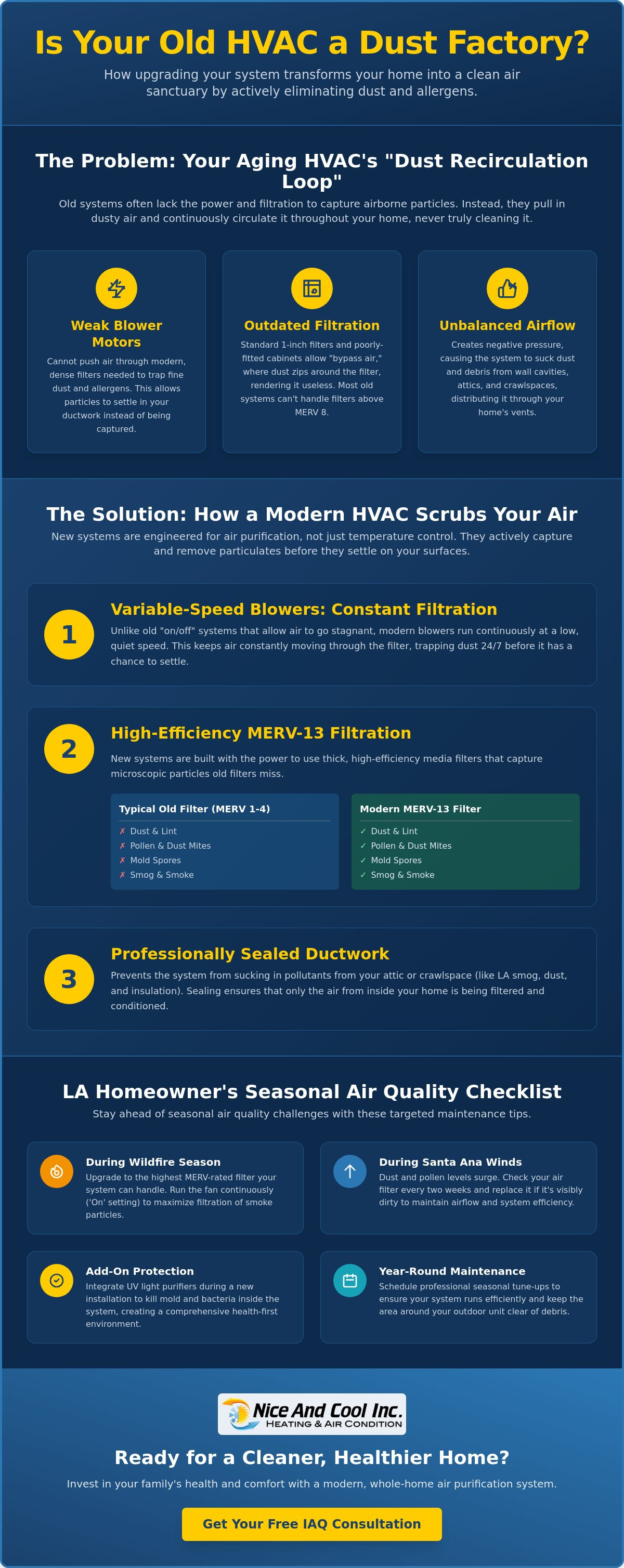
Many homeowners in Los Angeles feel like they are losing a battle against a persistent film of fine grey powder. If you find yourself cleaning your coffee table every other day, the problem likely isn't your cleaning routine. It's your mechanical system. An aging unit often creates what we call a "Recirculation Loop." This occurs when the system pulls in dusty air but lacks the mechanical strength or filtration quality to actually trap the particles. Instead of cleaning the air, the unit acts as a motorized stirrer, keeping dust suspended and moving it from one room to another. You can significantly reduce dust in home with new HVAC system technology that breaks this cycle by capturing those particles on the first pass.
The core of the issue often lies with the blower motor. Older motors lose the ability to maintain necessary static pressure. They simply cannot push air through the dense, high-efficiency filters required to catch fine allergens. If you try to force a modern filter into a failing system, the motor may struggle or overheat. This lack of pressure means air moves sluggishly, allowing dust to settle in your ductwork rather than being caught in a filter. In many local homes, return ducts run through dusty attics or crawlspaces. If these ducts have even minor leaks, they create a "vacuum effect." The system literally sucks in attic insulation, dirt, and outdoor pollutants through those cracks and distributes them through your vents.
How Inefficient Air Filters Fail You
Standard 1-inch fiberglass filters were originally designed to protect the internal machinery from large debris, not to clean the air you breathe. Many older units also suffer from "bypass air." This happens when the filter cabinet is poorly fitted, allowing dust to zip around the edges of the filter entirely. MERV (Minimum Efficiency Reporting Value) ratings measure a filter's ability to catch small particles; however, older Heating, ventilation, and air conditioning (HVAC) systems often freeze up if you install anything higher than a MERV 8 because they lack the power to pull air through the tighter weave.
The Pressure Problem: Sucking Dust from the Walls
When an HVAC system has unbalanced airflow, it creates negative pressure zones within your home. If a room is "starved" for air, it will pull replacement air from any available gap. This often means sucking dust and microscopic debris directly out of your wall cavities or floorboards. You might notice "soot marking," which appears as dark ghosting or staining on the carpet or walls near your supply vents. This isn't just dirt; it's a sign that your system is under such pressure that it's pulling debris from the building's internal structure. You can reduce dust in home with new HVAC system designs that prioritize balanced pressure and airtight seals, ensuring air only comes from where it's supposed to.
3 Ways a New HVAC System Actively Reduces Dust
If you've noticed that your current air conditioner seems to do very little for your home's cleanliness, it's because older units were primarily engineered to move heat, not to purify air. Modern technology has shifted this focus. You can effectively reduce dust in home with new HVAC system features that prioritize continuous filtration over simple temperature control. Instead of waiting for a thermostat to trigger a blast of air, these systems work as active air scrubbers that handle microscopic particles before they ever land on your furniture.
Variable-Speed Blowers: The Constant Air Scrubbers
The most significant leap in dust control is the transition from old "on/off" motors to variable-speed technology. Traditional systems operate at 100% capacity or 0% capacity. When the system shuts off, the air becomes stagnant, allowing dust to settle out of the air and onto your surfaces. Modern variable-speed blowers are different. They often run at lower, quieter speeds for longer durations. This constant air movement means your air is being filtered 24 hours a day, even when the system isn't actively cooling or heating. Because the air never stops moving, dust remains suspended until it's pulled back into the return and trapped. This steady flow is a core reason why the EPA emphasizes that well-designed systems help maintain good indoor air quality by removing particulates like dust, pollen, and mold spores.
High-Efficiency Media Cabinets
Most older systems rely on a thin, 1-inch filter slot that is often poorly sealed. A new installation allows for the integration of high-capacity media cabinets. These cabinets house deep-pleated filters, typically 4 to 5 inches thick. If you were to unfold one of these filters, the surface area would be significantly larger than a standard flat filter. This increased surface area allows the system to trap 99% of airborne particles without restricting airflow or straining the motor. Whether you are dealing with pet dander or fine Los Angeles smog, these media filters catch microscopic allergens that older units simply miss. If you are curious about which filtration level fits your specific needs, exploring professional Indoor Air Quality Solutions can help you tailor your setup for maximum cleanliness.
Finally, the effectiveness of these tools depends on "Whole-Home Scoping." During a modern installation, the system is sized specifically for your home's unique cubic footage and layout. This ensures that the blower maintains consistent static pressure throughout the entire house. When pressure is balanced, 100% of the air in your living space is forced through the filter rather than leaking out through gaps in the cabinetry or ductwork. This precision engineering is what allows you to reduce dust in home with new HVAC system performance that stays consistent for years to face.
The Ductwork Factor: Sealing Out the Los Angeles Grime
A new air conditioning unit is only as good as the "veins" it uses to transport air throughout your home. If your ductwork is leaky, disconnected, or poorly insulated, even the most advanced equipment will struggle to maintain air quality. When we perform an ac installation los angeles ca, we always include a total ductwork evaluation as a standard part of the process. This ensures that your home operates on a "Closed Loop" philosophy. In this model, air is only pulled from your living spaces and never from the unconditioned, dusty areas of your home. This approach is the most effective way to reduce dust in home with new HVAC system performance that actually delivers on its promise.
Many older Los Angeles homes still rely on original metal ducts that have lost their seals over the decades. We frequently recommend a transition to modern, R-8 insulated flex ducts during a system upgrade. These ducts provide superior thermal protection and are significantly easier to seal tightly at every joint. By upgrading the delivery system alongside the unit, you ensure that the clean, filtered air stays pure until it reaches your living room. It's a comprehensive strategy that treats the house as a single, healthy organism rather than just a collection of parts.
The Attic Dust Entry Point
Los Angeles attics are notorious for reaching temperatures up to 140°F during the summer months. These cramped spaces are often filled with decades of accumulated soot, pollen, and microscopic insulation fibers. If your return ducts have even pinhole-sized gaps, they act like a high-powered vacuum for this debris. While many homeowners worry about dirty air ducts, the bigger threat is often the unconditioned air being sucked in from the attic. During a professional installation, we use durable mastic sealant instead of standard tape. Mastic creates a permanent, airtight bond that prevents attic grime from ever entering your breathing air.
Proper Sizing and Airflow Balance
Dust often accumulates in "dead zones," which are areas where air doesn't circulate properly. We use "Manual J" calculations to determine the exact airflow needs for every room in your house based on its size and sunlight exposure. This ensures that every corner receives enough pressure to keep particles moving toward the central filters. Once your new system and ducts are in place, staying consistent with hvac maintenance los angeles will ensure your ducts stay as clean as the day they were installed. Balanced airflow is the final piece of the puzzle to reduce dust in home with new HVAC system technology.
Managing Dust in LA: A Homeowner’s Seasonal Checklist
Living in Southern California presents a unique set of challenges for keeping a home clean. Between the Santa Ana winds that carry desert silt and the urban smog that settles over the basin, your air quality is constantly under fire. While you can reduce dust in home with new HVAC system technology, maintaining that "just-installed" cleanliness requires a proactive approach tailored to our local climate. A high-performance system is a powerful tool, but it works best when you follow a consistent seasonal routine. Whether you are dealing with the spring pollen bloom or the heavy dust of autumn, staying ahead of the environment is the only way to ensure lasting comfort.
- Keep windows and doors tightly shut during Santa Ana wind events to prevent heavy outdoor silt from overwhelming your filters.
- Switch your thermostat to the "Fan On" or "Circulate" setting during high-pollen days to ensure your air is being scrubbed even when the compressor isn't running.
- Inspect your filter every 30 days during the peak of summer or during local brush fires to prevent airflow restriction.
- Wipe down your supply registers with a damp cloth monthly to prevent any stray particles from settling and being blown back into the room.
- Join the Nice and Cool Club Maintenance Plan to ensure professional eyes are on your system’s seals and motors twice a year.
Protecting Your System During Wildfire Season
Wildfire smoke is a significant concern in Los Angeles, as these events now account for approximately 44% of U.S. primary PM2.5 emissions. Fine ash and microscopic soot can quickly clog even the best filters, forcing your new motor to work harder than necessary and potentially shortening its lifespan. If there is a poor air quality alert, set your system to "Recirculate" mode. This stops the unit from pulling in smoky outside air and focuses entirely on cleaning the air already inside your home. Once the fires are contained, it is vital to schedule a post-fire inspection. Ash is abrasive; if it accumulates on your outdoor condenser coils, it can reduce efficiency and lead to premature wear.
The 90-Day Filter Routine
Timing is everything. Most 4-inch or 5-inch media filters are designed to last up to 90 days, but Los Angeles homeowners should check them more frequently during high-smog months. When you inspect the filter, look for "filter blow-by." This is indicated by dust streaks on the "clean" side of the filter frame, suggesting a poor seal or a filter that has become so clogged that air is forcing its way around the edges. If you notice these signs, it's time for a replacement. Setting a calendar reminder for the first day of each season is a simple way to protect your investment. You can effectively reduce dust in home with new HVAC system performance by ensuring that your primary line of defense is always in top condition.
By staying ahead of these environmental factors, you can enjoy the full benefits of your equipment year-round. If you want to ensure your system is ready for the next heatwave or wind event, consider signing up for the Nice and Cool Club Maintenance Plan today.
Professional IAQ Solutions with Nice and Cool Inc.
Choosing to reduce dust in home with new HVAC system technology is a major step toward a healthier lifestyle, but the equipment itself is only half the battle. The other half is the precision and care with which that system is installed and maintained. At Nice and Cool Inc., we position ourselves as more than just service providers; we are your local partners in creating a "Health-First" environment. As a family-oriented business with deep roots in the community, we understand that a home in Los Angeles isn't just a building. It's a sanctuary from the urban environment outside. We approach every project with the same level of care we'd give our own neighbors, ensuring that every seal is perfect and every component is optimized for your specific needs.
Our team takes immense pride in a reputation built on honesty and a commitment to quality. We don't believe in high-pressure sales or one-size-fits-all solutions. Instead, we act as a helpful guide to help you navigate the technical options available for your home. When you work with us, you're getting the expertise of a seasoned specialist who understands the unique air quality challenges of the Los Angeles basin, from coastal salt air to valley heat. We are here to ensure your new investment provides the peace of mind and domestic comfort you deserve.
Customizing Your Indoor Air Quality
We believe in tailoring our solutions to the unique rhythm of your household. If you have multiple pets that shed or family members who suffer from severe seasonal allergies, a standard filter setup might not be enough. During our installation process, we often integrate advanced Indoor Air Quality Solutions like iWave air purifiers or UV-C lights directly onto the evaporator coil. These technologies work in tandem with your filters to neutralize pathogens and clump microscopic dust particles together. This process makes the particles large enough for your high-efficiency media filter to trap effectively. Our focus on craftsmanship means we don't just "drop in" a unit; we ensure the entire cabinet and plenum are airtight so that your strategy to reduce dust in home with new HVAC system performance actually delivers visible results.
Your Next Step to a Cleaner Home
If you're tired of fighting a losing battle with a microfiber cloth and a vacuum, it's time to look at the mechanical heart of your home. A modern HVAC unit is a multi-purpose health investment that protects your respiratory system and your peace of mind. For over 20 years, we've served homeowners across Los Angeles County with a steady, deliberate pace that ensures no detail is overlooked. We've seen every type of architectural challenge this region has to offer, and we're ready to help you transition from an old, dusty system to a modern, air-scrubbing powerhouse.
Take the first step toward a noticeably cleaner home today. We offer comprehensive home air quality assessments to help you identify exactly where your current system is falling short. Contact Nice and Cool Inc. today for a consultation.
Take Control of Your Home's Air Quality Today
Endless cleaning cycles don't have to be your reality. By addressing the root cause of airborne particles, you can finally reclaim your time and your domestic comfort. Whether you choose to upgrade to variable-speed technology or focus on professional ductwork sealing, the path to a pristine living space starts with your mechanical system. It's clear that you can significantly reduce dust in home with new HVAC system performance that acts as a 24/7 air scrubber for your family.
Nice and Cool Inc. has been family-owned and operated since 2005. We take immense pride in being specialists in high-efficiency SEER2 installations that are tailored to the unique needs of Los Angeles homeowners. From advanced filtration options to the Nice and Cool Club Maintenance Plan, we provide the reliable tools and craftsmanship you need for long-term indoor air quality and peace of mind.
We look forward to helping you create the clean, fresh home environment you deserve.
Frequently Asked Questions
Will a new HVAC system completely eliminate all dust in my home?
No, a new system won't eliminate every speck of dust, as much of it is generated by people, pets, and textiles inside the house. However, you can significantly reduce dust in home with new HVAC system technology because it filters the air more frequently and effectively. While you'll still need to clean occasionally, you'll notice a massive decrease in how quickly grey film settles on your furniture and electronics.
How often should I change my filters if I have a new, high-efficiency system?
You should inspect your filter every 30 days, even if the manufacturer says it lasts longer. While deep-pleated media filters often last up to three months, the unique air quality in Los Angeles can lead to faster buildup. If you live near a busy road or have several pets, you may need a fresh filter sooner to maintain peak airflow and keep your home's air scrubbed clean.
Is it better to run my HVAC fan on "On" or "Auto" to reduce dust?
Setting your fan to "On" or "Circulate" is much better for reducing dust than the "Auto" setting. On "Auto," the system only filters air when it's actively heating or cooling. If the fan runs continuously, it keeps air moving through the filter 24 hours a day. This prevents dust from settling on your tables and shelves, keeping it suspended until the system can trap it.
Can leaky ducts really pull dust from my attic into my bedrooms?
Yes, leaky return ducts are one of the most common ways attic debris enters your living space. If there's a gap in the ductwork located in your attic, the system's blower creates a vacuum that pulls in insulation fibers and decades of accumulated dust. This contaminated air bypasses your main filter and is blown directly into your bedrooms, making your cleaning efforts feel completely useless.
Does a ductless mini-split system reduce dust better than central air?
Ductless mini-split systems are excellent for dust control because they eliminate the need for ductwork entirely. Without ducts, there's no risk of pulling in grime from attics or crawlspaces. However, central air systems with high-capacity media filters can often scrub a larger volume of air at once. Whether you choose a central unit or a ductless mini-split system, both offer modern filtration that far exceeds older equipment.
What MERV rating is best for reducing dust without damaging my new AC unit?
A MERV 13 rating is generally the "sweet spot" for modern residential air quality. California's building standards now require MERV 13 filters in new residential installations because they are dense enough to catch fine smoke and smog particles. Because you can reduce dust in home with new HVAC system blowers designed for higher pressure, these filters won't strain your new motor like they would an older, weaker system.
How much does it cost to add a whole-home air purifier to a new installation?
The cost of adding a whole-home air purifier depends on the specific technology, such as UV lights or ionization systems, and your home's existing configuration. While we don't provide flat pricing here, these units are often most affordable when integrated during a new installation rather than as a later add-on. We recommend asking your technician about current manufacturer incentives or seasonal promotions that might apply to your specific project.
Can a dirty outdoor AC unit cause dust inside my house?
No, a dirty outdoor condenser unit does not directly push dust into your home's interior. The outdoor unit's job is to release heat, and the air it moves stays outside. However, if the outdoor coils are caked in dirt, the system has to run longer and harder to cool your home. This extra strain can eventually lead to mechanical issues that might affect your indoor air quality indirectly over time.
Frequently Asked Questions
Standard 1-inch fiberglass filters were originally designed to protect the internal machinery from large debris, not to clean the air you breathe. Many older units also suffer from "bypass air." This happens when the filter cabinet is poorly fitted, allowing dust to zip around the edges of the filter entirely. MERV (Minimum Efficiency Reporting Value) ratings measure a filter's ability to catch small particles; however, older Heating, ventilation, and air conditioning (HVAC) systems often freeze up if you install anything higher than a MERV 8 because they lack the power to pull air through the tighter weave.