Heat Pump Installation Guide: Everything You Need to Know for 2026
August 2, 2026 18 min read
What if the biggest obstacle standing between your home and year-round comfort isn't the technology itself, but simply not knowing where to start? If you've been putting off switching to a heat pump because the installation process feels like a mystery, you're not alone. Most homeowners have the same questions: What will it actually cost? How long does it take? And how do I find someone I can trust to do it right?
Those concerns are completely valid, and they deserve straight answers. This heat pump installation guide is designed to walk you through everything you need to know before, during, and after installation, so you can move forward with confidence rather than guesswork.
From understanding the key factors that shape installation costs, to knowing what to look for in a qualified local HVAC provider, we'll cover each step in a clear, practical way. Whether you're replacing an aging system or installing a heat pump for the first time, by the end of this guide you'll have a solid picture of what the process involves and what questions to ask along the way.
Key Takeaways
- This heat pump installation guide breaks down everything from initial home assessment to final setup, so you know exactly what to expect at every stage of the process.
- Installation costs vary based on several key factors, including your home's existing HVAC infrastructure and the type of system that best fits your needs.
- Local climate conditions play a bigger role in heat pump performance than most homeowners realize, making it essential to choose a system matched to your specific environment.
- Regular professional maintenance is one of the most effective ways to protect your investment and keep your heat pump running efficiently year after year.
- Finding a qualified local installer means knowing the right questions to ask, and this guide gives you a clear framework for evaluating HVAC contractors with confidence.
What is Heat Pump Installation?
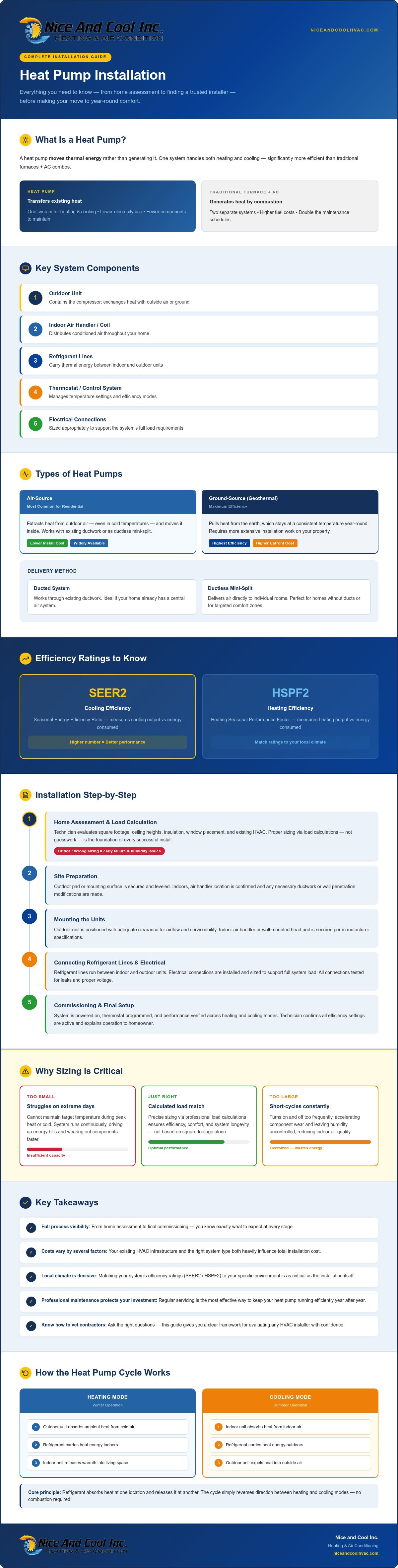
Heat pump installation is the process of fitting, connecting, and commissioning a system that moves heat rather than generating it. Instead of burning fuel to produce warmth or running a separate unit to cool your home, a heat pump transfers thermal energy between the indoors and outdoors depending on the season. The result is a single system that handles both heating and cooling with remarkable efficiency. For homeowners ready to step away from aging, costly equipment, it's one of the most practical upgrades available today.
Compared to traditional furnaces and central air conditioners, heat pumps stand out in a few meaningful ways. A conventional gas furnace creates heat by combustion; a heat pump simply relocates existing heat. That distinction matters because moving energy requires significantly less electricity than producing it from scratch. You also eliminate the need to maintain two separate systems, which simplifies both service scheduling and long-term costs.
A complete installation typically involves several key components working together:
- The outdoor unit, which contains the compressor and exchanges heat with the outside air or ground
- The indoor air handler or coil, which distributes conditioned air through your home
- The refrigerant lines, which carry thermal energy between the two units
- The thermostat or control system, which manages temperature settings and efficiency modes
- Electrical connections, sized appropriately to support the system's load requirements
Types of Heat Pumps
Air-source heat pumps are the most common choice for residential use. They extract heat from outdoor air, even in cold temperatures, and move it inside. Ground-source (or geothermal) systems pull heat from the earth, which stays at a more consistent temperature year-round, but they require more extensive installation. Whether you choose air-source or ground-source depends on your property, budget, and climate. Ducted systems work through existing ductwork, while ductless mini-split systems deliver conditioned air directly to individual rooms, making them ideal for homes without existing ducts or for targeted comfort zones.
How Heat Pumps Work
The core principle is straightforward: refrigerant absorbs heat at one location and releases it at another. In heating mode, the outdoor unit extracts ambient heat from the air, the refrigerant carries it inside, and the indoor unit releases it into your living space. The cycle reverses for cooling. Two key ratings to understand are SEER2 (cooling efficiency) and HSPF2 (heating efficiency); higher numbers indicate better performance. Any reliable heat pump installation guide will tell you that matching these ratings to your local climate is just as important as the installation itself.
Steps Involved in Heat Pump Installation
Understanding what actually happens during a heat pump installation removes a lot of the uncertainty homeowners feel before the process begins. It's not a single afternoon task, and it's not a weeks-long disruption either. When handled by experienced technicians, it follows a clear, logical sequence that protects your home, your investment, and your comfort from day one.
Home Assessment
Every successful installation starts well before any equipment arrives. A qualified technician will evaluate your home's square footage, ceiling heights, insulation levels, window placement, and existing HVAC infrastructure. This information directly shapes which system will perform best in your specific space.
Sizing matters more than most homeowners expect. A unit that's too small will struggle to maintain temperature on extreme days; one that's too large will cycle on and off too frequently, wearing components down faster and leaving humidity uncontrolled. Proper sizing is calculated using load calculations, not guesswork. This is one of the most important reasons to work with a professional rather than estimating based on home square footage alone. Any reliable heat pump installation guide will point to this step as the foundation everything else is built on.
Installation Process
Once the right system is selected and the installation date is scheduled at a time that works for you, the technical work begins. Here's what that process typically looks like:
- Site preparation: The outdoor pad or mounting surface is secured and leveled. Indoors, the air handler location is confirmed and any necessary modifications to ductwork or wall penetrations are made.
- Mounting the units: The outdoor unit is positioned with adequate clearance for airflow and serviceability. The indoor air handler or wall-mounted head unit is secured according to manufacturer specifications.
- Connecting refrigerant lines: Copper line sets are run between the indoor and outdoor units, carefully insulated and sealed to prevent energy loss or moisture intrusion.
- Electrical connections: Dedicated circuits are wired to handle the system's load requirements. This step must meet local electrical codes and is never something to cut corners on.
- System testing and calibration: Before the technician leaves, the system is pressurized, checked for leaks, and run through both heating and cooling modes. Airflow, refrigerant charge, and thermostat response are all verified.
That final calibration step is where quality installations are distinguished from rushed ones. A properly commissioned system runs cleaner, lasts longer, and delivers the efficiency ratings it was designed to achieve.
Before wrapping up, a good technician will also walk you through basic operation, filter maintenance, and what to watch for between service visits. If you're ready to move from planning to action, connect with a local heat pump specialist who can assess your home and give you a clear picture of what installation will involve.
What to Consider Before Installing a Heat Pump
Getting the installation right starts well before any technician shows up at your door. The decisions you make during the planning phase, from understanding your local climate to evaluating your home's existing setup, directly shape how well your system performs for years to come. A thorough heat pump installation guide doesn't skip this stage; it treats it as the foundation for everything that follows.
Local Climate and Your Home's Existing Setup
In Los Angeles, the climate works in your favor. Mild winters and warm, dry summers mean air-source heat pumps operate efficiently across all seasons without the extreme cold-weather limitations that affect homeowners in harsher climates. That said, coastal microclimates, inland heat pockets, and elevation differences across the region can all influence which system specification fits your home best.
Your existing HVAC infrastructure matters just as much. If your home already has ductwork in good condition, a ducted system may integrate cleanly. If the ducts are aging, undersized, or absent entirely, a ductless mini-split system could be the more practical path. An experienced technician will assess both your home and your current setup before recommending anything.
Energy Efficiency Ratings
Two ratings define how efficiently a heat pump performs: SEER2 (Seasonal Energy Efficiency Ratio) measures cooling performance, while HSPF2 (Heating Seasonal Performance Factor) measures heating efficiency. Higher numbers mean lower operating costs over time. When comparing models, don't focus solely on the upfront price. A higher-efficiency unit may cost more initially, but the reduction in monthly energy bills can offset that difference over the system's lifespan. In a climate like Los Angeles, where cooling demand runs high for much of the year, SEER2 ratings deserve particular attention.
- SEER2: Measures seasonal cooling efficiency; look for systems that meet or exceed current federal minimums for your region
- HSPF2: Measures heating efficiency; higher values indicate better performance in cooler months
- Combined ratings: Compare both figures together rather than optimizing for one at the expense of the other
Permits and Regulations
In Los Angeles, heat pump installations are subject to local building codes and typically require permits before work begins. This isn't a formality to work around; it's a safeguard that protects your home's safety, your warranty coverage, and your ability to sell the property down the line. Unpermitted HVAC work can create real complications during home inspections or insurance claims.
A qualified installer will handle the permitting process as part of the job. If a contractor suggests skipping permits to save time or money, that's a clear signal to look elsewhere. Compliance isn't optional, and any professional worth hiring knows that.
Choosing an experienced local installer ties all of these considerations together. Someone familiar with Los Angeles building departments, regional climate patterns, and the specific demands of residential homes in this area brings a level of practical knowledge that general contractors simply can't match.
Maintenance Tips for Your Heat Pump
A well-installed heat pump is only as good as the care it receives afterward. Regular maintenance is what separates a system that performs efficiently for fifteen-plus years from one that starts losing ground within five. If this heat pump installation guide has one consistent message, it's that protecting your investment doesn't stop the day installation is complete.
Common Maintenance Tasks
Several maintenance tasks fall within reach of most homeowners and make a genuine difference in day-to-day performance:
- Replacing or cleaning air filters: Clogged filters force your system to work harder, driving up energy use and accelerating wear. Check filters monthly and replace or clean them as needed, typically every one to three months depending on usage and indoor air conditions.
- Checking thermostat settings: Verify that your thermostat is programmed correctly for the season. A setting that made sense in January may be costing you in July. Smart thermostats can handle this automatically, but a quick manual check each season takes less than a minute.
- Inspecting the outdoor unit: Leaves, dirt, and debris accumulate around the outdoor unit and restrict airflow. Clear a two-foot perimeter regularly, and after any significant wind or rain, do a quick visual check to make sure nothing is blocking the coil or fan.
Long-term Care
Beyond the basics, long-term performance depends on professional attention at regular intervals. A qualified technician should inspect your system at least once a year, ideally before the season when you'll rely on it most. Pre-summer checks ensure your cooling performance is ready; a pre-winter inspection confirms the heating side is operating cleanly. These visits typically include refrigerant level checks, electrical connection inspections, coil cleaning, and a review of overall system operation.
Joining a structured maintenance plan takes the guesswork out of scheduling. The Nice and Cool Club is designed exactly for this: routine professional care on a consistent schedule, so your system stays in peak condition without you having to remember to book it. For a family-owned business that's been serving local homeowners since 2005, that kind of ongoing relationship with clients is part of how quality work gets protected over time.
Understanding your warranty is equally important. Most manufacturer warranties require documented professional maintenance to remain valid. Skipping annual service visits can quietly void coverage you're counting on.
Know the signs that your system needs attention sooner than scheduled: unusual noises, inconsistent temperatures between rooms, longer run cycles, or a noticeable increase in your energy bills. Any of these signals is worth a call before the problem compounds.
Schedule a professional heat pump maintenance visit and keep your system running the way it was designed to.
Finding a Trusted Installer in Los Angeles
The quality of your heat pump installation is only as good as the technician performing it. Equipment matters, but the hands putting it in matter just as much. In a city as large and varied as Los Angeles, the contractor you choose will either protect your investment or quietly undermine it. Local expertise isn't just a nice-to-have; it's a genuine advantage that shapes how well your system performs from the first day forward.
A technician who knows Los Angeles understands the permit requirements across different municipalities, the microclimates that affect equipment selection, and the specific building characteristics common to homes in this region. That practical, on-the-ground knowledge doesn't come from a manual. It comes from years of working in the area.
Questions to Ask Potential Installers
Before you commit to anyone, ask direct questions and pay attention to how they respond. Vague answers or reluctance to provide documentation are signals worth taking seriously.
- How many heat pump installations have you completed? General HVAC experience doesn't automatically translate to heat pump expertise. You want someone who installs these systems regularly, not occasionally.
- Are you licensed and insured in California? Verify both. A valid contractor's license and liability insurance protect you if something goes wrong during or after the job.
- What warranty coverage applies to both the equipment and the labor? Manufacturer warranties cover the unit; labor warranties cover the installation itself. Both matter, and a confident installer stands behind their work.
- What post-installation support do you offer? Ask whether they provide maintenance plans, how they handle follow-up calls, and what the process looks like if something needs adjustment after installation. A business like Nice and Cool Inc., which has been serving local homeowners since 2005, builds long-term client relationships rather than walking away once the job is done.
Resources for Finding Local HVAC Professionals
Start with online directories and review platforms to build an initial list of candidates. Look for consistent patterns in feedback rather than isolated reviews; a contractor with dozens of detailed, positive reviews over several years tells a more reliable story than one with a handful of recent ratings. Pay attention to how businesses respond to negative feedback, because that reveals how they handle problems.
Local home improvement associations and community groups can also point you toward contractors who have built a reputation within the neighborhood. Referrals from friends or family who've had similar work done carry real weight. Someone who has already been through the process can tell you what the experience was actually like, not just what was promised.
Whether you're using this heat pump installation guide to plan months ahead or you're ready to move now, getting at least two or three quotes gives you a meaningful basis for comparison. Price matters, but so does the clarity of the proposal, the depth of the home assessment, and how well the contractor communicates. Those factors often predict the quality of the finished job more accurately than the number at the bottom of the estimate.
Reach out to a local heat pump specialist and take the next step toward a system installed the right way, by people who know this community.
Your Next Step Toward Year-Round Comfort Starts Here
This heat pump installation guide has walked you through the full picture: how these systems work, what the installation process actually involves, what to evaluate before committing, how to keep your system running well, and what to look for in a contractor you can trust. The common thread running through all of it is that informed homeowners make better decisions and get better results.
A few things are worth carrying forward. Proper sizing and a thorough home assessment lay the groundwork for everything else. Efficiency ratings deserve real attention, not just a quick glance. And long-term care through a structured maintenance plan is what protects the investment you're making today.
Nice and Cool Inc. has been a family-owned part of the Los Angeles community since 2005. Their technicians bring genuine local knowledge to every job, and their Nice and Cool Club maintenance plan is built to keep your system performing the way it should for years to come.
When you're ready to move forward, contact Nice and Cool Inc. for your heat pump installation today and work with a team that treats your home like their own.
Frequently Asked Questions About Heat Pump Installation
What is the average cost of heat pump installation?
Installation costs vary considerably based on the type of system, your home's existing infrastructure, and the complexity of the job. A ductless mini-split system for a single zone will cost less than a whole-home ducted installation. Ground-source systems require more extensive work than air-source units and carry higher upfront costs accordingly. Rather than budgeting from a general figure, get a detailed quote after a proper home assessment so the number reflects your specific situation.
How long does it take to install a heat pump?
Most standard residential heat pump installations are completed in one to two days. A straightforward ductless mini-split in a home without existing ductwork can often be finished in a single day. More complex jobs, such as replacing a full ducted system or installing multiple indoor zones, may take longer. Permit processing timelines can also affect the overall schedule, which is another reason to work with a contractor who handles that paperwork as part of the job.
Can I install a heat pump myself?
In short, no. Heat pump installation involves refrigerant handling, electrical work, and load calculations that require licensed professionals. In California, handling refrigerants without EPA certification is illegal, and unpermitted electrical work creates safety risks and can void your manufacturer warranty. Attempting a DIY installation also risks improper sizing, which leads to poor performance and higher energy bills. A qualified technician protects both your home and the long-term value of the system.
What maintenance does a heat pump require?
Routine upkeep includes cleaning or replacing air filters monthly, keeping the outdoor unit clear of debris, and checking thermostat settings each season. Beyond those homeowner tasks, a professional inspection at least once a year covers refrigerant levels, electrical connections, coil cleaning, and overall system performance. A structured maintenance plan, like the Nice and Cool Club, takes the guesswork out of scheduling and helps ensure your system stays covered under manufacturer warranty terms.
Are heat pumps effective in Los Angeles's climate?
Heat pumps are genuinely well-suited to Los Angeles. Mild winters mean the system rarely encounters the extreme cold temperatures that challenge air-source performance in harsher climates, and the long cooling season is exactly where high SEER2 ratings pay off. That said, coastal and inland microclimates across the region do vary, so matching your system's specifications to your specific location matters. A local installer familiar with those nuances will recommend the right equipment for your neighborhood.
What should I do if my heat pump is not working?
Start with the basics: check your thermostat settings, confirm the air filter isn't clogged, and make sure the outdoor unit is clear of obstructions. If the system is running but not heating or cooling effectively, or if you notice unusual noises, inconsistent temperatures, or a spike in your energy bill, those are signals to call a professional rather than wait. Catching issues early typically means a simpler repair; delaying often turns a minor problem into a costlier one.
How do I choose the right size heat pump for my home?
Proper sizing comes from a formal load calculation that accounts for your home's square footage, ceiling height, insulation quality, window placement, and local climate conditions. This heat pump installation guide emphasizes that oversized and undersized systems both cause problems: one short-cycles and wears out faster, the other struggles on peak days. Square footage alone isn't a reliable basis for sizing. A qualified technician will run the numbers before recommending any specific system, ensuring the unit fits your home rather than just approximating it.
Frequently Asked Questions
Installation costs vary considerably based on the type of system, your home's existing infrastructure, and the complexity of the job. A ductless mini-split system for a single zone will cost less than a whole-home ducted installation. Ground-source systems require more extensive work than air-source units and carry higher upfront costs accordingly. Rather than budgeting from a general figure, get a detailed quote after a proper home assessment so the number reflects your specific situation.