Cost to Install a Mini-Split in a Garage: 2026 Homeowner’s Pricing Guide
July 8, 2026 18 min read

What if your garage could be the most comfortable room in your house instead of a 120 degree oven? Many homeowners in Los Angeles view their garage as a lost cause during the peak of summer, but a dedicated cooling zone can change that. When you start researching the cost to install mini split in garage setups, you'll likely run into a wall of technical jargon and confusing price ranges. We understand that you want a clear answer so you can plan your home improvement budget without worrying about surprise fees or hidden electrical requirements.
Whether you're looking to build a home gym or finally finish that workshop, getting the right equipment is about more than just the sticker price. This guide will help you understand the real-world factors that influence your total investment, from current SEER2 efficiency standards to local permit requirements. We'll also explain how to navigate the 2026 rebate landscape, including the latest LADWP incentives that can help offset your equipment costs. By the end, you'll have a straightforward roadmap for achieving a year-round functional space that stays cool without sending your electricity bill through the roof.
Key Takeaways
- Learn why a standalone ductless system is the safest, code-compliant way to cool a garage without risking your home's central HVAC efficiency.
- Determine the exact cooling power you need; most two-car garages require between 12,000 and 24,000 BTUs for consistent comfort.
- Break down the total cost to install mini split in garage setups by looking at the three main pillars: equipment quality, specialized labor, and local permits.
- Understand the technical requirements for a dedicated 220V/240V circuit to ensure your new system runs safely and reliably.
- Discover how to maximize your return on investment by leveraging 2026 utility rebates and high-efficiency SEER2 equipment.
Why a Ductless Mini-Split Is the Standard for Garage Conversions
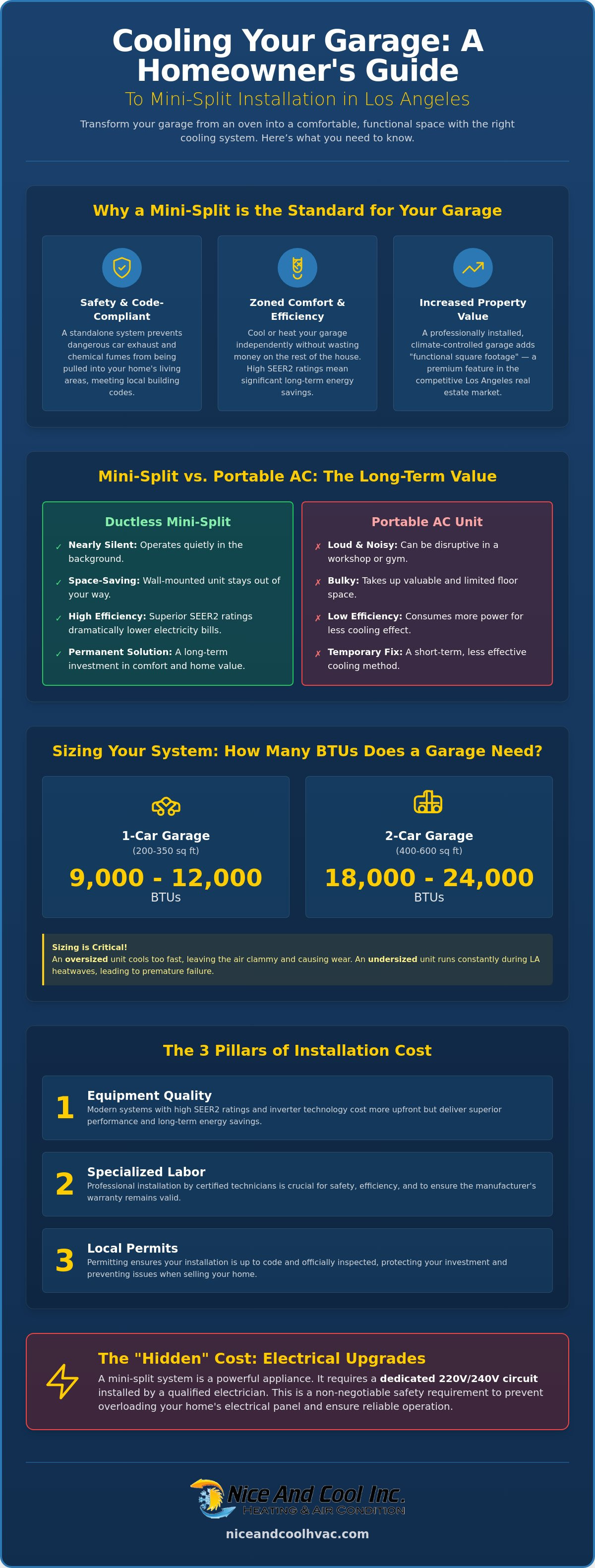
A garage mini-split is a standalone heating and cooling system designed to manage the climate of a single room without relying on your home's central furnace or air conditioner. If you've ever considered simply cutting a hole in your existing ductwork to vent air into the garage, you should proceed with caution. This approach is often a violation of local building codes because it can allow car exhaust or chemical fumes to pull back into your living areas. Additionally, your main HVAC system wasn't sized to handle that extra square footage, which usually leads to a breakdown or a massive spike in energy usage. Ductless mini-split systems solve this by providing a dedicated outdoor compressor and an indoor air handler that works independently.
For Los Angeles homeowners, these systems utilize advanced heat pump technology. This means the unit doesn't just cool; it can also provide efficient heat during those surprisingly chilly winter mornings in the San Fernando Valley. Whether you're setting up a high-end home gym or a quiet office for remote work, this "Zoned Comfort" allows you to keep the garage at a perfect 72 degrees without wasting money cooling the rest of the house. When you evaluate the total cost to install mini split in garage units, you aren't just paying for a machine. You're investing in a specialized solution tailored to the unique insulation challenges of a garage environment.
Mini-Split vs. Portable AC: The Long-Term Value
While a portable AC unit might seem like a quick fix, the performance gap is wide. Portable units are notoriously loud and take up valuable floor space in tight garages. In contrast, a wall-mounted mini-split is nearly silent and stays out of the way. If you care about efficiency, mini-splits are the clear winner. They typically carry much higher SEER2 ratings than portables, which means they use significantly less electricity to achieve the same cooling effect. Over several Los Angeles summers, the energy savings alone can help justify the initial cost to install mini split in garage equipment.
The Impact on Your Los Angeles Property Value
Adding climate control to your garage effectively creates "functional square footage" that appeals to modern buyers. In the competitive Los Angeles real estate market, a finished, climate-controlled workspace is a premium feature that sets a home apart. It's vital to ensure the work is professional and permitted. If a future home inspector sees an unpermitted HVAC installation, it can create major headaches during a sale. Choosing a professional installation ensures your investment is safe, legal, and adds genuine value to your property for years to come.
Sizing Your System: How Many BTUs Does a Garage Need?
Choosing the right size for your unit is the most critical step in determining the final cost to install mini split in garage systems. Capacity is measured in BTUs, or British Thermal Units. Think of BTUs as the "muscle" of your air conditioner. If you have a standard two-car garage, you'll generally need between 12,000 and 24,000 BTUs to stay comfortable. However, sizing isn't just about square footage. In Los Angeles, a west-facing garage door can act like a giant radiator. It soaks up the afternoon sun and pushes interior temperatures well past 100 degrees.
Modern systems use inverter technology to handle these heat spikes efficiently. Unlike older units that only run at full speed or zero, an inverter adjusts its power level like a dimmer switch. This keeps your garage at a steady temperature without the constant, noisy cycling of a traditional AC. While programs like SMUD offers up to $3,000 in rebates for these efficient heat pumps in other parts of the state, local LA homeowners should focus on how high-efficiency equipment lowers their long-term utility bills.
The 1-Car vs. 2-Car Garage Calculation
A typical one-car garage (200 to 350 square feet) usually requires a 9,000 to 12,000 BTU unit. For a two-car space (400 to 600 square feet), you'll likely need 18,000 to 24,000 BTUs. It's tempting to buy the biggest unit available, but "oversizing" is a common mistake. If the unit is too powerful, it will cool the air so fast that it doesn't have time to remove humidity. This leads to a "cold and clammy" feeling and causes the system to short-cycle, which wears out the compressor. Conversely, an undersized unit will run constantly during an LA heatwave, leading to premature failure. If you're unsure which capacity fits your space, our team can provide a professional Ductless Mini-Split Systems assessment to ensure you get the right fit.
Factors That Increase Your Required Capacity
Several variables can change the math for your specific garage. If your garage door isn't insulated, it can account for up to 70% of the heat gain in the room. High or vaulted ceilings also increase the air volume that needs to be conditioned. Finally, consider what you're doing in the space. If you're running heat-generating equipment like a dryer, a server rack, or power tools, you'll need extra cooling power to offset that internal heat. These factors all play a role in the total cost to install mini split in garage projects because they might push you into a higher BTU category.
Breaking Down the Total Cost to Install a Mini-Split in a Garage
When you look at the total cost to install mini split in garage units, it's helpful to view the project through three distinct lenses: the equipment you choose, the professional labor required for a safe setup, and the necessary permits and materials. In Los Angeles, these costs are often influenced by the city's specific building codes and utility standards. While a DIY kit from the internet might seem cheaper upfront, it often lacks the longevity and warranty protection of a professional heat pump installation. A legal, permitted installation in LA typically requires a mechanical permit, which ensures your system meets safety standards and won't create a liability when you eventually sell your home.
Equipment Tiers: Entry-Level vs. High-Efficiency
The difference between a 15 SEER2 and a 25+ SEER2 system is more than just a number on a sticker. Higher efficiency units use significantly less electricity, which is vital in California where residential electricity prices averaged 31 cents per kilowatt-hour in 2024. If you choose a high-efficiency system, you may also qualify for substantial LADWP rebates. For example, systems with a SEER2 rating over 20.5 can qualify for rebates up to $2,500 per ton for equipment installed on or after November 1, 2025. Whether you need a simple single-zone unit for a small workshop or a multi-zone capable system that can expand to other rooms, the equipment tier you select will be a primary driver of your budget. Brand-name reliability also provides a "parts and labor" peace of mind that off-brand units simply cannot match.
Professional Labor: What Are You Paying For?
Professional labor covers the technical steps that ensure your system actually reaches its rated efficiency. Our technicians spend several hours vacuuming the refrigerant lines to remove every trace of moisture and performing high-pressure nitrogen tests to check for microscopic leaks. This precision is what prevents the system from failing during a 105-degree August afternoon. We also focus on the visual impact of the project by using "Line Hide" covers. These specialized channels protect and conceal the external piping against your home's exterior, maintaining your curb appeal.
To keep this investment running at peak performance, many of our neighbors join the Nice and Cool Club Maintenance Plan. Regular care prevents the 5-15% efficiency drop that occurs when filters and coils aren't cleaned properly during heavy use seasons. This proactive approach ensures the cost to install mini split in garage equipment translates into years of reliable, low-cost comfort rather than a series of expensive repairs.
The "Hidden" Costs: Electrical Upgrades and Site Prep
You might wonder why a relatively small cooling unit can't just plug into a standard wall outlet like a toaster or a vacuum. Most professional-grade systems require a dedicated 220V or 240V circuit to operate safely and efficiently. This isn't just a suggestion; it's a requirement for the system to handle the high-torque demands of the compressor during a heatwave. If you try to share a circuit with your garage door opener or power tools, you'll likely deal with constant tripped breakers and potential damage to your new equipment. This dedicated line is a significant factor in the total cost to install mini split in garage projects, especially in older homes where the garage wasn't originally wired for heavy appliances.
In many classic Los Angeles neighborhoods, electrical panels are already at maximum capacity. If your panel is full, you'll need to create space or upgrade the service to accommodate the new double-pole breaker. Whether your garage is attached or detached, the distance from the main panel influences the labor and material costs. If you're worried about your home's current electrical capacity, you can schedule Heat Pump Services to get a clear picture of your site's specific requirements before you buy any equipment.
Electrical Panel Requirements and Upgrades
Checking your panel for space is the first step in site prep. You're looking for two empty slots side-by-side to fit a double-pole breaker. If your panel is maxed out, a technician might install a sub-panel to manage the load specifically for the garage. This is especially common for detached garages where running a single heavy-gauge line from the main house is more efficient than multiple smaller circuits. The National Electrical Code requires a weatherproof disconnect switch installed within sight of the outdoor unit for safety during future maintenance.
Condensate Management: Where Does the Water Go?
Mini-splits act as powerful dehumidifiers, and that moisture has to go somewhere. If your garage layout allows it, a simple gravity drain through an exterior wall is the most cost-effective and reliable solution. However, if the indoor unit is mounted on an interior wall or below the exit point, you'll need a condensate pump to push that water out. While a pump adds a small amount to the cost to install mini split in garage setups, it's a vital investment. Proper drainage prevents water from pooling on your garage floor, which can lead to mold growth or even damage to your concrete slab over time.
Don't overlook the impact of an uninsulated garage door during your site prep. An uninsulated metal door acts like a giant conductor, pulling heat into the space and forcing your mini-split to run much harder than necessary. Adding an insulation kit to your door is a simple step that protects your system from overworking and keeps your energy bills predictable.
Maximizing ROI: Rebates and Efficiency in Los Angeles
Investing in a garage climate system is about more than just surviving the next heatwave. It's a strategic move to lower your long term energy costs. While the federal 25C tax credit expired at the end of 2025, the focus for 2026 has shifted entirely to local utility incentives. These programs are designed to reward homeowners who choose high performance equipment that takes the strain off the local power grid. When you calculate the total cost to install mini split in garage units, these rebates often act as a significant "down payment" on your comfort. Choosing a system with a high SEER2 rating ensures you aren't just saving money on the installation, but also on every monthly bill for the next decade.
Local Los Angeles Rebates and Incentives
The Los Angeles Department of Water and Power (LADWP) currently offers some of the most aggressive incentives in the state for ductless upgrades. For systems installed on or after November 1, 2025, you can qualify for substantial cash back based on efficiency tiers. If your new system meets a SEER2 rating of over 15.2, the rebate starts at $1,500 per ton. For those who opt for ultra high efficiency models with a SEER2 greater than 20.5, that incentive can jump to $2,500 per ton. To qualify, your equipment must be Energy Star certified and installed by a licensed professional. Our team at Nice and Cool Inc. takes the stress out of this process by assisting with all the necessary documentation and technical specifications required for these local programs.
Why Professional Installation Saves Money Long Term
Many homeowners fall into the "DIY Trap" by purchasing "Quick-Connect" kits online. While these seem cheaper, they often lead to much higher costs over time. If a system isn't charged with the exact amount of refrigerant required for the line length, it will work twice as hard to produce half the cooling. This leads to early compressor failure and utility bills that are 20% to 30% higher than they should be. A professional ac installation los angeles ca ensures that your system is pressure tested and vacuumed to factory standards, which protects your manufacturer's warranty. Most major brands will void your parts warranty entirely if the unit wasn't installed by a C-20 licensed contractor.
To keep your system running at peak efficiency, follow this simple maintenance checklist:
- Clean Filters: Wash the indoor unit filters every two to four weeks during high use months.
- Clear the Compressor: Ensure at least 24 inches of clearance around your outdoor unit to maintain airflow.
- Inspect Drains: Check the condensate line once a season to ensure no dust or debris has caused a blockage.
If you're ready to transform your workspace or gym, we can help you navigate the technical choices and find the best rebates available. You can request a tailored garage cooling quote to see exactly how the cost to install mini split in garage equipment fits into your 2026 home improvement goals.
Ready to Reclaim Your Garage?
Transforming your garage into a functional living space is a smart home improvement that pays dividends in both daily comfort and long term property value. As we've discussed, the total cost to install mini split in garage systems is an investment in professional sizing, electrical safety, and high-efficiency performance. By focusing on the latest SEER2 standards and taking advantage of current LADWP rebates, you can create a comfortable workspace or gym without facing unpredictable energy bills.
Since 2005, our family-owned team has served as Los Angeles specialists in high-efficiency ductless technology. We're here to help you navigate the technical requirements and ensure your installation is safe, permitted, and built to last. With our Nice and Cool Club Maintenance Plan, you can enjoy peace of mind knowing your new system will stay reliable through every heatwave. Request a Tailored Garage Mini-Split Quote from Nice and Cool Inc. today and take the first step toward a cooler, more versatile home.
Frequently Asked Questions
Is a mini-split in the garage worth the cost?
A mini-split is absolutely worth the investment if you plan to use your garage for anything other than parking cars. By controlling the climate, you effectively add hundreds of square feet of usable living space to your home. Whether you're building a home office or a workout zone, the ability to stay cool in the summer and warm in the winter makes the space functional year-round. It's often more cost-effective than a traditional room addition.
How much does a mini-split for a 2-car garage cost?
The total cost to install mini split in garage units for a two-car space depends on the unit's cooling power and efficiency rating. Most two-car garages require between 18,000 and 24,000 BTUs of cooling capacity to handle the heat load. Factors like your current electrical panel's capacity and the distance between the indoor and outdoor units will influence your final investment. We recommend a professional site assessment to get an accurate, tailored quote for your specific layout.
Can I install a garage mini-split myself to save money?
You shouldn't attempt the installation yourself because it requires specialized tools and licensing. In California, any work involving refrigerant lines must be performed by a licensed C-20 HVAC contractor to comply with environmental laws. Beyond legal requirements, a professional installation protects your manufacturer's warranty. DIY mistakes often lead to refrigerant leaks or electrical hazards that end up costing much more to repair than the initial savings were worth.
How long does it take to install a mini-split in a garage?
A standard single-zone installation typically takes between four and eight hours to complete. This timeframe includes mounting the indoor air handler, placing the outdoor condenser, and connecting the refrigerant and electrical lines. If your project requires a significant electrical panel upgrade or a complex line run, it might take a bit longer. We aim to finish most garage projects in a single day so you can start enjoying your comfortable space immediately.
Do I need to insulate my garage before installing a mini-split?
You don't have to insulate your garage first, but doing so will significantly lower your monthly energy bills. An uninsulated garage door and thin walls allow heat to pour in, forcing your new system to run much harder to maintain a steady temperature. If you add insulation to the door and walls, your mini-split can reach your desired temperature faster and stay there with less effort. This reduces wear and tear on the equipment over time.
Will a mini-split increase my Los Angeles property taxes?
In most cases, adding a mini-split won't trigger a reassessment of your property taxes in Los Angeles. Unlike adding a new room or a structural extension, installing an HVAC unit is generally viewed as a mechanical upgrade to the existing structure. While it increases your home's market appeal and functional value to future buyers, it typically doesn't change the square footage recorded on your property's title. You can check with the local assessor for specific tax rules.
What is the best SEER2 rating for a garage in Southern California?
For Southern California's climate, we recommend a system with a SEER2 rating of at least 18. While the legal minimum for our region is 14.3, higher efficiency units are better equipped to handle our intense summer heatwaves. If you choose a unit in the 20 to 25 SEER2 range, you'll likely qualify for higher utility rebates from LADWP. These high-efficiency models provide the best balance between upfront cost and long-term utility savings.
Can one mini-split cool both my garage and an adjacent room?
A single indoor air handler isn't designed to cool two separate rooms effectively. If you want to cool both your garage and an adjacent laundry room or workshop, you'll need a multi-zone system. This setup uses one outdoor compressor connected to two separate indoor units. This allows you to control the temperature in each space independently, which is much more efficient than trying to force air through an open door or a shared vent.
Frequently Asked Questions
While a portable AC unit might seem like a quick fix, the performance gap is wide. Portable units are notoriously loud and take up valuable floor space in tight garages. In contrast, a wall-mounted mini-split is nearly silent and stays out of the way. If you care about efficiency, mini-splits are the clear winner. They typically carry much higher SEER2 ratings than portables, which means they use significantly less electricity to achieve the same cooling effect. Over several Los Angeles summers, the energy savings alone can help justify the initial cost to install mini split in garage equipment.