Best HVAC Systems for Los Angeles: 2026 Buyer’s Guide
August 17, 2026 20 min read
What if the cooling system that worked for your neighbor in Santa Monica actually leaves your San Fernando Valley home feeling like an oven by mid-afternoon? You already know that Los Angeles isn't just one climate. It's a collection of microclimates where a 100°F day in the hills feels completely different than a humid afternoon near the coast. Between rising utility rates and the noise restrictions of our dense neighborhoods, finding the best hvac system for los angeles homes has become a complex puzzle for many local families.
We understand the frustration of seeing your energy bill spike while your upstairs bedrooms stay stubbornly warm. This guide will help you solve that puzzle by identifying the most efficient, whisper-quiet solutions tailored to your specific neighborhood. We'll show you how to maximize available LADWP rebates and navigate the new 2026 energy codes. You'll learn about the latest GWP-compliant refrigerants, the benefits of variable-speed heat pumps, and how to choose a system that provides reliable comfort and long-term peace of mind for your home.
Key Takeaways
- Learn how your specific LA zip code determines your cooling load and why coastal homes need different equipment than those in the San Fernando Valley.
- Discover why modern heat pumps are now the gold standard for Southern California, providing efficient year-round comfort in one high-performance system.
- Compare traditional central air with ductless mini-splits to identify the best hvac system for los angeles homes based on your current ductwork and layout.
- Understand the 2026 SEER2 efficiency requirements and how choosing the right equipment can significantly lower your monthly LADWP or SCE bills.
- Find out why professional sizing through a Manual J calculation is the only way to ensure your new unit operates reliably during a 100°F heatwave.
Choosing the Best HVAC System for Los Angeles Microclimates
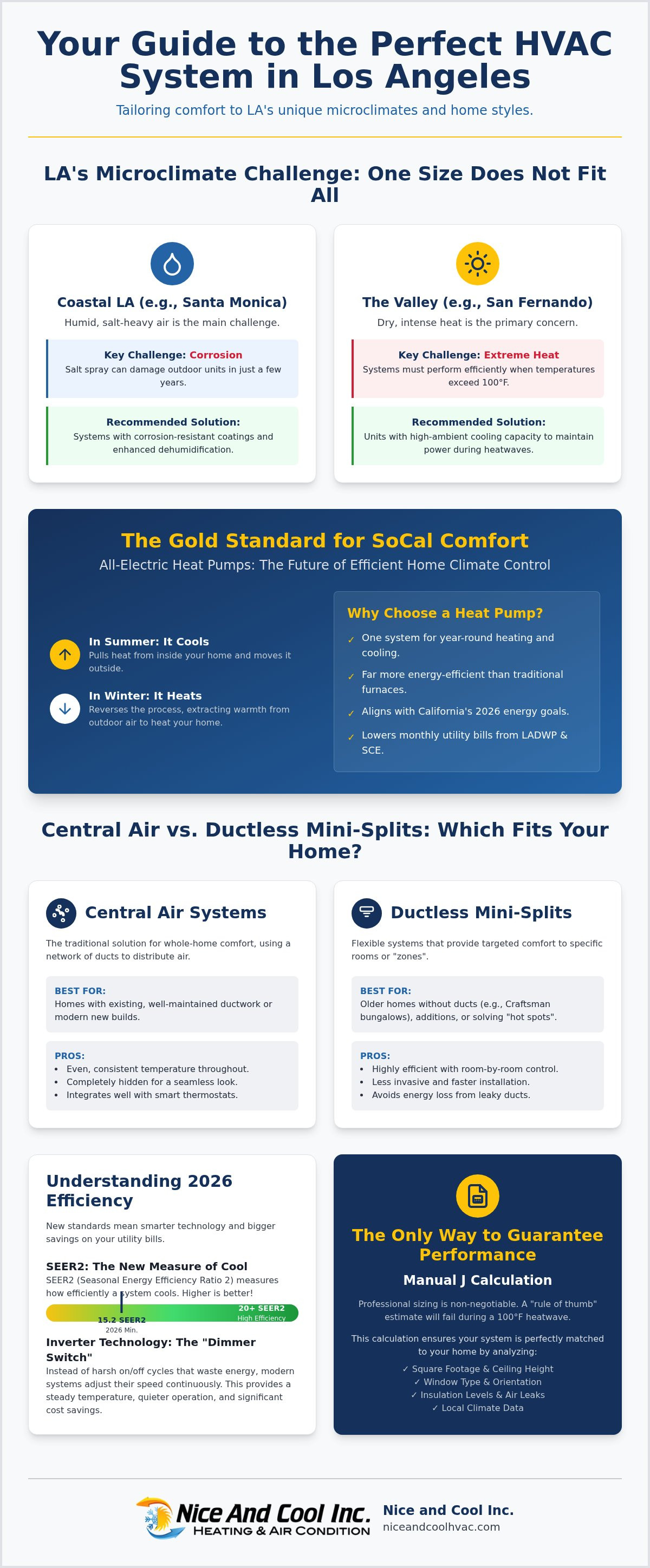
Los Angeles isn't just one city; it's a patchwork of distinct environments. If you're searching for the best hvac system for los angeles homes, you first need to look at your specific zip code. A system designed for a beach bungalow in the South Bay will struggle to keep up with a heatwave in the San Fernando Valley. Most national advice ignores these microclimates, but local experience shows that "one-size-fits-all" installations often lead to premature equipment failure and skyrocketing utility bills. Modern HVAC systems must be tailored to the specific atmospheric challenges of your neighborhood to ensure long-term reliability.
Coastal LA vs. The Valley: Different Needs
Whether you're in Santa Monica or Malibu, the marine layer brings salt-heavy air that can corrode standard outdoor units in just a few years. We recommend choosing systems with specialized corrosion-resistant coatings to protect the condenser coils from the "salt spray" effect. This level of environmental protection is a standard practice in other humid coastal regions as well; for instance, GAP Mechanical specializes in these types of durable HVAC solutions for homeowners facing the intense heat and moisture of Florida. Conversely, if your home is in Woodland Hills or Burbank, your priority is high-ambient cooling capacity. You need a system rated to perform efficiently when temperatures exceed 100°F without losing cooling power. Humidity also plays a role. Coastal homes often require enhanced dehumidification settings to prevent that "clammy" indoor feeling, while Valley homes focus on raw cooling power to combat dry, desert-like heat.
Older Bungalows vs. Modern LA New Builds
The architecture of your home dictates the installation strategy. Historic Spanish-style or Craftsman bungalows often lack the attic space or crawlspace needed for traditional large-scale ductwork. In these cases, retrofitting a central air system can be invasive and expensive. We often suggest ductless mini-split systems for these older properties because they provide targeted cooling without damaging the home's historic integrity. Modern new builds with open-concept floor plans present a different challenge. These homes require precise airflow balancing to ensure the kitchen doesn't stay warm while the living room freezes. By using a Manual J calculation, we can size the equipment perfectly for your square footage and ceiling height, ensuring the best hvac system for los angeles homes is the one that fits your specific floor plan.
Heat Pumps: The Gold Standard for Southern California in 2026
As Los Angeles moves toward a greener future, the technology under your roof is changing. For many residents, the best hvac system for los angeles homes is no longer a separate furnace and air conditioner. Instead, the all-electric heat pump has emerged as the preferred choice for 2026. This shift is driven by California's aggressive decarbonization goals and the 2022 Energy Code, which encourages homeowners to move away from gas-powered appliances. Because our winters rarely see freezing temperatures, a heat pump doesn't need to work hard to keep you warm, making it far more efficient than a traditional gas furnace.
Modern heat pumps are designed for both high-performance cooling and reliable heating. Heat pumps move heat from one place to another rather than creating it through combustion or electric resistance. During a scorching July afternoon, the system pulls heat out of your home and releases it outside. In the winter, it reverses the process, extracting warmth from the outdoor air to keep your living room cozy. It's an elegant, single-unit solution that simplifies your home maintenance while providing superior comfort.
Energy Efficiency and Cost Savings
Transitioning to a heat pump can lead to noticeable changes in your monthly utility bills. Most high-efficiency models now utilize inverter technology, which allows the system to scale its power up or down like a dimmer switch rather than just turning on and off. This prevents the massive energy spikes associated with older units. If you're looking to lower your LADWP or SCE costs, choosing the best hvac system for los angeles homes often involves selecting a unit that meets the 2026 minimum of 15.2 SEER2. These systems maintain a steady temperature with less effort, which is especially helpful during our extended 100°F heatwaves. To complement your new unit with broader efficiency improvements, check out Underline Energy Concepts for expert roofing and electrical upgrades designed for Southern California homes.
Navigating the financial side of a new installation requires a bit of local knowledge. While the federal Section 25C tax credit expired at the end of 2025, Los Angeles residents can still access substantial local incentives. For example, LADWP currently offers rebates ranging from $1,000 to $1,250 per ton for ducted systems, and up to $2,500 per ton for ductless mini-splits. Stacking these rebates can significantly reduce your initial investment. To get a full breakdown of how these incentives apply to your property, explore our Heat Pump Installation in Los Angeles: The Complete 2026 Homeowner’s Guide. If you're ready to see if your home is a candidate for electrification, our team can help you evaluate our Heat Pump Services to find the right fit for your neighborhood.
Central AC vs. Ductless Mini-Splits: Which Fits Your Home?
Whether you’re renovating a mid-century home in Silver Lake or maintaining a property in the Valley, your existing infrastructure often dictates the best hvac system for los angeles homes. The choice typically comes down to how your home is currently built and how much control you want over individual rooms. Most national guides suggest that central air is always the standard, but in the unique landscape of Los Angeles real estate, ductless technology is often the more practical and cost-effective path forward.
When to Stick with Central Air
The importance of finding a specialist who understands local building styles is universal. For homeowners in the UK, Essex Home Air Conditioning provides professional residential installation services that ensure cooling systems are perfectly matched to the local environment.
If your house already has a network of well-insulated, modern ducts, a central air conditioning system is usually the most logical choice. Central systems excel at providing a uniform temperature across every room simultaneously. They also offer superior opportunities for Improving Indoor Air Quality through high-MERV filtration systems that capture dust, pollen, and wildfire smoke before they circulate. If your ductwork is older than 15 years, it might be leaking up to 30% of your conditioned air into the attic. In this situation, you must decide whether to invest in duct repair or transition to a new setup. For a deeper look at the logistics of these systems, check out our guide to Air Conditioning Installation in Los Angeles: The Full 2026 Homeowner’s Guide.
The Benefits of Multi-Zone Mini-Splits
Ductless mini-splits have seen a massive surge in popularity across LA County, especially for homes with "trouble spots." If you have a two-story home where the upstairs remains stubbornly hot while the downstairs freezes, a multi-zone mini-split can solve the problem without the need for massive renovations. These systems allow you to control the temperature of each room independently. This room-by-room control is a game-changer for energy savings. Whether you're working from a home office or have built a new ADU for family, you only pay to cool the space you’re actually occupying. Mini-splits are also the quietest option on the market. In dense Los Angeles neighborhoods where outdoor units are often placed close to bedroom windows or property lines, the whisper-quiet operation of a mini-split prevents noise complaints and ensures a better night's sleep.
Aesthetics also play a role in your final decision. Central air is virtually invisible, utilizing hidden vents that blend into the ceiling or floor. Mini-splits require wall-mounted air handlers, though modern designs are increasingly sleek and unobtrusive. If you value a minimalist look, central air wins; if you value precision, efficiency, and the ability to solve uneven cooling, ductless is likely the best hvac system for los angeles homes for your specific needs.
2026 Performance Metrics: SEER2 and Indoor Air Quality
Selecting the best hvac system for los angeles homes involves looking beyond the brand name and focusing on performance metrics. In 2026, the industry has fully transitioned to the SEER2 testing standard, which provides a more accurate representation of how equipment performs under real-world conditions. Whether you live in the breezy South Bay or the sun-drenched Valley, these numbers directly impact your long-term comfort and your home’s resale value. A system that meets or exceeds current standards ensures you aren't left with obsolete technology that struggles during a record-breaking August heatwave.
Understanding SEER2 Ratings
For property owners looking to explore energy-efficient water-based heating solutions, you can learn more about specialized design and installation services for residential and commercial buildings.
If you're replacing a unit installed ten years ago, you'll notice that the old SEER ratings have been replaced by SEER2. This new system uses more rigorous testing that accounts for the static pressure of your ductwork. For the Southwest region in 2026, the minimum required efficiency for new residential split-system air conditioners is 14.3 SEER2, while heat pumps must meet at least 15.2 SEER2. A higher SEER2 rating is essential for Valley homes because the equipment must work harder for longer periods, making every point of efficiency a major contributor to your monthly savings. However, it's vital to find the "sweet spot" where the higher upfront cost of ultra-efficient equipment is actually justified by your projected energy savings over the next decade.
One common mistake we see in Los Angeles is "over-sizing" the system. Homeowners often believe that a bigger unit will cool the house faster. In reality, a unit that is too large for your square footage will "short cycle," turning on and off too quickly to remove humidity from the air. This leads to a home that feels cold but clammy. This tailored approach ensures you get the best hvac system for los angeles homes without paying for power you don't need.
Wildfires and Air Filtration
In Southern California, our HVAC systems do more than just regulate temperature; they act as the first line of defense against outdoor pollutants. Wildfire season and Santa Ana wind events can significantly degrade your home's air quality. We now consider MERV 13+ filtration a standard for any modern installation. These filters are dense enough to capture the fine particulate matter found in smoke, which standard filters often miss. If you live in an area prone to brush fires or high dust levels, integrating a whole-home air purifier into your system can provide an extra layer of protection by neutralizing airborne pathogens and odors. Our specialists can help you integrate these Indoor Air Quality Solutions into your home today to ensure your family breathes easier year-round.
Expert Installation and Long-Term Reliability
Choosing high-efficiency equipment is only half the battle. Even the best hvac system for los angeles homes will underperform if the installation isn't handled with precision. At Nice and Cool Inc., we believe professional sizing through a Manual J load calculation is non-negotiable. To ensure your investment remains protected, you can explore Bilge Minder for remote monitoring systems that alert you to potential issues with HVAC units and other critical equipment. This process takes into account more than just your square footage; it evaluates the specific thermal characteristics of your property. Without this level of detail, you risk ending up with a system that cycles too often or fails to keep your second floor comfortable during a heatwave.
A proper load calculation considers several local factors:
- The quality and age of your home's insulation.
- The orientation of your windows relative to the intense afternoon sun.
- Local shade from trees or neighboring buildings.
- The airtightness of your existing ductwork.
The technical expertise required for such precise work is a testament to the specialized training available in the industry. For those looking to enter this high-demand field, you can explore Vocational Trade Tuition at the National Technical Institute (NTI) to see how modern technicians are prepared for these complex mechanical challenges.
Our approach has been refined over two decades of serving local neighborhoods. Since 2005, we've specialized in residential solutions that address the specific quirks of Southern California properties. We focus on preventing the most common local service calls, such as frozen coils caused by improper airflow or clogged condensate lines that can lead to water damage. By getting the installation right the first time, we ensure your investment provides the quiet, reliable operation you expect when the thermometer hits triple digits. This same standard of reliability is vital for your vehicle during extreme weather, and sites like nwhoustonautorepair.com offer guidance on maintaining your car's battery and electrical health to avoid summer breakdowns.
There's a significant advantage to working with a family-owned specialist rather than a massive national franchise. We understand the unique challenges of LA's housing stock, from retrofitting 1920s bungalows to optimizing modern open-concept builds. We also handle the heavy lifting of navigating LA City and County permitting, ensuring your replacement is fully compliant with 2026 regulations. If you're currently dealing with equipment issues, you might find our AC Not Blowing Cold Air in Los Angeles? 2026 Homeowner’s Troubleshooting Guide helpful for identifying the root cause.
Next Steps: Consultation and Maintenance
Long-term reliability doesn't end on installation day. To protect your investment and maintain your manufacturer's warranty, documented routine care is essential. This is why we created the Nice and Cool Club Maintenance Plan. It provides the consistent, professional attention your system needs to survive our dusty summers and damp winters. Beyond HVAC, keeping your other household machines in top shape is equally important, and services like Rhino Appliance Repair can provide the expert care needed for your kitchen and laundry units. When you're ready to upgrade, our professional home comfort assessment will give you a clear roadmap for your property. You can schedule your expert HVAC consultation with Nice and Cool Inc. today to ensure your home stays perfectly conditioned for years to come.
Beyond climate control and appliance maintenance, many homeowners also choose to explore Custom Pool Design and Construction as a way to further increase their property's appeal and fully enjoy the sunny California weather.
Similarly, if you maintain a secondary residence in a snowy climate, Utah Heat Cable offers specialized snow melt systems to prevent the formation of ice dams and protect your property throughout the winter.
In addition to climate control, ensuring your home's water systems are properly maintained is vital for long-term comfort, and you can explore Plumbing Repair and Installation Services for expert guidance on plumbing and water heater care.
Furthermore, if you are overseeing a commercial project or new construction, you can learn more about the specialized HVAC and mechanical services available through J3 Mechanical Services.
Additionally, for those overseeing new construction or commercial upgrades, Firemex Solutions Inc. provides essential fire sprinkler system design and installation services to ensure long-term safety.
For residents in the San Gabriel Valley seeking comprehensive property care, Hardworking Handyman™ LLC offers professional home repair and maintenance services to ensure your entire house remains in peak condition.
Transitioning to a new heating and cooling setup is a significant decision for any local homeowner. Whether you’re opting for the high-efficiency performance of a modern heat pump or the room-by-room precision of a ductless mini-split, the best hvac system for los angeles homes is ultimately the one that’s been tailored to your specific neighborhood and property layout. By choosing equipment that meets the latest SEER2 standards and prioritizing indoor air quality, you’re not just lowering your monthly utility bills; you’re protecting your family’s health and your property’s future value.
Since 2005, our family-owned and operated team has focused on providing reliable, high-performance solutions that withstand the unique demands of the Southern California climate. We take immense pride in our community roots and remain committed to helping our neighbors navigate complex 2026 regulations with ease. Through the Nice and Cool Club Maintenance Plan, we stay by your side long after the initial installation is complete to ensure your continued peace of mind. Ready for a cooler home? Contact Nice and Cool Inc. for a tailored HVAC quote today. We look forward to helping you stay comfortable through every LA heatwave.
Frequently Asked Questions
What is the most energy-efficient HVAC system for Los Angeles?
Variable-speed heat pumps are currently the most efficient choice for our local climate. These systems don't just turn on and off; they adjust their output to match your home's exact cooling needs in real-time. When searching for the best hvac system for los angeles homes, look for units with high SEER2 ratings. These systems excel in LA because our temperate winters allow them to provide heating without the high energy consumption of traditional gas furnaces. For those curious about how high-performance cooling systems are maintained in even more demanding desert environments, you can learn more about AirConService24.com and their approach to professional AC services.
You can save significantly through local utility programs. For 2026, LADWP offers rebates between $1,000 and $1,250 per ton for qualifying ducted heat pump systems. If you choose a ductless mini-split, those rebates can increase to $1,500 or even $2,500 per ton depending on the unit's efficiency. Stacking these with potential state incentives can drastically lower your initial investment while providing long-term utility savings for your Los Angeles property. While California focuses on electric heat pump incentives, those maintaining traditional gas systems can learn more about Gas2Heat.com Ltd for expert guidance on boiler efficiency and gas services.
Is a ductless mini-split better than central AC for an old LA home?
Whether a mini-split is better depends on your home’s existing infrastructure. Many historic LA homes lack the attic space for modern ductwork, making ductless systems the superior choice. They avoid the energy loss associated with leaky ducts and allow for room-by-room temperature control. If your home has a Spanish-style or Craftsman layout with inconsistent cooling, a mini-split often provides a more effective and less invasive solution than traditional central air. For homeowners seeking specialized expertise in these types of residential installations, D-technix offers professional guidance on choosing the right air conditioning and heat pump systems for private properties.
The 2026 minimum standard for the Southwest region is 14.3 SEER2 for air conditioners and 15.2 SEER2 for heat pumps. However, for homes in the San Fernando Valley, we recommend aiming for 18 SEER2 or higher. The extreme summer heat in areas like Northridge or Woodland Hills means your system runs longer; a higher efficiency rating will pay for itself much faster through lower monthly LADWP bills compared to a base-model unit. For those living in other high-heat areas of the Southwest, ProServ Las Vegas provides specialized solutions to ensure cooling systems remain efficient and reliable during record-breaking heatwaves.
You should have your system professionally serviced twice a year, ideally once in the spring and once in the fall. Our local environment is particularly dusty, and coastal salt air can accelerate wear on outdoor components. Regular maintenance helps prevent common issues like clogged condensate lines or frozen coils. Joining a program like the Nice and Cool Club Maintenance Plan ensures these checks happen on schedule, protecting your warranty and extending the equipment's lifespan. For those looking to maintain other critical home systems, you can learn more about comprehensive plumbing care to keep your entire property in top condition.
Yes, modern systems are highly effective at improving indoor air quality during wildfire season. By installing high-performance MERV 13 filters, your HVAC system can capture fine smoke particles and allergens that older units miss. For even greater protection, we can integrate whole-home air purifiers that neutralize pollutants. This is a critical consideration for the best hvac system for los angeles homes, especially for families living near brush-heavy hillsides or high-traffic corridors.
Can I install a heat pump if I currently have a gas furnace?
Can I install a heat pump if I currently have a gas furnace?
You can definitely switch to a heat pump even if you currently use a gas furnace. Most homeowners choose a full conversion to all-electric to take advantage of significant rebates and reduce their carbon footprint. Alternatively, a dual-fuel system allows you to keep a gas backup for the rare chilly night while using the electric heat pump for cooling and moderate heating. We can evaluate your existing electrical panel to ensure it supports the transition; companies specializing in home automation and modern electrical systems, such as BE-Élec49, highlight how essential a robust electrical foundation is for these advanced upgrades.
A standard residential HVAC installation typically takes between one and three days to complete. If you are simply replacing an existing central unit, we can often finish the job in a single day. However, if your project involves extensive ductwork repair, electrical upgrades for a new heat pump, or installing multiple zones for a ductless system, it may take longer. We always provide a clear timeline after our initial home comfort assessment.
Frequently Asked Questions
Variable-speed heat pumps are currently the most efficient choice for our local climate. These systems don't just turn on and off; they adjust their output to match your home's exact cooling needs in real-time. When searching for the best hvac system for los angeles homes, look for units with high SEER2 ratings. These systems excel in LA because our temperate winters allow them to provide heating without the high energy consumption of traditional gas furnaces.