How to Choose a Reliable HVAC Contractor in LA: A 2026 Homeowner’s Guide
June 26, 2026 16 min read
In the sprawling Los Angeles market, a flashy billboard or a high-pressure sales pitch doesn't guarantee a cool home. It often just leads to a system that fails when the Santa Ana winds kick in. Knowing how to choose a reliable HVAC contractor in LA is no longer just about basic comfort; it's about protecting your investment against rising energy costs and complex 2026 regulations.
You've likely felt the frustration of contractors who care more about closing a deal than calculating your home's actual cooling load. Whether you're dealing with "solar cowboys" who provide subpar mechanical work or you're just trying to make sense of the latest Title 24 energy codes, the process can feel overwhelming. We want to help you cut through the noise so you can find a partner who values craftsmanship over shortcuts.
This guide walks you through the essential steps of verifying C-20 licenses, understanding the industry shift to A2L refrigerants, and ensuring your new system meets the strict 15.2 SEER2 efficiency standards. By the end, you'll have the confidence to select a specialist who ensures your home remains efficient, compliant, and comfortable for the long haul.
Key Takeaways
- Discover why the lowest bid in Southern California often leads to higher long-term costs and how to avoid common high-pressure sales tactics.
- Learn the importance of verifying a current C-20 license and why NATE certification remains the industry gold standard for technical expertise.
- Master how to choose a reliable HVAC contractor in LA by learning to spot red flags in quotes and comparing efficiency ratings for long-term savings.
- Understand why a professional Manual J load calculation is essential to prevent the efficiency losses and humidity issues caused by oversized equipment.
- Gain peace of mind by identifying contractors who prioritize tailoring systems to your home's specific needs rather than pushing one-size-fits-all solutions.
Navigating the Los Angeles HVAC Market: Why Reliability Matters
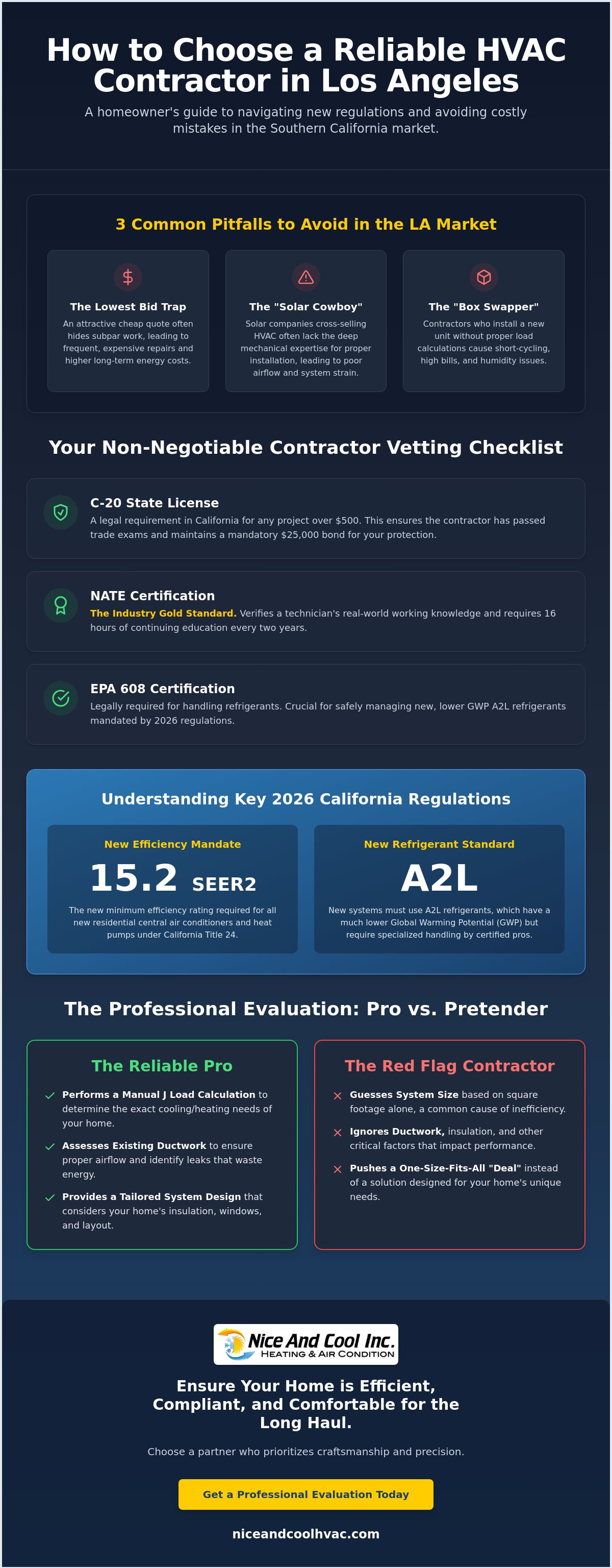
Los Angeles presents a unique set of challenges for any Heating, ventilation, and air conditioning (HVAC) system. From the salty air of Santa Monica to the blistering triple-digit heat of the San Fernando Valley, your equipment works harder here than in almost any other part of the country. During peak summer months, demand for service skyrockets, and many homeowners feel pressured to make quick decisions. However, understanding how to choose a reliable HVAC contractor in LA is the only way to avoid the "lowest bid" trap. While a cheap quote might look attractive on paper, it often leads to higher long-term costs through frequent repairs and inefficient operation.
A professional HVAC system designer differs significantly from a "box swapper." A box swapper simply removes your old unit and drops in a new one without looking at your home's specific needs. Whether you live in a historic Craftsman or a modern condo, your home requires a tailored approach. A reliable contractor takes the time to evaluate your home's thermal envelope, ensuring that your new system protects both your property value and your indoor air quality by maintaining proper humidity and filtration levels.
The "Solar Cowboy" Phenomenon in Southern California
The recent push for electrification has brought a wave of "solar cowboys" into the market. These are companies that primarily sell solar panels but cross-sell HVAC services to boost their profits. They often lack the deep mechanical expertise required for complex installations. If you hire a non-specialist, you risk poor ductwork integration that can choke your system's airflow. Specialized HVAC providers offer better long-term repair support because they understand the intricate mechanics of the machinery, not just how to wire it to a roof.
The Impact of HVAC Reliability on LA Energy Bills
Your monthly expenses are directly tied to the quality of your installation. If your unit is improperly sized or installed, it will likely suffer from "short-cycling," where it turns on and off too frequently. This behavior causes your LADWP or SCE bills to spike and significantly shortens the lifespan of your expensive equipment. High-quality installation ensures your unit runs in smooth, efficient cycles that keep costs down. A professional AC installation in Los Angeles ca requires a local expert who understands coastal vs. valley microclimates. Learning how to choose a reliable HVAC contractor in LA means finding someone who prioritizes this level of precision over high-volume sales.
Verifying Credentials: C-20 Licenses, NATE, and California Compliance
When you're researching how to choose a reliable HVAC contractor in LA, the first step is always the C-20 license. The California C-20 Warm-Air Heating, Ventilating and Air-Conditioning license is a legal requirement for any project where labor and materials exceed $500. It's not just a piece of paper; it ensures the contractor has passed specific trade exams and maintains a mandatory $25,000 contractor's bond. California's official guide to hiring a contractor provides a clear checklist for homeowners to confirm these details before any work begins on their property.
Learning how to choose a reliable HVAC contractor in LA also means looking for technicians who carry NATE (North American Technician Excellence) certification. This is the industry gold standard. It requires rigorous testing and must be renewed every two years with 16 hours of continuing education. Additionally, verify that the team holds EPA 608 certification. As of January 1, 2026, new residential systems are generally expected to use A2L refrigerants. These have a lower Global Warming Potential but require specialized handling that only certified professionals should manage. If you're looking for a partner who prioritizes these safety and efficiency benchmarks, our team at Nice and Cool Inc. is here to help.
California Title 24 and Local Permit Requirements
As of January 1, 2026, new statewide HVAC regulations under Title 24 are in full effect. These standards mandate a minimum efficiency of 15.2 SEER2 for central air conditioners and heat pumps. A reliable contractor will never suggest "skipping the permit" to save money. Permits are essential for your safety and home's resale value. In Los Angeles, a typical permit costs between $200 and $400. This process includes mandatory HERS (Home Energy Rating System) testing. For altered systems with 40 or more linear feet of new ductwork, Title 24 requires that total duct leakage not exceed 15%. This verification protects you from the energy waste caused by poor installation.
Insurance and Bonding: Protecting Your Property
There's a significant difference between being "licensed" and being "insured and bonded." Always ask for a Certificate of Insurance (COI) that shows both general liability and workers' compensation coverage. Liability insurance protects your home if a technician accidentally causes damage, while workers' comp ensures you aren't held responsible if a crew member is injured on your property. Professional bonding adds another layer of security, protecting you against unfinished or substandard work. A trustworthy local specialist will provide these documents without hesitation, giving you the peace of mind that your investment is fully protected.
How to Compare HVAC Quotes and Spot Red Flags
Once you've narrowed your list to a few licensed professionals, the next step in learning how to choose a reliable HVAC contractor in LA is evaluating the actual bids. A quote is more than just a price tag; it's a blueprint of the service and quality you should expect. If a contractor provides a vague, one-page document with a single bottom-line number, it's often a sign that they're cutting corners on the planning phase. You deserve a clear, itemized breakdown that allows you to compare apples to apples.
To find the best value for your home, follow these five steps when reviewing any proposal:
- Step 1: Request an itemized breakdown. Ensure the quote lists specific costs for equipment, labor, permits, and materials. This transparency prevents "hidden fees" from appearing on your final invoice.
- Step 2: Compare SEER2 ratings and brands. In 2026, the California baseline is 15.2 SEER2. Whether you're looking at a standard central unit or a high-efficiency heat pump, verify that the model numbers on the quote match the efficiency ratings promised.
- Step 3: Evaluate the warranties. Distinguish between the manufacturer’s warranty on parts and the contractor’s warranty on labor. A reliable specialist will stand behind their craftsmanship for at least one to two years.
- Step 4: Check for essential extras. Does the bid include a new smart thermostat, or does it account for the mandatory duct sealing required by Title 24? These details can significantly impact your total cost.
- Step 5: Review the payment schedule. Avoid contractors who demand large upfront deposits. In California, the legal limit for a down payment is typically 10% or $1,000, whichever is less.
The Danger of "Ballpark" Quotes Over the Phone
A professional cannot accurately price a system without seeing your home. Every property has unique ductwork configurations, insulation levels, and electrical needs. If a company gives you a firm price over the phone, they're likely using a "bait and switch" tactic. They'll attract you with a low number, only to "discover" expensive complications once the old unit is already removed. A trustworthy expert will always insist on a physical site visit before finalizing a bid.
Identifying High-Pressure Sales Tactics
You should never feel rushed into a five-figure investment. Warning signs of an unreliable provider include "today only" discounts or aggressive follow-up calls designed to wear you down. There is a clear difference between a helpful consultant who explains your options and a commissioned salesperson who just wants a signature. When you're deciding how to choose a reliable HVAC contractor in LA, look for a partner who gives you the space and information needed to make an informed choice for your family's comfort.
The Professional Evaluation: Sizing and Ductwork Assessment
A high-quality installation begins long before the first tool touches your home. When you are learning how to choose a reliable HVAC contractor in LA, you must look for a team that prioritizes engineering over guesswork. Many contractors still rely on outdated "rules of thumb," such as assigning one ton of cooling for every 500 square feet. This approach is fundamentally flawed because it ignores the unique architectural details of your property. A reliable specialist will perform a thorough physical evaluation to ensure your new system is tailored to your specific environment.
This evaluation should include a deep dive into your home's thermal characteristics. Whether you have original single-pane windows in a historic bungalow or modern energy-efficient glazing, these factors change the math of your cooling needs. A professional will also inspect your attic insulation levels and the orientation of your home relative to the afternoon sun. If a contractor skips these steps, they're likely to sell you a system that doesn't fit your needs, leading to years of avoidable discomfort and high utility bills.
Sizing Your System for Los Angeles Weather
In the HVAC world, bigger is rarely better. If your system is oversized for your home, it will suffer from constant short-cycling. This means the unit turns on, cools the air quickly, and shuts off before it can properly dehumidify your living space. This leaves you with a home that feels "clammy" and air that isn't properly filtered. A Manual J calculation is the only way to mathematically ensure system comfort by accounting for every thermal variable in your specific home layout. By correctly sizing the unit, you ensure it runs in long, efficient cycles that maintain a steady temperature and lower your SCE or LADWP expenses.
Assessing Ductwork and Indoor Air Quality
Even the most advanced 2026 heat pump will fail to perform if it's connected to leaking or undersized ductwork. A reliable contractor will always test your existing ducts for integrity before suggesting a replacement unit. In Los Angeles, where smog and seasonal wildfire smoke are constant concerns, your ductwork plays a critical role in your health. Whether you live near a major freeway or in a valley prone to dust, integrating indoor air quality solutions is vital to combat local pollutants. Modern systems can be fitted with HEPA-grade filtration and UV lights to neutralize allergens and bacteria. To get a precise assessment of your home's needs, schedule a professional load calculation with the experts at Nice and Cool Inc. today.
Why Nice and Cool Inc. is the Reliable Choice for LA Homeowners
The HVAC industry in Southern California has undergone a significant transformation. Many once-local companies are now owned by private equity groups that prioritize high-volume sales over individual craftsmanship. When you're researching how to choose a reliable HVAC contractor in LA, it's vital to understand this dynamic. At Nice and Cool Inc., we've remained a family-oriented business because we value a neighborly service model. We don't view our clients as data points on a corporate spreadsheet. Instead, we focus on precision installations that provide long-term reliability for our community members.
Our deep roots in the Los Angeles area provide a level of personal accountability that larger franchises simply cannot match. Whether you need a simple fix or a complete system redesign, we provide transparent pricing and a detailed walkthrough of every project. We believe that if you understand the technical reasoning behind our recommendations, then you can make the best decision for your home's comfort. This commitment to honesty and quality is what sets a true local specialist apart from a high-volume sales machine.
Our Approach to Residential AC and Heat Pump Installation
We take immense pride in fitting modern technology to the diverse architecture of Los Angeles. Our expertise in heat pump installation allows us to help homeowners maximize available California rebates, including the substantial incentives offered by LADWP. We prioritize craftsmanship at every stage. On the day of your installation, our technicians follow a systematic process that respects your home and your time. We use protective coverings for your floors and perform a comprehensive final test of the system to ensure it meets the strict 2026 Title 24 standards before we consider the job finished.
The Nice and Cool Club Maintenance Plan
Finding a trustworthy professional is only the first step. To maintain that reliability, your system needs consistent, expert care. The Nice and Cool Club Maintenance Plan turns a one-time service into a long-term partnership. Whether you have a brand-new unit or an older system, preventative care is essential. It's the most effective way to avoid a sudden, mid-summer air conditioning repair los angeles ca. Our members receive priority scheduling and exclusive benefits, ensuring their homes stay cool even during the most intense heatwaves. When you decide how to choose a reliable HVAC contractor in LA, select a team that's dedicated to your comfort through every season of the year.
Secure Your Home’s Long-Term Comfort
Choosing the right partner for your home’s climate control is about more than just surviving the next heatwave. It’s about ensuring your system meets 2026 standards and operates at peak efficiency for years to come. By prioritizing C-20 licensing, insisting on a detailed Manual J load calculation, and avoiding high-pressure sales tactics, you’ve already mastered the essentials of how to choose a reliable HVAC contractor in LA.
At Nice and Cool Inc., we’ve been family-owned and operated since 2005. Our NATE-certified technicians focus on the precision installation and tailoring that your specific Southern California microclimate requires. Whether you’re upgrading to a high-efficiency heat pump or looking for long-term peace of mind through the Nice and Cool Club Maintenance Plan, we’re here to act as your trusted local guide. Experience the Nice and Cool difference; schedule your professional home evaluation today!
Your home deserves the care of a specialist who treats your property with the same pride they take in their own. We look forward to helping you stay cool and efficient through every season.
Frequently Asked Questions
How do I verify if an HVAC contractor is licensed in California?
You can verify a license by visiting the California Contractors State License Board (CSLB) website and entering the contractor's license number. Ensure they hold a current C-20 license in good standing. This search also confirms if they maintain the mandatory $25,000 contractor's bond and active workers' compensation insurance for their employees.
What questions should I ask an HVAC contractor during the initial interview?
Ask if they perform a Manual J load calculation and if they'll handle all necessary city permits. You should also inquire about their technicians' NATE certifications and whether they provide a written, itemized quote rather than a "ballpark" figure. These specific questions are essential when you're learning how to choose a reliable HVAC contractor in LA.
Do I really need a permit for a simple AC replacement in Los Angeles?
Yes, a permit is a legal requirement for any HVAC replacement in Los Angeles. It ensures your new system complies with Title 24 energy standards and includes a third-party safety inspection. If you skip this step, it can lead to complications during home appraisals or even cause your homeowner's insurance to deny future claims.
Why are some HVAC quotes so much higher than others for the same equipment?
Higher quotes typically reflect a more thorough installation process and better labor quality. While the equipment might be identical, a premium bid usually includes comprehensive ductwork sealing, proper sizing calculations, and the cost of pulling legal permits. Lower bids often cut corners on these critical steps, which leads to higher energy bills later.
What is the difference between a local family-owned HVAC company and a franchise?
Local family-owned companies generally prioritize long-term community reputation and personal accountability. Many franchises are owned by private equity groups that focus on high-volume sales and aggressive growth. If you prefer a tailored, neighborly approach where you aren't just another number, a local specialist is often the more reliable choice.
Should I choose a contractor based on Yelp or Google reviews alone?
Reviews are a helpful starting point, but they shouldn't be your only deciding factor. Look for detailed testimonials that mention technical expertise and problem-solving rather than just "friendly" service. Always cross-reference high ratings with the contractor's official CSLB status to ensure their licensing and insurance are currently valid.
What certifications should a reliable HVAC technician have in 2026?
A qualified technician in 2026 should hold NATE certification and an EPA 608 certification for handling modern A2L refrigerants. These credentials prove they've undergone rigorous testing and stay updated on the latest efficiency standards. A reliable contractor will be proud to share these qualifications with you during the bidding process.
How much of a deposit is reasonable for a new HVAC installation?
California law limits home improvement down payments to 10% of the total project price or $1,000, whichever is less. If a contractor demands a large upfront deposit before any work begins, it's a significant red flag. A trustworthy provider follows these legal limits and schedules remaining payments as specific project milestones are completed.
Frequently Asked Questions
The recent push for electrification has brought a wave of "solar cowboys" into the market. These are companies that primarily sell solar panels but cross-sell HVAC services to boost their profits. They often lack the deep mechanical expertise required for complex installations. If you hire a non-specialist, you risk poor ductwork integration that can choke your system's airflow. Specialized HVAC providers offer better long-term repair support because they understand the intricate mechanics of the machinery, not just how to wire it to a roof.