AC Fan Not Spinning? A 2026 Homeowner’s Troubleshooting Guide
August 26, 2026 18 min read
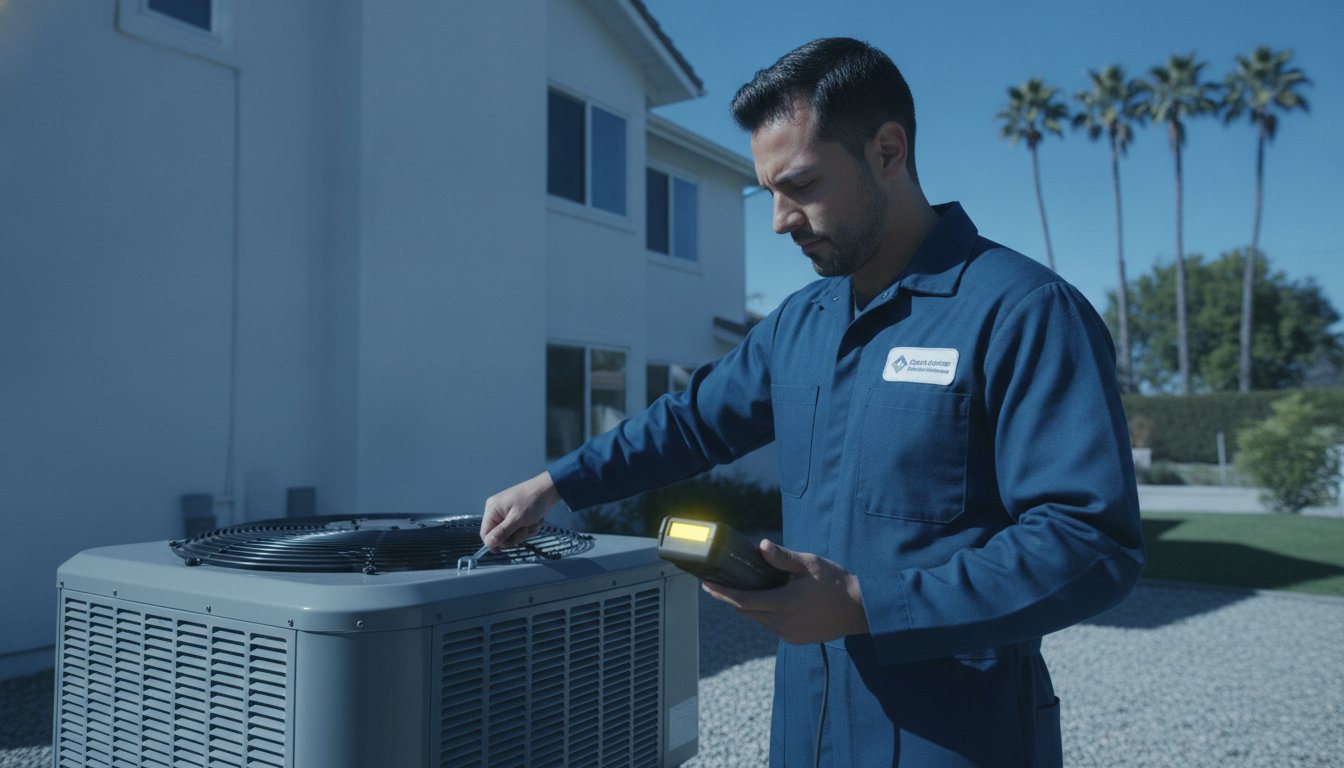
It is mid-afternoon in the middle of a Los Angeles heatwave, and your home is getting warmer by the minute. You step outside to check your unit, only to realize the ac fan not spinning despite the system being turned on. We understand how stressful this moment feels. It is natural to worry about the cost of a major repair or the possibility that your entire system has reached its end, especially when your family's comfort is at stake.
The good news is that a stationary fan does not always mean a total system failure. This guide will help you discover why your AC fan has stopped and teach you which simple fixes you can safely handle today versus when it is time to call a professional. We will cover everything from checking your breakers to identifying signs of a failing motor. You will also learn how the latest 2026 California energy regulations might affect your repair options, ensuring you have a clear understanding of the fault before making any decisions. Let's get your home back to the cool, comfortable haven it should be.
Key Takeaways
- Learn how to perform a simple power test to determine if a tripped breaker or thermostat setting is the reason behind your unit's silence.
- Identify the specific mechanical signs of a failed capacitor or contactor when you notice your ac fan not spinning.
- Master the "stick test" to safely diagnose whether your fan motor is seized or just needs a professional jumpstart.
- Discover how internal issues like frozen evaporator coils can force your outdoor unit to shut down to prevent permanent damage.
- See how joining the Nice and Cool Club Maintenance Plan helps you avoid expensive repairs by catching small electrical faults before they lead to a breakdown.
Initial Checks: Why Your AC Fan Might Be Dormant
Before you assume the motor has burned out, it's helpful to distinguish which part of your system is struggling. Most homeowners have two separate fans: the indoor blower that pushes air through your vents and the outdoor condenser fan. If you notice your ac fan not spinning on that large outdoor unit, the issue might be a simple communication error or a safety shutdown rather than a mechanical failure.
Thermostat and Power Source Troubleshooting
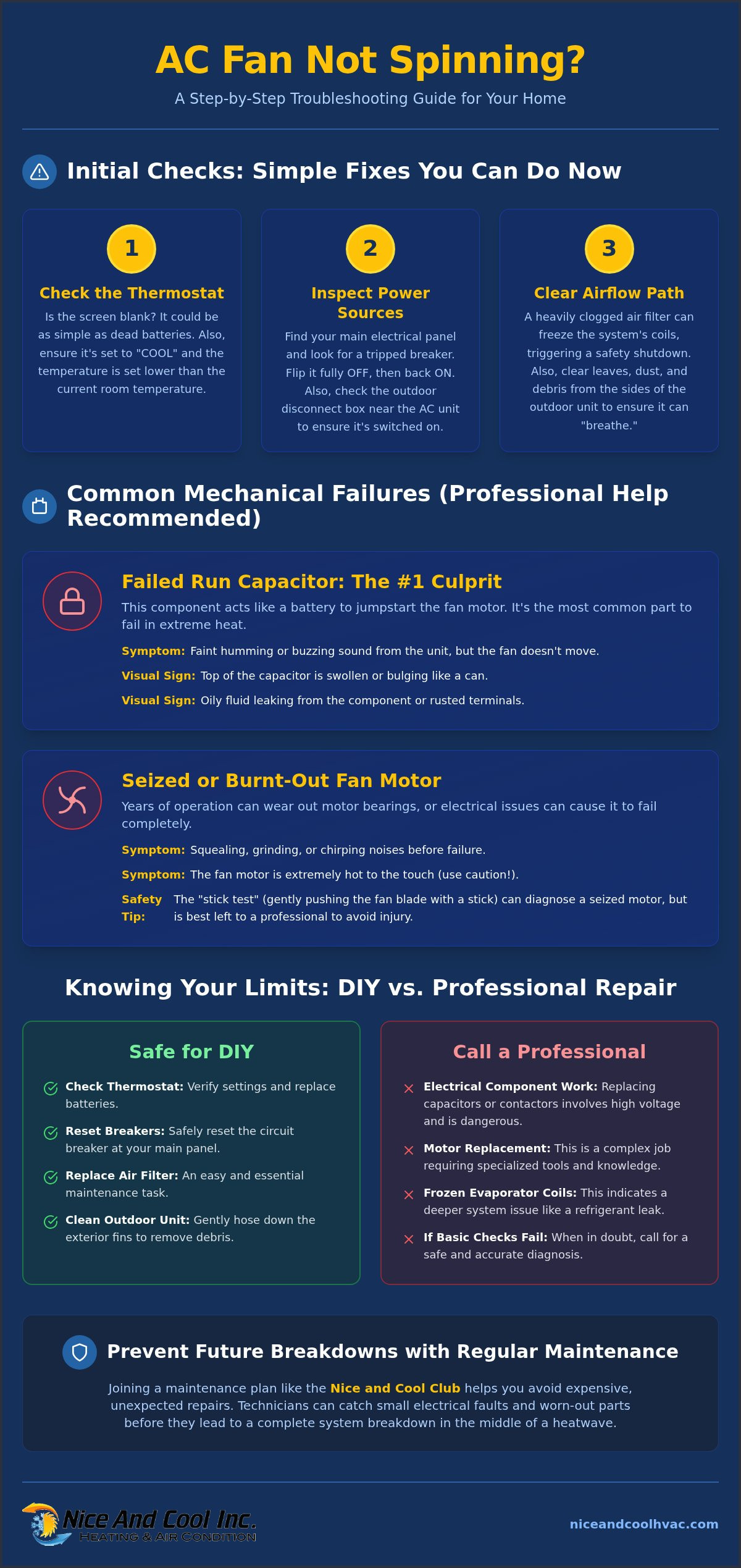
The first step is checking the "brain" of your system. If your thermostat screen is blank, then your fan will never receive the signal to start. This often happens because of dead batteries or a tripped float switch in your drain line. If the thermostat looks active, head to your main electrical panel. Look for a switch that is sitting in the middle position. If you find a tripped breaker, then flip it all the way off before clicking it back to the on position. It's a simple reset that solves more problems than you might think.
You should also inspect the outdoor disconnect box located near your unit. This box contains a pull-out handle or a switch and, in some cases, a set of fuses. If a fuse has blown, then the outdoor unit loses all power while the indoor unit continues to run. This creates a confusing situation where you hear the indoor blower humming inside but see no movement from the ac fan not spinning outside. Check whether the handle is fully seated and the switch is in the "on" position.
Airflow Restrictions and Safety Switches
A common reason for a total system stall is a neglected air filter. If a filter is heavily clogged, then the airflow across the evaporator coils drops significantly. This causes the coils to freeze into a block of ice. Once this happens, the system may trigger a safety shutdown to protect the compressor from damage. Understanding how air conditioning works helps clarify why this matters; without proper airflow, the heat exchange process fails, putting immense pressure on every component.
Modern units also feature a high-pressure switch. This is a protective "kill switch" that stops the fan if the system gets too hot. In Los Angeles, our seasonal winds can blow dust, leaves, and debris into the sides of your unit. If the metal fins are choked with dirt, then the unit cannot breathe and the internal pressure spikes. Clearing away this debris is a simple task that can sometimes restore function immediately. If these basic checks don't solve the problem, the fault likely lies deeper within the electrical components.
Deep Dive: Common Mechanical Failures in the Outside Unit
Once you have confirmed that your thermostat is working and the breakers are on, the focus shifts to the mechanical parts inside the condenser. If you see the ac fan not spinning despite hearing a faint hum, the issue is likely a failed start component or a seized motor. These parts endure significant stress during Southern California summers, where constant cycling can wear down even the most durable machinery.
The Run Capacitor: The Most Frequent Culprit
The run capacitor acts like a temporary battery for your fan motor. It stores an electrical charge and releases it in a powerful burst to give the fan the "jumpstart" it needs to spin. It also provides the consistent energy required to keep the blades moving at the correct speed. During record-breaking LA heatwaves, capacitors often overheat and fail. If you look at the top of the capacitor and see it bulging like a soda can under pressure, it has definitely failed. You might also notice rusted terminals or oily leaks around the base. If the capacitor is dead, then the motor will simply sit still and vibrate, creating a distinct humming sound as it waits for a boost that never comes.
Condenser Fan Motor Issues
If the capacitor tests fine but the fan remains dormant, the motor itself may have reached the end of its lifespan. Years of operation in our dusty environment can lead to worn-out bearings. You can often spot a failing motor by listening for squealing, grinding, or chirping noises in the days leading up to a total breakdown. In some cases, the fan might spin very slowly or become extremely hot to the touch. This heat is a clear sign that the motor is drawing too much electricity or is struggling against internal mechanical resistance. Whether the motor is electrically shorted or mechanically seized, a professional air conditioning repair is usually the most reliable way to restore your home's cooling.
Physical obstructions are another common, yet often overlooked, cause of failure. Our local Los Angeles wildlife, including small rodents or nesting birds, can occasionally find their way into the unit. Similarly, heavy debris from palm fronds or branches can wedge itself between the fan blades and the protective cage. If the blades cannot move freely, the motor will eventually overheat and shut down to prevent a fire. Always turn off the power at the outdoor disconnect box before you check for these types of physical blocks.
System-Wide Issues: When the Fan Stops Due to Other Failures
Sometimes the ac fan not spinning is actually a symptom of a larger communication breakdown within your cooling system. Instead of a mechanical failure in the fan itself, another component may have failed, triggering a safety shutdown or breaking the electrical circuit. In our experience serving Los Angeles, these secondary failures often stem from the unique combination of high heat and fine coastal dust that settles into sensitive electrical parts.
The Ice Factor: Frozen Coils and Fan Stoppage
It might seem counterintuitive to check for ice when it is 90 degrees in the San Fernando Valley, but frozen evaporator coils are a major cause of outdoor unit failure. If the indoor coils become a block of ice, the system can no longer effectively transfer heat. This often causes the compressor and the outdoor fan to stop running to prevent a catastrophic liquid slugging event, where liquid refrigerant enters the compressor. You can check for this by looking at the copper lines entering your outdoor unit; if they are covered in white frost, your system is frozen.
The "Thaw and See" method is a safe way to troubleshoot this at home. Turn your thermostat from "Cool" to "Off" and switch the fan setting from "Auto" to "On." This runs the indoor blower without the outdoor unit, allowing the ice to melt naturally. If your system was simply AC not blowing cold air Los Angeles before the fan stopped, a frozen coil was likely the culprit. Once the ice is gone, the outdoor fan may start spinning again, though you still need to address the low refrigerant or airflow issue that caused the freeze.
The Contactor: Your System's Electrical Gatekeeper
The contactor is a small, heavy-duty switch located inside the outdoor unit's service panel. When your thermostat calls for cooling, it sends a low-voltage signal to the contactor, which then pulls down a metal plunger to allow high-voltage power to reach the fan and compressor. Over years of heavy use, these metal points can become "pitted" or burnt, preventing a solid electrical connection. If you hear a loud chattering or clicking sound from the unit, but the ac fan not spinning remains an issue, the contactor is likely struggling to close the circuit.
In Los Angeles, we frequently see contactor failure caused by small pests. Argentine ants are notoriously attracted to the electromagnetic fields of HVAC components. They can crawl between the contact points, effectively blocking the electrical flow or causing the switch to burn out. Keeping the area around your condenser clear of vegetation and debris can help prevent these tiny intruders from grounding your system. If the contactor has failed, it must be replaced by a professional to ensure the high-voltage wiring is handled safely and according to current 2026 building codes.
DIY vs. Professional Repair: Knowing Your Limits in LA
When you are staring at an ac fan not spinning, the urge to find a quick DIY fix is strong. We understand that nobody wants to wait for a technician during a humid Los Angeles afternoon. However, your safety and the longevity of your equipment are the top priorities. While some minor issues like clearing debris are safe for homeowners, most electrical faults require specialized tools and training to resolve without causing further damage.
The 'Stick Test' Done Safely
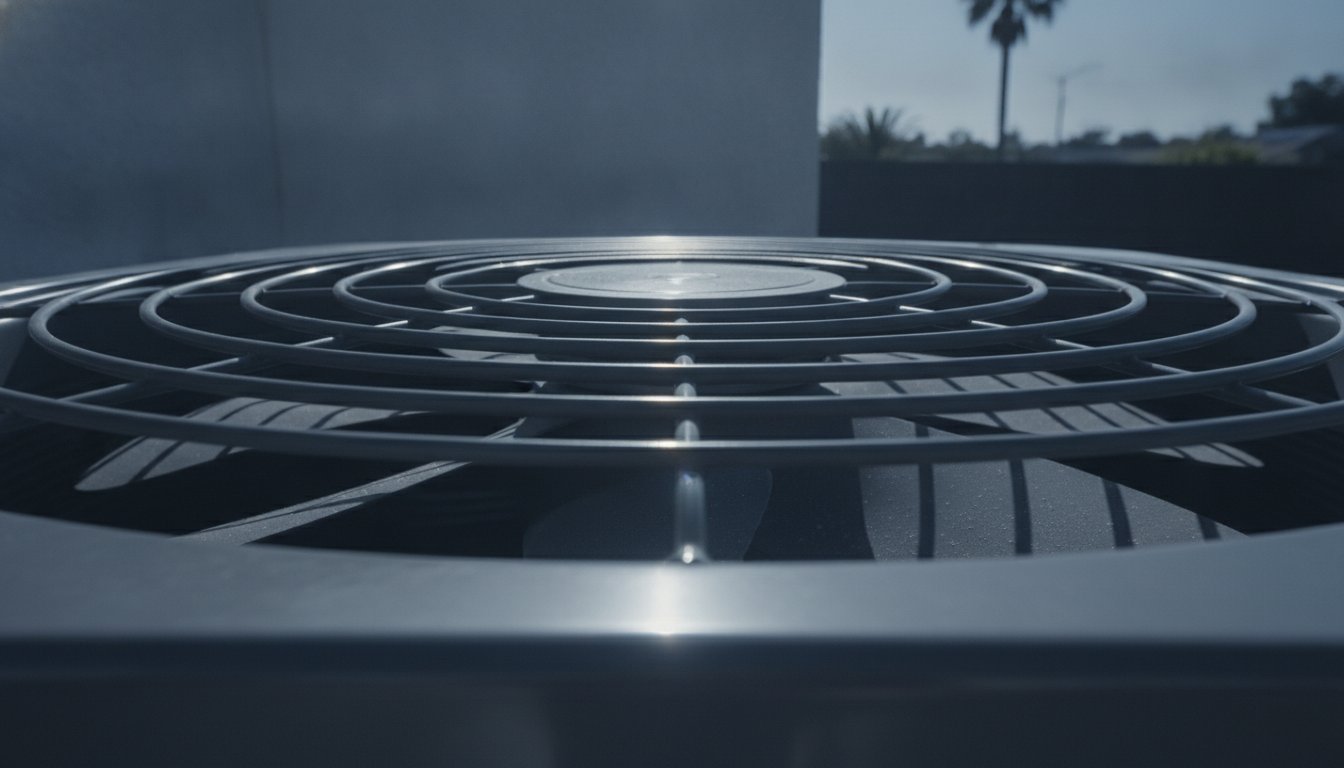
The "stick test" is a diagnostic procedure used to determine if a capacitor has lost the torque required to start the fan motor. To perform this, find a long, thin object like a wooden stick or a heavily insulated screwdriver. With the power turned on and the thermostat calling for cooling, gently push one of the fan blades through the top grille. If the fan begins to spin on its own after this nudge, then your capacitor is almost certainly dead.
- Warning: A fan that starts this way is not "fixed." It will stop again as soon as the cycle ends.
- Risk: Running a motor with a bad capacitor causes it to pull excessive amperage, which can lead to a permanent motor burnout within hours.
- Safety: Never use your fingers or any metal object that isn't insulated. The electrical components inside can hold a lethal charge even if the unit is off.
Why Professional Diagnosis Saves Money Long-Term
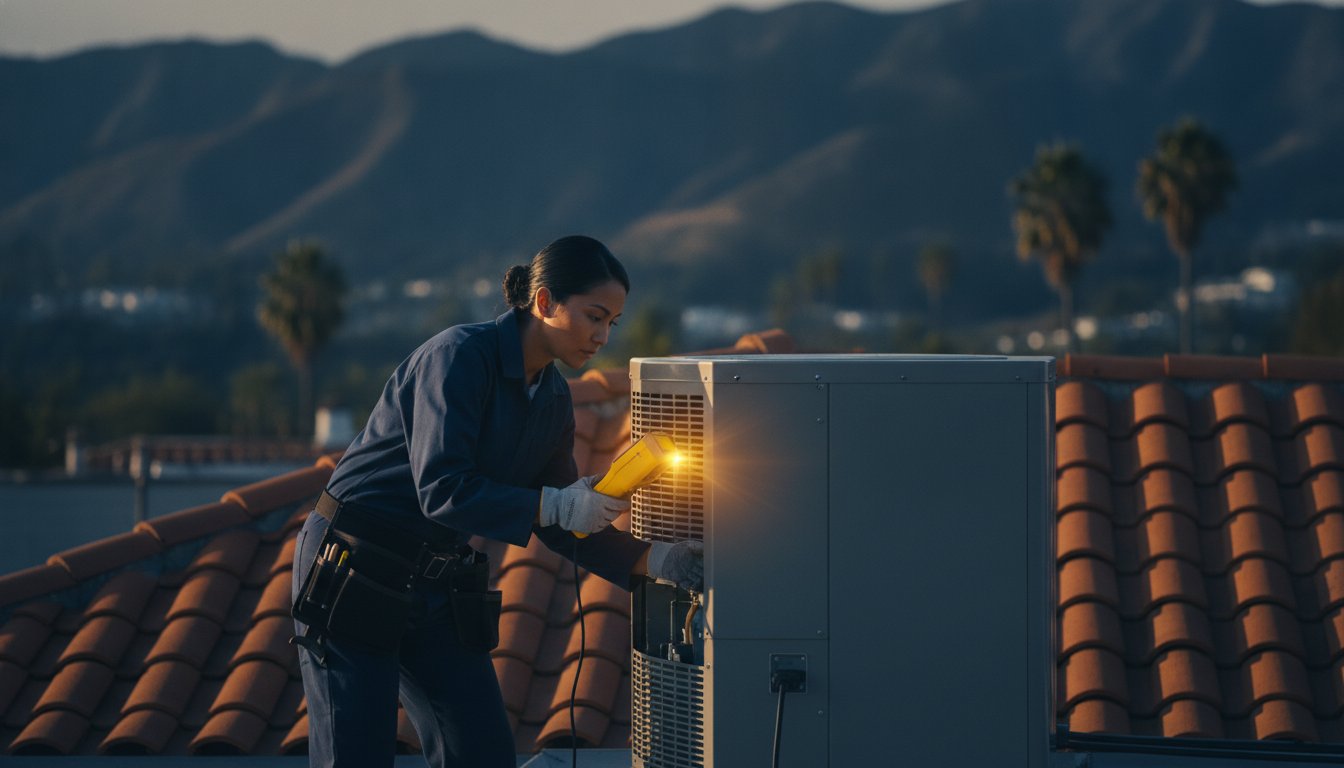
Many homeowners try to save money by guessing which part is broken and ordering replacements online. We call this the "parts cannon" approach, and it is often more expensive than a professional service call. You might replace the capacitor only to realize the real issue is a grounded motor or a faulty control board. Our technicians use precision multimeters to identify the exact point of failure, ensuring you only pay for the parts you actually need. Whether you need a simple component swap or more extensive air conditioning repair services, a professional diagnosis provides the accuracy a DIY approach lacks.
If your circuit breaker trips immediately after you reset it, then you must stop troubleshooting. This is a clear sign of a high-voltage short circuit or a seized compressor. Forcing the system to run in this condition can cause an electrical fire or ruin the most expensive parts of your unit. As a family-owned business serving Los Angeles since 2005, Nice and Cool Inc. takes pride in providing honest, reliable assessments that protect your home. If you are unsure about the next step, it is always safer to schedule a professional inspection rather than risking your equipment.
Preventing Fan Failure with the Nice and Cool Club Maintenance Plan
The best way to handle a broken AC is to ensure it never breaks in the first place. When you are faced with an ac fan not spinning, it's usually the result of gradual wear and tear that could have been identified months earlier. Our goal at Nice and Cool Inc. is to act as your long-term partner in home comfort, catching small electrical "drifts" before they turn into mid-summer emergencies. By staying ahead of the heat, you protect your family from the discomfort of a sudden breakdown.
What’s Included in Professional Maintenance?
A precision tune-up is about more than just a quick look at the unit. We focus on the specific components that keep your fan moving reliably. For example, we thoroughly clean the condenser coils to ensure heat can escape efficiently. If the coils are dirty, then the fan motor must run longer and hotter to compensate, which significantly shortens its lifespan. According to the U.S. Department of Energy, regular maintenance can reduce energy consumption by 5% to 15%, making it a financially smart move for any Los Angeles household.
- Testing for 'Drift': We use multimeters to check if your capacitor is still within its rated microfarad range. If it has drifted too far, then we replace it before it leaves you with an ac fan not spinning.
- Lubrication and Cleaning: Removing grit and applying lubrication to the motor bearings prevents the friction that leads to a seized fan.
- Refrigerant Monitoring: We ensure your system is running with the correct levels of modern, lower-GWP refrigerants like R-454B or R-32, preventing the frozen coils that often cause a fan shutdown.
The Long-Term Benefits of the Nice and Cool Club
Living in Southern California means your HVAC system works harder than in most other parts of the country. Joining the Nice and Cool Club Maintenance Plan provides a dedicated layer of protection for your equipment. Club members receive priority service during peak LA heatwaves, which is essential when every technician in the city is booked weeks in advance. You also benefit from discounts on repairs and the peace of mind that comes from a family-owned business watching over your home.
If your system is older and frequently experiences mechanical struggles, it might be time to consider whether a repair is still the best path forward. For those with units over ten years old, a new AC installation Los Angeles CA might be more cost-effective, especially with the 14.3 SEER2 efficiency standards now in place for 2026. Whether you need a simple tune-up or a full system upgrade, we are here to help you make the best choice for your family's comfort. Join the Nice and Cool Club today to secure your system's reliability for years to come.
Restore Your Home's Comfort and Prevent Future Failures
Dealing with an ac fan not spinning is frustrating, but you now have the knowledge to identify whether the issue is a simple tripped breaker or a complex capacitor failure. You understand that while a quick diagnostic nudge might get the blades moving, it's often a sign of a deeper electrical struggle that requires professional attention to avoid permanent motor damage. Safety remains the most important factor; if the power is on but the unit is silent, then it's time to step back and let an expert handle the high-voltage components.
Since 2005, our family-owned team has helped Los Angeles homeowners navigate these heatwave emergencies with honest advice and dependable service. The Nice and Cool Club Maintenance Plan is your best tool for ensuring 2026 reliability and catching small faults before they become expensive repairs. We take pride in our community roots and are committed to keeping your home a cool sanctuary. Schedule your AC fan repair with Nice and Cool Inc. today! We look forward to restoring your peace of mind and your home's comfort.
Frequently Asked Questions
Is it safe to run my AC if the outside fan isn't spinning?
No, it is not safe to run your AC if the outdoor fan is stationary. The fan dissipates heat from the refrigerant; without that airflow, the compressor will quickly overheat. This creates extreme internal pressure that can permanently damage the compressor, the most expensive part of your system. If you notice the fan has stopped, turn off the AC at the thermostat immediately to prevent a minor repair from turning into a full system replacement.
Why is my AC humming but the fan isn't turning?
A humming sound indicates that your fan motor is receiving electrical power but cannot physically rotate. This typically happens when the start capacitor has failed or the motor bearings have seized due to age and dust. The sound you hear is the electrical current struggling to move the rotor against mechanical or electrical resistance. You should turn the system off immediately to prevent the motor windings from overheating and melting under the constant electrical load.
Can a bad capacitor cause the AC fan to not spin?
A failing capacitor is the single most common reason for an ac fan not spinning. This component acts like a battery, providing the high-voltage "kick" needed to start the motor. In the intense Los Angeles summer heat, capacitors can bulge or leak, losing their ability to store energy. If the capacitor is dead, the motor will receive power but won't have enough torque to move the blades, often resulting in a faint humming sound.
How much does it typically cost to replace an AC fan motor in Los Angeles?
While we don't provide flat quotes without an inspection, industry data shows that replacing an AC fan motor in Los Angeles typically costs between $500 and $636. The total range varies from $341 to $1,022 depending on the motor type. Local labor rates generally fall between $85 and $250 per hour. Investing in a professional repair ensures the work meets the 2025 California Energy Code requirements, protecting your system's efficiency and your home's safety.
What happens if I ignore a fan that needs a 'nudge' to start?
Using a "nudge" to start your fan is a temporary diagnostic tool, not a solution. If the motor requires a manual push, the capacitor has likely failed and can no longer provide starting torque. Forcing the motor to run this way causes it to draw excessive amperage, which generates intense heat. This heat destroys the motor's internal insulation, leading to a total motor burnout that will cost significantly more to fix than a simple capacitor replacement.
Will a dirty air filter really stop my outside fan from working?
A dirty air filter is a frequent culprit behind system-wide shutdowns. When airflow is restricted, the indoor evaporator coils can freeze into a solid block of ice. This disruption in the heat exchange process often triggers a safety switch that cuts power to the outdoor unit to prevent compressor damage. If you see your ac fan not spinning, check your indoor filter; if it is gray and clogged, it might be the root cause.
Can I replace an AC fan motor myself or do I need a pro?
Clearing debris is a safe DIY task, but replacing a motor requires a professional. In California, any HVAC project where labor and materials exceed $500 requires a C-20 license. Modern units are complex and involve high-voltage electricity that can be lethal if handled incorrectly. A licensed technician ensures the new motor is properly phased and balanced, which prevents premature failure and keeps your manufacturer's warranty intact for the long term.
How long do AC fan motors usually last in the Southern California climate?
In our Southern California climate, most condenser fan motors last between 10 and 15 years. However, the combination of high operating hours during LA heatwaves and fine coastal dust can accelerate wear on the bearings. Regular maintenance is the best way to hit that 15-year mark. Keeping the coils clean and the motor lubricated reduces the physical strain on the component, ensuring it runs efficiently even when the temperature outside climbs into the triple digits.
Frequently Asked Questions
A precision tune-up is about more than just a quick look at the unit. We focus on the specific components that keep your fan moving reliably. For example, we thoroughly clean the condenser coils to ensure heat can escape efficiently. If the coils are dirty, then the fan motor must run longer and hotter to compensate, which significantly shortens its lifespan. According to the U.S. Department of Energy, regular maintenance can reduce energy consumption by 5% to 15%, making it a financially smart move for any Los Angeles household.