Benefits of a Heat Pump in California: The 2026 Homeowner’s Guide
June 4, 2026 20 min read
With California electricity rates now averaging 34 cents per kWh, you might think that switching to an all-electric system is a gamble for your wallet. It's a common concern, especially when major statewide rebate programs are moving to waitlists. If you're tired of monthly bills exceeding $300 or if you're worried about staying cool during a blistering Los Angeles summer, you aren't alone. Understanding the benefits of a heat pump in California is the first step toward taking control of your home comfort and your utility budget.
Beyond climate control, keeping all your household systems in peak condition is vital for a stress-free home. If you are in the Bakersfield region and need assistance with your kitchen or laundry equipment, you can visit their website to discover professional repair options that complement your overall home efficiency strategy.
The good news is that these systems are now the strategic choice for savvy homeowners. Whether you're looking to meet strict new Title 24 building codes or you simply want a system that handles both heating and cooling with precision, heat pumps are built for our climate. This guide will help you navigate the 2026 landscape with ease. We'll show you how to find active financial support through local utility programs like LADWP and SCE, even though federal credits have expired. You'll discover how the latest refrigerant technology ensures your home stays a sanctuary while keeping your energy costs manageable.
Key Takeaways
- Learn how heat pumps provide both heating and cooling by moving heat rather than burning fuel, creating a more reliable and consistent home environment.
- Discover the specific benefits of a heat pump in California, including how to navigate the 2026 rebate landscape and find active local utility incentives.
- See why modern SEER2 ratings mean your new system will keep you perfectly comfortable even during intense Southern California heatwaves.
- Identify whether your current electrical panel and ductwork are ready for an upgrade or if a ductless mini-split system is a better fit for your space.
- Understand why local expertise and regular maintenance through the Nice and Cool Club are the keys to long-term efficiency and peace of mind.
The Evolution of California Home Comfort: Why Heat Pumps are the New Standard
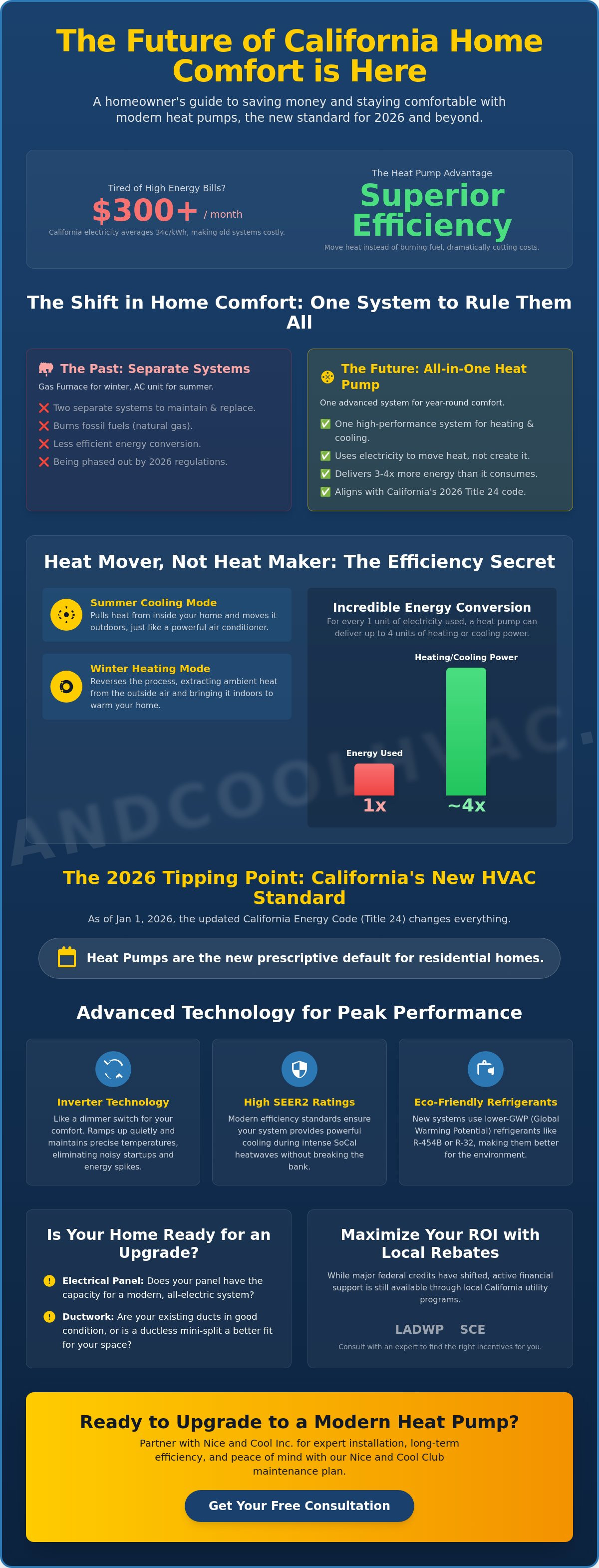
California is currently leading a major shift in how we think about home comfort. For decades, the standard setup for most families was a gas furnace for winter and a central AC for summer. That's changing fast. As of January 1, 2026, the updated California Energy Code (Title 24) has made heat pumps the prescriptive default for space heating in new residential construction. This isn't just about regulation; it's about a smarter, more efficient way to manage your home's climate. By understanding the benefits of a heat pump in California, you can see why the state is moving away from traditional combustion based heating.
One of the biggest advantages of these systems is their "Dual-Action" nature. Instead of maintaining two separate pieces of equipment, you have one high-performance system that provides both crisp cooling and cozy heating. It's a streamlined approach that fits perfectly with the modern California lifestyle. The state's push toward electrification is designed to reduce our reliance on natural gas, which saw record low consumption in 2025. By choosing a heat pump now, you're aligning your home with these new standards while avoiding the complexities of performance modeling required for new gas furnace installations under the 2026 code.
How Heat Pumps Work: A Simple Science Lesson
Think of a heat pump as a refrigerator that can switch directions. While a traditional furnace burns natural gas to generate heat, a heat pump uses electricity to move heat from one place to another. During a hot Los Angeles afternoon, it pulls heat from inside your home and pushes it outdoors. In the winter, it reverses the process, extracting heat from the outside air and bringing it inside. Even when it feels chilly out, there's still ambient heat available for the system to collect.
This process relies on a component called a reversing valve. By understanding how heat pumps work, it's easy to see why they are so efficient. Because they move heat rather than creating it through combustion, they can often deliver three to four times more energy than they consume. This "heat transfer" method is the secret behind the massive energy savings many homeowners see after an upgrade.
Why 2026 is the Tipping Point for California HVAC
If you've been waiting for the right time to upgrade, 2026 is the year the technology and the regulations have truly converged. Modern models now feature advanced inverter technology. These systems act like a dimmer switch rather than a standard light switch. Instead of a loud "thud" when the system kicks on at full blast, inverter systems ramp up quietly and maintain your desired temperature with incredible precision. This is especially helpful in Southern California where temperatures can swing 30 degrees between day and night.
We are also seeing a major environmental shift. Older systems used R-410A refrigerant, but 2026 regulations require lower-GWP options like R-454B or R-32. This makes your new system more eco-friendly and future-proof. Before you dive into the specifics of an installation, it helps to have a clear understanding of what is HVAC and how electrification is redefining domestic comfort. When you look at the long term reliability and the technical maturity of these units, the benefits of a heat pump in California become very clear for any homeowner planning for the future.
Efficiency in Every Season: How Heat Pumps Master the California Climate
Living in Southern California means dealing with unique microclimates. Whether you are enjoying the coastal breeze in Santa Monica or facing the dry heat of Burbank, your comfort needs change based on your zip code. One of the primary benefits of a heat pump in California is its ability to adapt to these specific conditions. In coastal areas, these systems excel at pulling excess moisture from the air, preventing that sticky feeling indoors. Meanwhile, in the San Fernando Valley where temperatures often spike above 100°F, modern heat pumps utilize high SEER2 ratings to provide powerful cooling without the massive energy spikes associated with older technology.
Some homeowners worry that a heat pump won't keep up during a true LA heatwave. This is often based on outdated information about older models. Today's inverter-driven systems are designed for high-ambient conditions. They don't just turn on and turn off at full blast. They adjust their speed to match the cooling demand of your home. This precision is vital when electricity rates are averaging 34 cents per kWh. If you want to maximize your investment, checking the latest California heat pump rebates can help offset the initial cost of these high-efficiency units.
Superior Cooling for LA Summers
Traditional air conditioners operate at one speed: 100%. This leads to frequent cycling, which wears down components and creates hot spots in your home. Heat pumps with variable-speed compressors operate much more like a dimmer switch. They maintain a steady, whisper-quiet flow of air that keeps every room at the exact temperature you set. This consistent operation also provides superior humidity control. It's an essential feature for those living near the water where salt air and dampness can otherwise make a home feel less than fresh.
Heating Without the Gas Bill
Southern California's mild winters are the sweet spot for heat pump technology. Since we rarely see temperatures drop below freezing, your system operates at peak efficiency nearly all winter long. Under 2026 regulations, these systems are required to lockout supplemental electric heat when it's above 35°F. This ensures you aren't wasting energy when the heat pump can handle the load on its own. By switching from a gas furnace, you also remove the risks associated with carbon monoxide and gas leaks. It's a cleaner, safer way to keep your family warm. If you are noticing your current system struggling to keep up with the changing seasons, it might be time to look into Heat Pump Services to see if an upgrade is right for your home.
There is a lingering myth that these systems require more frequent hvac system repair than traditional setups. In reality, modern units are incredibly reliable because they are built as a single, cohesive system. You don't have to manage the wear and tear of a separate furnace and air conditioner. By focusing on a single, high-quality installation, you simplify your home maintenance while enjoying the long-term benefits of a heat pump in California.
Maximizing Your ROI: California Rebates and Energy Savings in 2026
Investing in your home's infrastructure is a significant decision, and the financial landscape for HVAC has changed quite a bit as we enter 2026. If you're looking to understand the true benefits of a heat pump in California, you have to look past the initial purchase and focus on the total cost of ownership. While the federal 25C tax credit, which previously offered up to $2,000, expired at the end of 2025, Southern California homeowners still have several powerful ways to offset their costs. By combining localized utility incentives with long term energy efficiency, these systems often prove to be a much wiser financial asset than traditional gas and AC combos.
When you compare a heat pump to a standard gas furnace over a ten year period, the savings become clear. Even though California electricity rates are currently averaging 34 cents per kWh, the sheer efficiency of moving heat rather than generating it allows homeowners to reduce their annual energy bills significantly. This is especially true if you've already invested in home solar panels. A heat pump acts as a perfect partner for solar, allowing you to use the energy you've already generated to keep your home comfortable day and night without relying on the grid or fluctuating gas prices.
Navigating the 2026 Rebate Landscape
The rebate process in 2026 requires a bit more focus on your specific utility provider. Whether you're a customer of Southern California Edison (SCE) or the Los Angeles Department of Water & Power (LADWP), there are active funds waiting for you. For example, LADWP is currently offering up to $2,500 per ton for qualifying systems. If you're looking at the High-Efficiency Electric Home Rebate Act (HEEHRA), it's important to know that while single-family home applications are currently on a waitlist as of February 2026, the program still offers up to $8,000 for income-qualified households. To unlock these financial tiers, you must work with a "Qualified Contractor" who understands the specific filing requirements for each program.
Long-Term Savings Beyond the Install
The immediate savings from a rebate are great, but the real value of a heat pump in California shows up on your monthly statement. Modern SEER2 ratings are much higher than the systems from just a decade ago, meaning your new unit uses far less power to achieve the same level of comfort. This efficiency directly combats those rising SCE bills. Beyond the monthly utilities, an electrified home is increasingly seen as a premium asset. Buyers in 2026 are looking for homes that are already prepared for the state's clean energy future, which can lead to a boost in property value. If you're planning to stay in your home for the next decade, the transition to a heat pump isn't just about comfort; it's a strategic move to future-proof your biggest investment.
Preparing for Installation: Is Your Home Ready for a Heat Pump Upgrade?
Moving toward a fully electric home is an exciting transition, but it requires a bit of groundwork to ensure you get the best performance from your new system. Many homeowners start this journey with questions about their existing infrastructure. Whether you are living in a classic mid-century home or a newer build, evaluating these physical factors helps you realize the full benefits of a heat pump in California. Preparation isn't just about the unit itself; it's about ensuring your home can support the high efficiency levels these systems are designed to deliver.
The Electrical and Ductwork Audit
A common concern found on forums like Reddit is the belief that every heat pump requires a massive 200-amp electrical panel upgrade. While some homes do need more power, it isn't a universal rule. Many modern, inverter-driven systems are incredibly energy efficient and can often work within existing limits. If your panel is nearing capacity, we can look at "Smart Panels" or load-shedding devices as a cost effective alternative to a full service upgrade. This technical assessment is a core part of a professional heat pump installation. We use a Manual J load calculation to determine the exact size your home needs, ensuring you don't pay for more capacity than necessary.
Your ductwork also plays a starring role. If your existing ducts are undersized or leaky, they can choke the airflow of a high-performance heat pump. During our audit, we determine whether your current ducts can be repaired or if they need a complete refresh to handle the consistent airflow of a variable-speed system. Sizing is critical here; in the world of heat pumps, bigger is rarely better. An oversized unit will "short cycle," turning on and off too frequently, which wastes energy and leads to uneven temperatures.
Ductless Mini-Splits vs. Central Heat Pumps
If your home has limited attic space or no existing ductwork, you don't have to miss out on electrification. Ductless Mini-Split Systems are a perfect solution for many older Los Angeles homes. These units allow for "Zoned Cooling," which means you only spend money to condition the rooms you are actually using. This is a game changer for two-story homes where the upstairs bedrooms often stay stubbornly hot while the living room feels like a walk-in freezer. By installing individual air handlers, you gain precise control over every corner of your house.
One of the most overlooked benefits of a heat pump in California is the impact on your indoor air quality. Because these systems move air more consistently than old gas furnaces, they are excellent at scrubbing the air through high-grade filtration. This is a vital feature during our local wildfire seasons. When outdoor air quality dips, a well-maintained heat pump with a MERV 13 filter keeps your indoor environment safe and breathable. If you are ready to see how these systems fit into your specific floor plan, our team can provide a tailored assessment for your HeatPump Installation today.
Partnering with Nice and Cool Inc. for Your Heat Pump Transition
Choosing the right equipment is only half the battle. The other half is choosing a team that understands how to calibrate that equipment for our unique Southern California environment. To truly enjoy the benefits of a heat pump in California, you need a partner who understands the long-term technical requirements of these advanced systems. Whether you are dealing with the salt air of the coast or the extreme temperature swings of the inland valleys, Nice and Cool Inc. ensures your system is sized and installed with precision. We don't just drop a unit in your yard; we customize the installation to your home's specific needs.
Navigating the 2026 rebate landscape can be a headache for any homeowner. Because the rules for utility incentives like those from LADWP and SCE change frequently, Nice and Cool Inc. takes the lead on the documentation process. We assist you with the necessary paperwork and technical verification to ensure you receive the maximum financial return on your investment. Our commitment to a professional, clean installation means we treat your home with the same respect we would our own, leaving your space better than we found it.
The Nice and Cool Inc. Difference in LA
We are a family-owned business with deep roots in the Los Angeles community. This means our reputation is built on neighborly trust rather than high-pressure sales tactics. If your current HVAC setup is struggling, Nice and Cool Inc. always starts with a diagnostic-first approach. We look for every opportunity to perform an effective hvac system repair before we ever suggest a full replacement. Our technicians have specialized expertise in both traditional central Heat Pump Services and modern Ductless Mini-Split Systems, allowing us to offer the best solution for your architecture and budget.
Protecting Your Investment with Nice and Cool Inc.
A high-efficiency heat pump is a sophisticated piece of technology that requires regular attention to maintain its SEER2 performance. If you want your system to last for decades, then routine maintenance is essential. The Nice and Cool Club Maintenance Plan provides bi-annual tuning that specifically targets the components most likely to wear down in our climate. This proactive care helps prevent common 2026 system failures, such as refrigerant leaks or sensor malfunctions, before they lead to an expensive breakdown.
Whether you are looking to lower your monthly utility bills or you want to future-proof your home against rising gas prices, Nice and Cool Inc. is here to guide you through every step of the process. Our goal is to provide you with peace of mind and a home that stays perfectly comfortable regardless of the weather outside. To get started on your journey toward a more efficient home, Schedule your heat pump consultation with Nice and Cool Inc. today!
Take Control of Your Home Comfort and Energy Costs
Deciding on a new HVAC system is a significant step toward a more efficient and comfortable future for your family. We've explored how modern technology manages the specific demands of the Los Angeles climate and how localized utility programs provide the financial support you need. By choosing to upgrade now, you can lock in the long-term benefits of a heat pump in California before local utility funds are fully reserved. Whether you are looking for superior cooling during a heatwave or a way to lower your monthly SCE bill, these systems offer a reliable, all-electric solution.
The team at Nice and Cool Inc. is here to ensure your transition is seamless. As authorized rebate specialists, we handle the complex 2026 documentation so you don't have to. Plus, with our specialized maintenance protection, your investment stays in peak condition for years to come. Don't let rising rates or rebate confusion stand in your way. Claim Your 2026 California Heat Pump Rebates with Nice and Cool Inc. and start enjoying a more efficient home today. We look forward to helping you achieve the perfect indoor climate.
Frequently Asked Questions
Are heat pumps really effective during a 100-degree Los Angeles heatwave?
Modern heat pumps are highly effective in extreme heat because they use variable-speed inverter technology. Unlike older systems that only run at full power or stay off, these units modulate their output to match the cooling demand of your home. This allows them to maintain a consistent temperature even when the San Fernando Valley sees triple-digit temperatures. They are designed to operate efficiently in high-ambient conditions, ensuring your indoor sanctuary stays cool without the constant on-and-off cycling of a traditional AC.
How much can I actually save with California heat pump rebates in 2026?
Your total savings in 2026 depend largely on your specific utility provider. For example, LADWP customers can access rebates of up to $2,500 per ton for qualifying high-efficiency systems. While statewide programs like HEEHRA are currently on a waitlist for single-family homes, local incentives remain a powerful way to offset your initial costs. Navigating these local programs is one of the primary financial benefits of a heat pump in California, especially as federal tax credits for these installations have expired.
Do I need to replace my gas furnace to install a heat pump?
Yes, a standard heat pump installation typically replaces both your existing gas furnace and your central air conditioner. Since a heat pump handles both heating and cooling, you no longer need a separate combustion-based unit. This transition simplifies your home infrastructure and removes the risks associated with natural gas in the home. If your current furnace is still functional but you want to electrify, we can evaluate whether a full transition or a hybrid setup makes the most sense for your specific needs.
What is the average lifespan of a heat pump in the Southern California climate?
A well-maintained heat pump in Los Angeles typically lasts between 15 and 20 years. Our mild coastal and inland winters are actually very gentle on these systems because they rarely have to work in freezing conditions. This "sweet spot" climate helps the compressor and other vital components last longer than they might in harsher regions. Regular bi-annual tuning through a professional maintenance plan is the best way to ensure your system reaches the upper end of this lifespan.
Will a heat pump make my electricity bill skyrocket?
While your electricity usage will increase, you will completely eliminate your natural gas bill for heating. With California electricity rates currently averaging 34 cents per kWh, the key is the system’s high efficiency rating. Because heat pumps move heat rather than creating it, they use significantly less total energy than a furnace and AC combo. If you have home solar panels, the impact on your bill is even lower, as you can power your climate control with the energy you harvest from the sun.
How do I know if my electrical panel can handle a new heat pump?
We determine your home's readiness by performing a professional load calculation known as a Manual J. This assessment looks at your current electrical capacity and the demands of the new system. If your panel is nearly full, you don't always need a costly 200-amp upgrade. In many 2026 installations, we can use smart load-management devices or "smart panels" that prioritize energy flow, allowing you to enjoy the benefits of a heat pump in California without a total service overhaul.
Is a ductless mini-split better than a central heat pump for an LA home?
Ductless mini-splits are often the better choice for older Los Angeles homes that lack attic space or existing ductwork. They allow for precise "zoned" cooling, meaning you only pay to condition the rooms you are currently using. If your home already has a healthy duct system, a central heat pump is usually the more straightforward replacement. Whether you choose ductless or central, both options provide the same high-efficiency heat transfer technology that defines modern California comfort.
What happens if my heat pump needs an hvac system repair in the future?
If your system needs attention, it requires a technician who is specifically trained in inverter technology and modern refrigerants like R-454B. These systems are incredibly reliable, but their sophisticated electronics mean you shouldn't rely on a general handyman. By staying current with your maintenance through the Nice and Cool Club, you'll receive priority service and expert care. This proactive approach ensures any potential hvac system repair is handled quickly before it impacts your home comfort.
Frequently Asked Questions
Think of a heat pump as a refrigerator that can switch directions. While a traditional furnace burns natural gas to generate heat, a heat pump uses electricity to move heat from one place to another. During a hot Los Angeles afternoon, it pulls heat from inside your home and pushes it outdoors. In the winter, it reverses the process, extracting heat from the outside air and bringing it inside. Even when it feels chilly out, there's still ambient heat available for the system to collect. This process relies on a component called a reversing valve. By understanding how heat pumps work, it's easy to see why they are so efficient. Because they move heat rather than creating it through combustion, they can often deliver three to four times more energy than they consume. This "heat transfer" method is the secret behind the massive energy savings many homeowners see after an upgrade.