Expert Furnace Repair in Los Angeles: The 2026 Homeowner’s Guide
August 12, 2026 17 min read
In a city famous for its year-round sunshine, many Los Angeles furnaces fail not because they are overworked, but because they spend nine months of the year silently collecting dust. When that first cold snap hits and you need reliable furnace repair los angeles, the sudden silence of a broken heater can feel stressful. It's natural to worry about unexpected repair bills or whether a technician might push for a replacement you don't actually need. More importantly, safety concerns regarding gas leaks or carbon monoxide are always a priority for homeowners.
We understand that you want your home to be a warm, safe sanctuary without high-pressure sales. This 2026 guide will help you manage the latest California Energy Code requirements, including the 81% AFUE efficiency standards, while teaching you how to troubleshoot common issues yourself. Whether you are dealing with a pilot light glitch or considering the "5,000 Rule" for a major repair, we'll provide the expert clarity you need. You'll learn how to keep your system running efficiently and how to choose a local specialist who treats your home with care.
Key Takeaways
- Recognize "LA Idle" syndrome and understand why local heating systems often struggle after sitting dormant for most of the year.
- Identify how dust from Santa Ana winds affects your flame sensors and when you need expert furnace repair los angeles to restore safety.
- Apply the 50% Rule to determine if fixing your current unit is cost-effective or if its age makes a replacement the better long-term choice.
- Master basic DIY troubleshooting steps, such as checking the hidden furnace switch, to resolve minor issues without a professional service call.
- Explore how proactive maintenance plans help you avoid the stress of unexpected breakdowns during the rare Southern California cold snaps.
Identifying Common Signs You Need Furnace Repair in Los Angeles
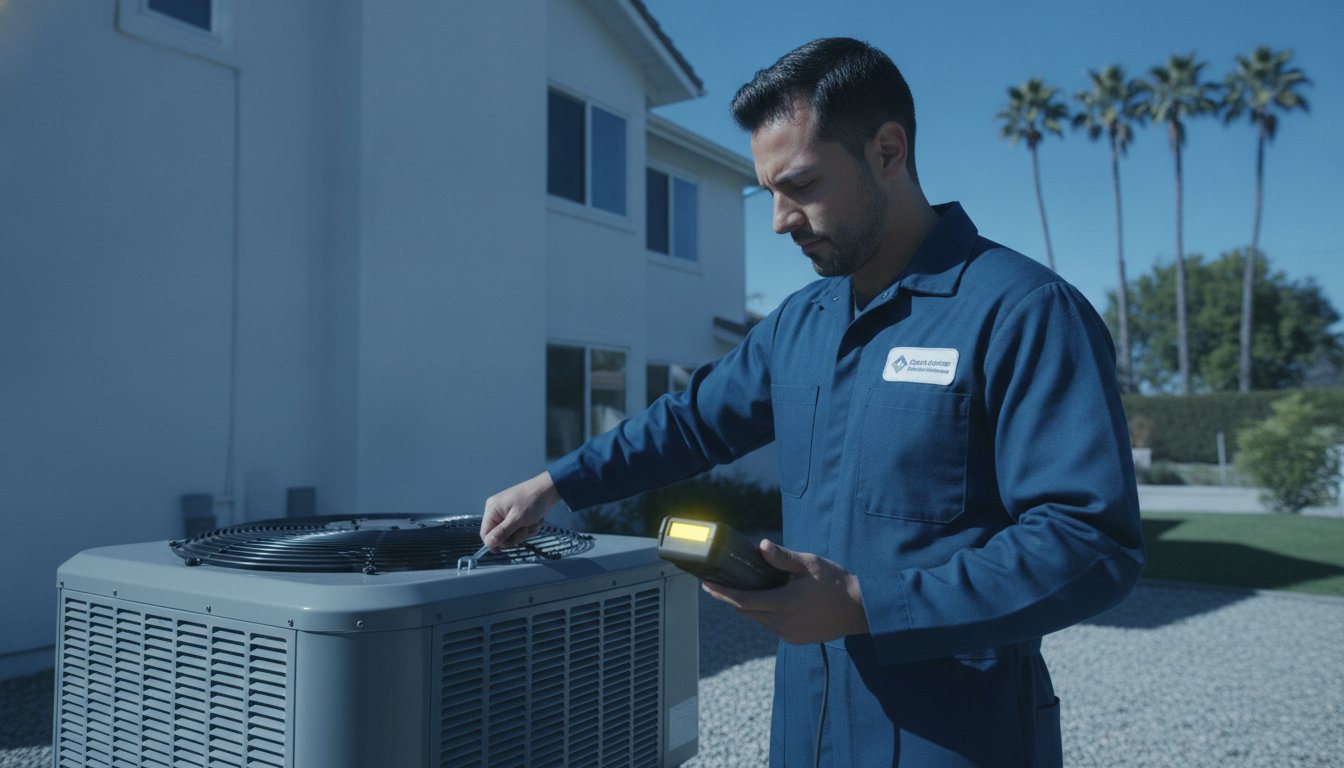
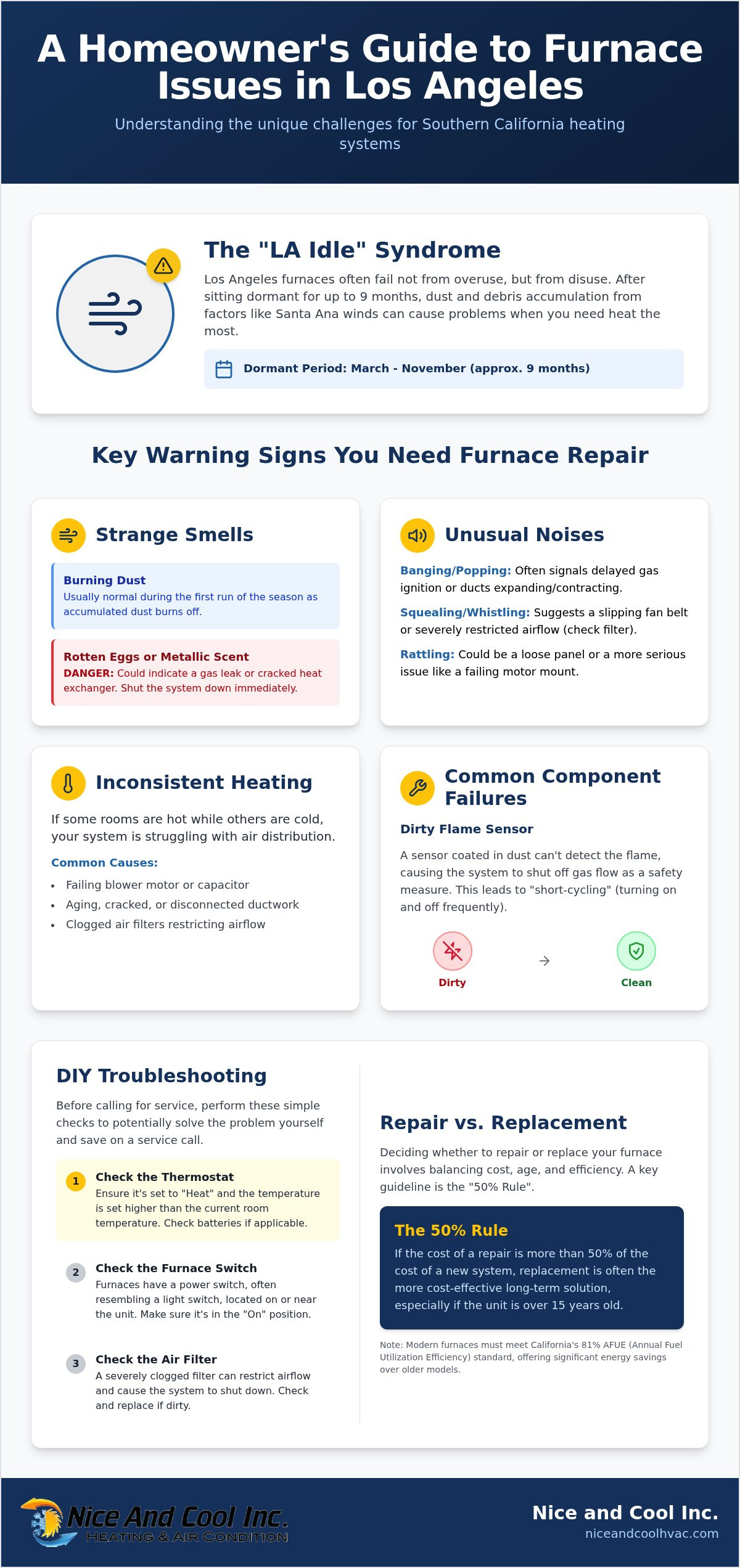
In the context of home comfort, furnace repair is a restorative service designed to return your heating system to its peak efficiency and, more importantly, ensure it operates safely. Many homeowners in Southern California experience what we call "LA Idle" syndrome. Because our winters are mild, a furnace might sit dormant from March until November. During these months, the unit becomes a magnet for dust and debris. The Santa Ana winds often push fine grit into outdoor intakes, coating sensitive components. When you finally flip the switch, that accumulated grime can cause the system to struggle, leading to a sudden need for furnace repair los angeles just as the temperature drops.
If you notice a faint burning smell during the first run of the season, it's usually just dust incinerating on the heat exchanger. However, if you smell rotten eggs or a sharp metallic scent, you should shut the system down immediately. This could indicate a gas leak or a cracked heat exchanger. Another red flag is short-cycling. This happens when your heater turns on and off too frequently. Whether it's a clogged filter or a failing thermostat, short-cycling wastes energy and puts immense strain on your equipment.
Strange Noises: What Your Furnace Is Trying to Tell You
Your furnace should operate with a steady, predictable hum. If you start hearing mechanical protests, it's time to investigate. Different sounds point to different internal struggles:
- Banging or popping: This often signals delayed ignition. Small amounts of gas build up before igniting, creating a mini-explosion. It can also be the sound of metal ducts expanding and contracting under heat.
- Squealing or whistling: High-pitched noises usually suggest a slipping fan belt or restricted airflow. If your air filter is completely blocked, the system may "whistle" as it tries to pull air through any available gap.
- Rattling: This could be as simple as a loose access panel or as serious as a failing motor mount or a fractured blower wheel.
Inconsistent Heating and Cold Spots
If your living room feels like a sauna while the bedroom remains a refrigerator, your furnace is likely struggling with air distribution. This inconsistency often traces back to the blower motor. If the motor is wearing out or the capacitor is failing, a weak fan cannot push enough warm air to the furthest reaches of your home. In older Los Angeles residences, the problem is frequently exacerbated by aging ductwork. Cracks or disconnected joints in the attic allow expensive heat to escape before it ever reaches your vents, forcing your furnace to work twice as hard for half the comfort. Identifying these leaks is a critical part of a professional furnace repair los angeles service.
The Southern California climate creates a set of challenges that most national HVAC guides simply don't address. While homeowners in colder states deal with mechanical wear from constant use, we face issues born from long periods of inactivity. When your system sits dormant for three quarters of the year, it becomes a resting place for fine particulate matter. This is particularly true during the Santa Ana wind season, when microscopic dust penetrates even the most well-sealed cabinets. Understanding these local quirks is the first step in avoiding an emergency furnace repair los angeles.
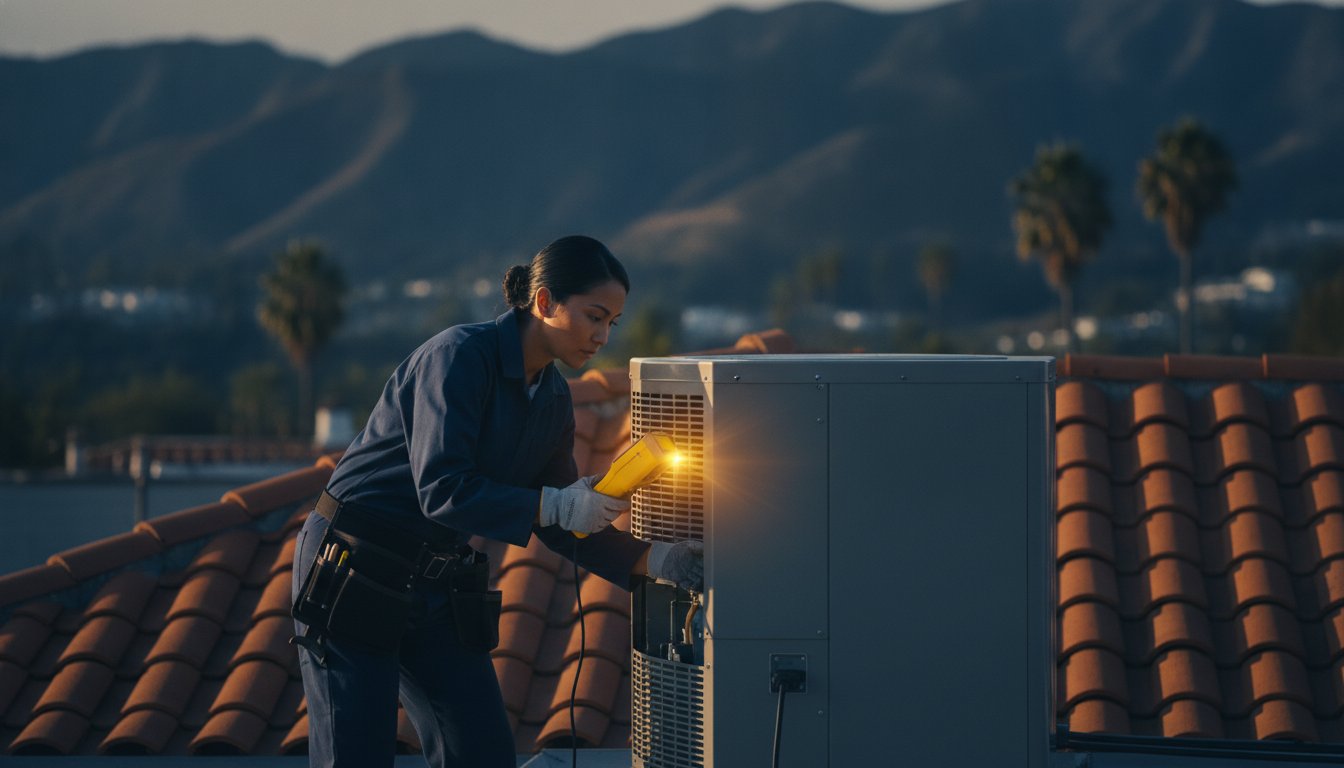
Switching your thermostat between cooling and heating modes frequently during our "yo-yo" weather weeks can also lead to calibration errors. If your system is a heat pump, those living near the coast must contend with salt air. Briny mist can corrode the aluminum fins and copper coils of your outdoor unit, leading to refrigerant leaks that compromise your heating capacity. If you haven't had a seasonal check-up, these environmental factors often lead to a late-night call for furnace repair los angeles.
Dirty Flame Sensors and Igniter Failures
A common culprit for a furnace that starts and then immediately shuts down is a dirty flame sensor. This small metal rod detects whether a flame is present. If it's coated in a thin layer of carbon or Santa Ana dust, it can't "see" the fire, and the system shuts off gas flow as a safety precaution. Modern systems typically use hot surface igniters rather than traditional standing pilot lights. These igniters are fragile components that can crack if they've been sitting in a damp or dusty environment for too long. While some homeowners try to clean these sensors with sandpaper, it's a delicate task that can easily ruin the component. A professional cleaning ensures the sensor is polished without being damaged.
Airflow Restrictions: More Than Just a Dirty Filter
In Los Angeles, our air is often filled with more than just oxygen. Pollen, smog, and construction dust mean your air filters likely need changing more often than the standard three-month recommendation. If a filter is clogged, your furnace has to work harder to pull air through the system. Some homeowners try to save money by closing registers in unused guest rooms, but this actually creates excessive pressure within the ductwork. Static pressure is the measure of resistance your blower motor must overcome to move air through the system; high static pressure can cause the motor to burn out prematurely. To keep your system running smoothly without these hidden stresses, consider joining the Nice and Cool Club Maintenance Plan for regular professional oversight.
Furnace Repair vs. Replacement: The Homeowner’s Decision Matrix
Deciding whether to invest in another round of furnace repair los angeles or to retire your old unit entirely is often a matter of simple arithmetic. We recommend the 50% Rule: if the estimated repair cost is more than half the price of a brand-new installation, you're likely throwing good money after bad. This is especially true if your current unit is in the "red zone," which for most Southern California homes is between 15 and 20 years of age. While our mild climate might extend the physical life of the cabinet, the internal mechanical components still degrade over time.
Beyond the math of the repair itself, safety is the ultimate deciding factor. If a technician discovers a cracked heat exchanger, the unit must be decommissioned immediately. This isn't a high-pressure sales tactic; it's a critical safety requirement to prevent carbon monoxide from entering your living space. In these instances, the decision matrix is clear: safety always outweighs the cost of a fix. When your system reaches this stage, moving to a modern unit isn't just about heat; it's about protecting your family.
Evaluating the Cost of Frequent Repairs
It helps to look back at your records for the last three heating seasons. If you've dealt with multiple "nuisance" repairs, such as failing igniters or blower motor hiccups, those small costs add up quickly. For a deeper look at how to manage these choices, see our Furnace Repair in Los Angeles: The 2026 Homeowner’s Guide. Often, the total spent on keeping an old unit alive could have covered a significant portion of a modern, warrantied system that offers 10 years of predictable comfort without the anxiety of a mid-winter breakdown.
Modern Standards and SEER2/AFUE Ratings in 2026
As of January 1, 2026, the updated California Building Energy Efficiency Standards (Title 24) are in full effect. These mandates require a minimum furnace efficiency of 81% AFUE for new installations. If your current unit is an older 80% model from a decade ago, upgrading to a 96% high-efficiency system can lead to immediate reductions in your monthly SoCalGas bills. Modern units aren't just more efficient; they operate with variable-speed motors that provide more consistent temperatures and quieter operation. Choosing a new installation provides a level of peace of mind that an aging, patched-together system simply cannot match. You'll spend less time worrying about the next furnace repair los angeles and more time enjoying a comfortable home.
DIY Troubleshooting: What to Check Before Calling a Pro
Before you book a professional furnace repair los angeles, it's worth taking ten minutes to perform a few basic checks. Sometimes the solution is as simple as a flipped switch or a dead battery. Start by locating the furnace's power switch. It's often mounted on the side of the unit or a nearby wall and looks exactly like a standard light switch. If someone accidentally flipped it while reaching for a light, the system won't budge. Next, check your circuit breaker panel. If the breaker has tripped to the "off" or "neutral" position, flip it back once. If it trips again immediately, stop and call a technician.
Your thermostat is the next logical stop. Ensure it's set to "Heat" rather than "Cool" or "Auto." If the display is blank or flickering, replace the batteries before assuming the unit is broken. You should also check your air filter. As we discussed earlier, LA dust can clog a filter quickly. A heavily restricted filter causes the internal temperature to spike, which triggers a safety component called the "limit switch" to shut the system down. Finally, if you have a gas furnace, verify that the shut-off valve on the gas line is in the "open" position, which means the handle is parallel to the pipe.
Smart Thermostat Syncing and Power Issues
Many Los Angeles homes now use Nest or Ecobee systems, which introduce their own set of quirks. If your smart thermostat is behaving erratically, it might be a "vampire" power issue. Without a dedicated C-wire (common wire) to provide steady power, the thermostat tries to "steal" electricity from the heating circuit, which can cause the furnace to cycle on and off unexpectedly. If your Wi-Fi goes down, your heating schedule might stall or revert to a default setting. If your screen is unresponsive, then try a hard reset by removing the faceplate for 30 seconds. Whether the issue is a sync error or a wiring problem, a reset often clears the logic board's memory and restores function.
The Limits of DIY: When to Put Down the Tools
While checking a switch or a filter is safe, opening the gas valve assembly or the blower cabinet is not. You should never attempt to repair gas valves, electrical control boards, or heat exchangers yourself. If you smell rotten eggs, then you must evacuate the house immediately and call for help from a safe distance. Carbon monoxide is a colorless, odorless gas that can leak from a cracked heat exchanger and poses a life-threatening risk to everyone in the home. If your basic troubleshooting doesn't yield results, it's time to contact the experts for reliable heating repair to ensure your system is handled with professional precision and care.
The Nice and Cool Approach: Reliable Heating for LA Families
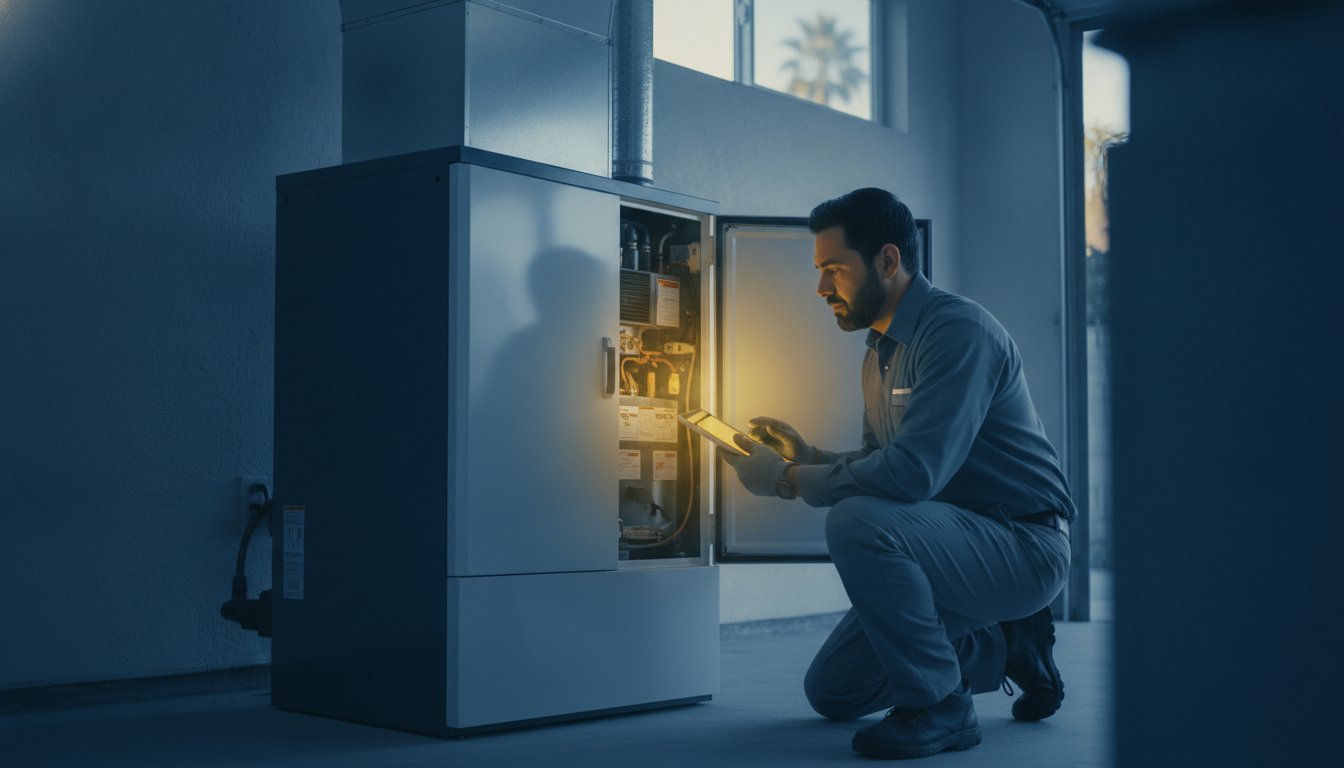
At Nice and Cool Inc., we believe that effective furnace repair los angeles starts with a deep understanding of our local community. We don't just swap parts and leave; we use advanced diagnostic tools to identify why a component failed in the first place. Whether it's a blower motor struggling against restricted airflow or a sensor fouled by seasonal dust, we pinpoint the root cause. This methodical approach saves you money by preventing the same issue from returning next month. As a family-owned and operated business established in 2005, we take immense pride in our reputation for honesty and craftsmanship.
Every member of our team is a background-checked professional who understands that they are guests in your home. We maintain high standards for cleanliness and respect, ensuring that we leave your living space exactly as we found it. Our pricing is always transparent, so you won't have to worry about hidden fees or high-pressure sales tactics. We serve the entire Los Angeles County area, providing the same level of care and steady, deliberate service to every neighbor we visit.
Why Experience Matters in the LA Market
Our history in the region gives us a unique perspective on the various architectural styles found across the city. Whether you live in a classic 1920s Spanish Colonial with original ductwork or a modern condo with a high-efficiency heat pump, we've seen it all. This local expertise allows us to tailor our services to the specific needs of your home. If you've ever dealt with an AC not blowing cold air in Los Angeles, then you know how important it is to have a technician who understands our specific climate pressures. We bring that same level of specialized knowledge to every furnace repair los angeles call, ensuring your system is fit for the unique demands of our environment.
Joining the Nice and Cool Club
The best way to handle a furnace emergency is to prevent it from happening. We designed the Nice and Cool Club Maintenance Plan to address the neglect-based failures common in Southern California. By performing a methodical check-up before the cold weather hits, we can clean those dusty flame sensors and inspect heat exchangers before they become a safety risk. Club members enjoy several benefits that prioritize their comfort:
- Priority scheduling during peak winter and summer seasons.
- Exclusive discounts on any necessary repairs or parts.
- Methodical seasonal tune-ups that eliminate the "first-burn" panic in November.
If you want to ensure your home stays warm and safe all winter long, then proactive care is your best strategy. Schedule your professional furnace repair with Nice and Cool today and experience the difference of working with a local specialist who truly cares about your long-term comfort.
Secure Your Home Comfort for the Season Ahead
Understanding your heating system is the first step toward a stress-free winter. Whether you're navigating the "LA Idle" syndrome caused by months of dust accumulation or deciding if your aging unit is ready for retirement, having a clear plan makes all the difference. We've explored how simple DIY checks can resolve minor hiccups, but when those steps aren't enough, professional furnace repair los angeles ensures your family stays safe and warm.
Nice and Cool Inc. has been a family-owned local specialist since 2005, serving all of Los Angeles County with dependable craftsmanship. If you want to avoid the "first-burn" panic altogether, then joining the Nice and Cool Club Maintenance Plan is the most effective way to protect your long-term comfort. We are here to act as your helpful guide, providing honest diagnostics and tailored solutions for your home. Book Your Expert Los Angeles Furnace Repair Now and let us handle the technical details while you enjoy a cozy, worry-free season.
Frequently Asked Questions
How much does furnace repair typically cost in Los Angeles?
Repair costs depend on several factors, including the specific part that needs attention and the age of your system. Minor issues like a sensor cleaning or a thermostat adjustment are generally less expensive than major mechanical failures like a blower motor replacement. If the repair cost is significant, we recommend comparing it against the age of the unit to determine if a modern replacement is a better long-term investment.
Why is my furnace blowing cold air even though the heat is on?
This often happens if the thermostat fan setting is set to "On" instead of "Auto," which keeps the fan running even when the burners are off. Other causes include a dirty flame sensor that can't detect a flame or a tripped limit switch. If the system starts with warm air but turns cold quickly, the furnace is likely overheating and shutting down for safety.
Is it safe to run my furnace if it smells like it's burning?
It depends on the type of smell. If you're turning the heat on for the first time in months, a dusty smell is normal as debris burns off the heat exchanger. However, if you smell ozone, burning plastic, or smoke, you should shut the system down immediately. These scents often indicate electrical components are failing, which requires professional furnace repair los angeles to resolve safely.
How often should I have my furnace serviced in a mild climate like LA?
You should schedule a professional tune-up once per year, ideally in the fall before the first cold snap. Even though we don't use our heaters as much as homeowners in colder states, our systems face unique issues from long periods of inactivity. Annual service ensures that dust accumulation and mechanical wear don't lead to a sudden breakdown when you need warmth the most.
Can a dirty air filter really cause my furnace to stop working?
Yes, a clogged filter is a leading cause of system failure. When airflow is restricted, the heat exchanger cannot shed heat fast enough, causing it to reach dangerous temperatures. This triggers the high-limit switch, which cuts off the gas supply to prevent a fire. Changing your filter every three months is the easiest way to prevent this common and avoidable issue.
What are the most common reasons for a furnace to fail in Southern California?
In our region, failures are typically caused by "idle syndrome" and environmental factors. Dust from Santa Ana winds often coats flame sensors and igniters, preventing the system from staying lit. If your system hasn't been used in months, it may require professional furnace repair los angeles to clean these sensitive components and recalibrate the control board for the upcoming winter season.
How do I know if my furnace's heat exchanger is cracked?
A cracked heat exchanger is difficult to see without specialized tools, but there are warning signs. Look for a flickering or yellow flame instead of a steady blue one, or excessive soot inside the unit. If your carbon monoxide detector goes off, it's a clear sign of a leak. Because these cracks allow toxic gases into your home, they require immediate professional attention.
What should I do if I smell gas near my heating unit?
If you smell a strong odor of rotten eggs, you must leave the premises immediately. Don't turn any lights on or off, and don't use your phone inside the house, as a small spark could ignite the gas. Once you are at a safe distance, call the gas company or emergency services. Never attempt to locate or fix a gas leak yourself, as it's a major safety risk.
Frequently Asked Questions
Repair costs depend on several factors, including the specific part that needs attention and the age of your system. Minor issues like a sensor cleaning or a thermostat adjustment are generally less expensive than major mechanical failures like a blower motor replacement. If the repair cost is significant, we recommend comparing it against the age of the unit to determine if a modern replacement is a better long-term investment.