How to Choose a Residential HVAC Contractor in Long Beach: 2026 Homeowner’s Guide
June 13, 2026 16 min read
That federal tax credit you were planning to use for a new AC system is officially gone as of January 2026. Choosing a residential HVAC contractor Long Beach residents can depend on has become a high-stakes decision, especially with new Title 24 energy codes now in full effect. If you're currently facing rising utility bills or watching salt air slowly corrode your outdoor unit, it's natural to feel overwhelmed by shifting regulations and the fear of a poor installation.
For those looking to dive deeper into how these regulations affect home value and efficiency, read more from Comfort Boys Home Service Company about the latest industry standards.
This guide will help you find a trustworthy local partner who knows how to build for coastal durability while maximizing the rebates still available through SCE and SoCalGas. Whether you need a system that can withstand the humidity or a partner for long-term maintenance, we'll provide the clarity you need. We will break down the 2026 efficiency standards, explain why HERS testing is non-negotiable, and provide a clear roadmap for selecting a specialist who treats your home with the care it deserves.
Key Takeaways
- Learn why the California C-20 license and NATE certification are the non-negotiable gold standards for technical excellence and safety in your home.
- Discover how to protect your equipment from salt air corrosion by partnering with a specialized residential HVAC contractor Long Beach homeowners trust.
- Compare traditional air conditioning with modern heat pump technology to determine which system offers the best efficiency for our unique coastal environment.
- Master the process of reviewing professional estimates to help you identify honest value and successfully navigate available local utility rebates.
Finding a Reliable Residential HVAC Contractor in Long Beach
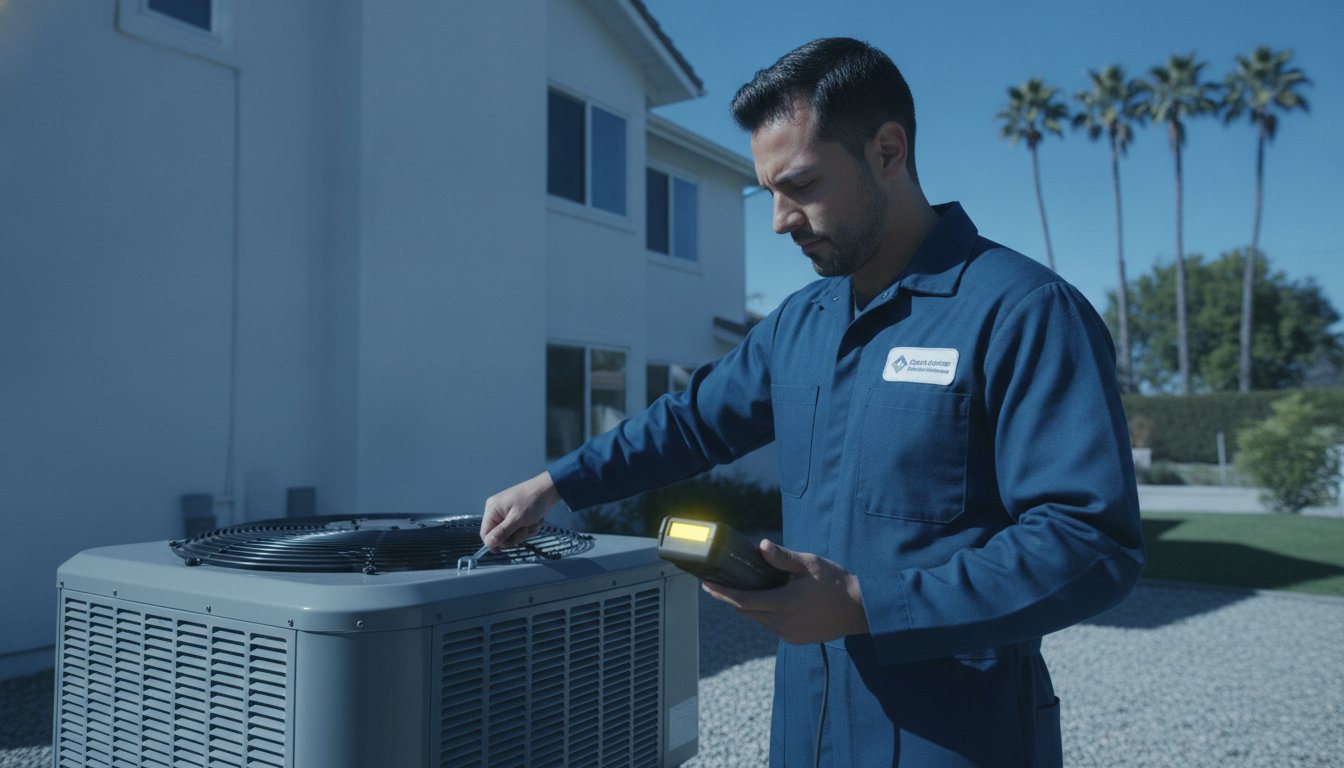
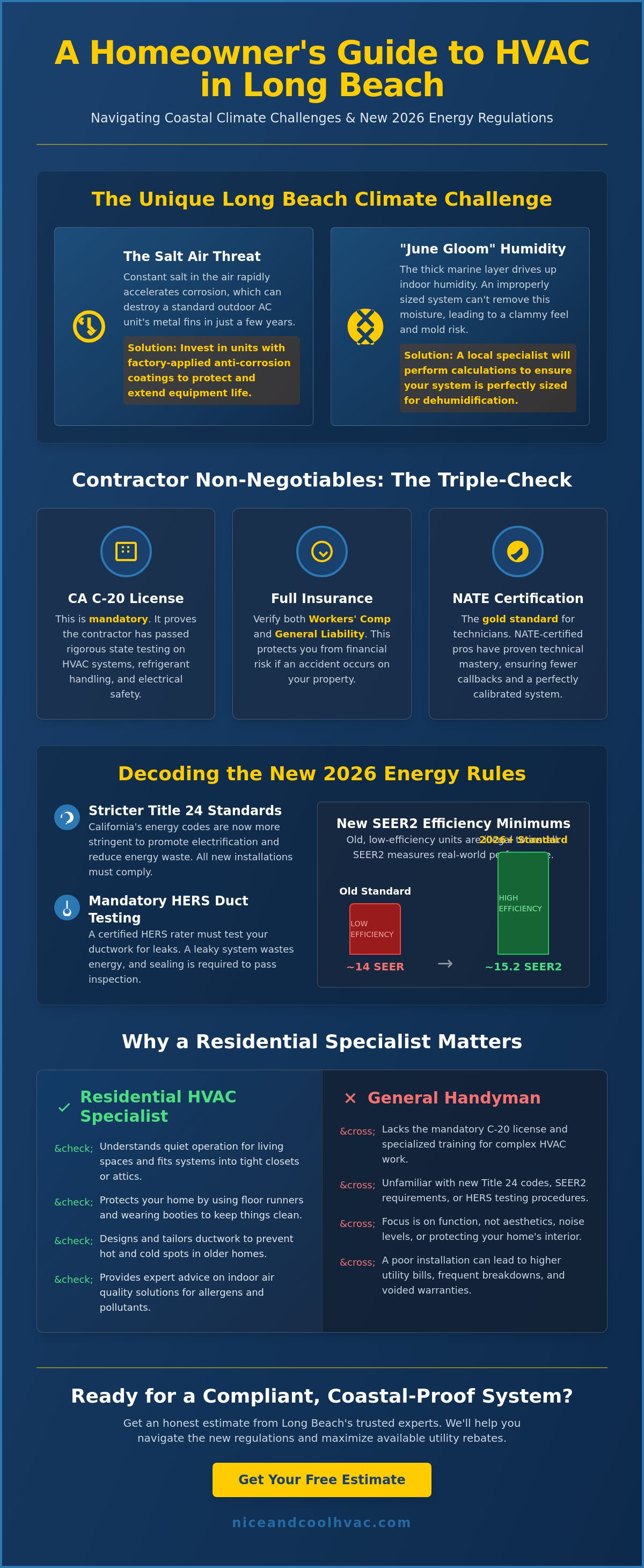
Finding a reliable residential HVAC contractor Long Beach homeowners can trust involves more than just looking for the lowest bid. You should think of your contractor as a home comfort architect. They don't just swap out metal boxes; they design a system that regulates temperature, manages humidity, and purifies the air you breathe. While a general handyman might be great for fixing a leaky faucet or painting a fence, they lack the specialized training and the mandatory California C-20 license required for complex Heating, ventilation, and air conditioning (HVAC) work. A C-20 license ensures the technician understands high-voltage electricity, refrigerant handling, and the specific Title 24 energy codes that keep your home efficient and safe.
The Long Beach Microclimate Factor
Our city's proximity to the Port of Long Beach and the Pacific Ocean creates a unique environment that is notoriously tough on mechanical equipment. If you live near the coast, salt air is a constant presence. This salt air accelerates corrosion, which can eat through standard outdoor condenser fins in just a few years. A local residential HVAC contractor Long Beach specialist knows how to select units with factory-applied anti-corrosion coatings to extend the life of your investment. We also deal with "June Gloom," that thick marine layer that drives up humidity levels. Without a properly sized system, your indoor evaporator coils can struggle to pull moisture from the air, leading to a clammy feeling indoors and potential mold growth.
Why Residential Specialization Matters
Commercial contractors are used to massive rooftop units and vast warehouses where noise and aesthetics aren't primary concerns. In your home, the requirements are entirely different. A residential specialist understands that your system needs to operate quietly and fit into tight spaces, like the narrow closets of a historic Belmont Heights bungalow or the attic of a modern Bixby Knolls home. They take the time to protect your living space by wearing booties and using floor runners to keep your carpets clean.
Whether you have a 1920s Spanish Revival or a mid-century modern build, a home-focused expert will tailor your ductwork to ensure every room receives the right amount of airflow. This prevents those frustrating "hot spots" common in older Long Beach properties. By focusing specifically on residential needs, these specialists can also provide better advice on indoor air quality solutions that protect your family from local allergens and pollutants.
Essential Qualifications for Your Long Beach HVAC Expert
Every professional residential HVAC contractor Long Beach homeowners hire must hold a valid California C-20 license. This license isn't just a piece of paper; it proves the contractor has passed rigorous testing on heating, ventilation, and cooling systems. If a contractor can't provide their license number, they shouldn't be in your home. You also need to verify they carry both workers' compensation and general liability insurance. These protections ensure that you aren't held financially responsible for any accidents that happen on your property during a system installation or repair.
Decoding 2026 SEER2 and Title 24 Standards
SEER2 is the updated Seasonal Energy Efficiency Ratio that measures a system's cooling efficiency under real-world duct pressure for 2026. As of January 1, 2026, California's Title 24 standards have become even more stringent to encourage electrification and reduce energy waste. This means that a standard HVAC change-out now requires mandatory HERS testing to verify that your ductwork doesn't leak more than the state allows. If you're offered a "deal" on an older, low-efficiency unit, be careful. Installing equipment that doesn't meet the new Southwest region SEER2 minimums is no longer legal in Southern California. A qualified residential HVAC contractor Long Beach specialist will ensure your system is fully compliant with these latest environmental laws.
NATE Certification and Technical Mastery
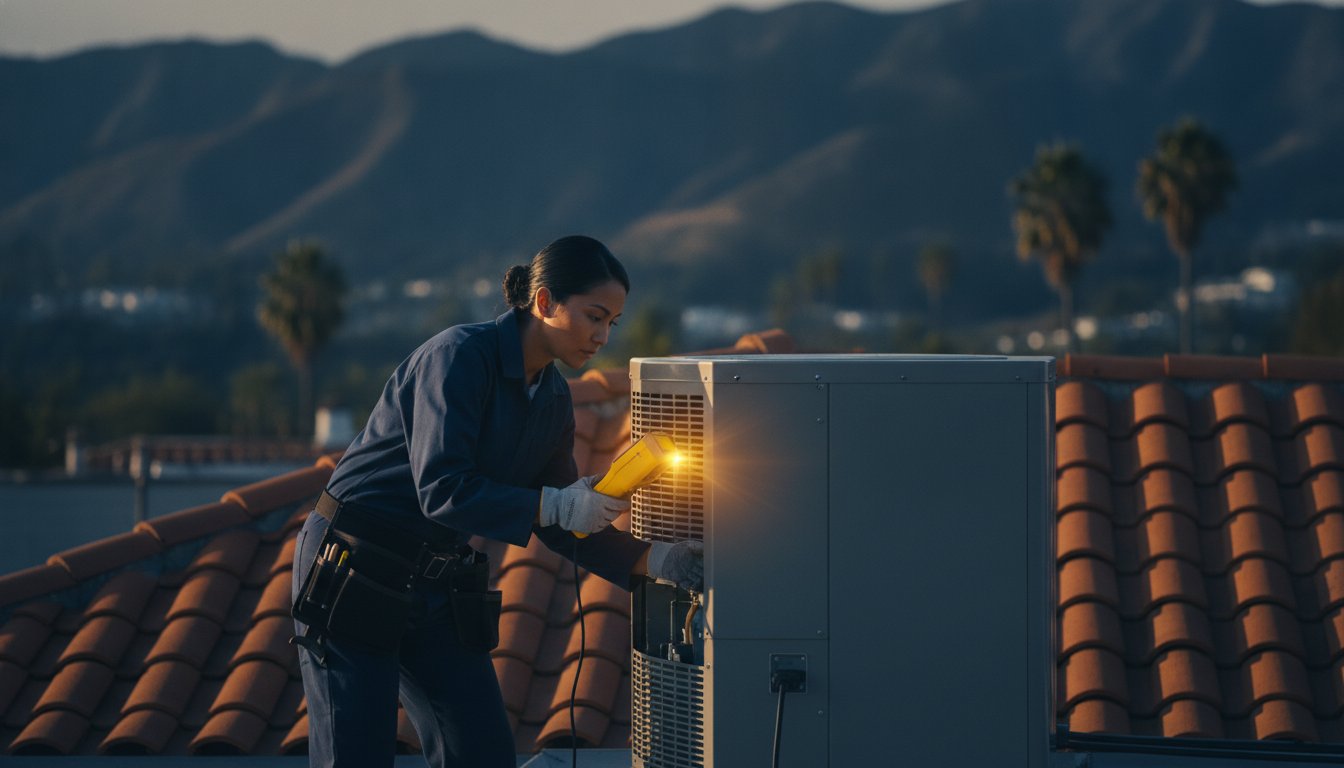
NATE (North American Technician Excellence) certification is the gold standard for individual technicians in our industry. While the company holds the business license, individual NATE certification proves the person actually doing the work has mastered the technical details of modern systems. This advanced training significantly reduces the need for frequent air conditioning unit repairs later on. Certified pros understand the delicate balance of refrigerant levels and the complexities of new, low-GWP refrigerants like R-454B. They ensure your system is calibrated for peak performance from day one, protecting your long-term investment.
Whether you're looking for a simple upgrade or a complete system overhaul, checking these credentials provides the peace of mind you deserve. If you're unsure whether your current unit meets these new standards, our team at Nice and Cool Inc. can provide a professional evaluation of your home’s efficiency needs.
Choosing the Right System: Long Beach Home Solutions
Selecting the right equipment requires a residential HVAC contractor Long Beach homeowners can trust to perform a Manual J load calculation. This process is the only way to ensure your system is "right-sized" for your specific floor plan. If a system is too large, it will cycle on and off too frequently, which prevents it from properly dehumidifying your home. If it's too small, it will run constantly without ever reaching your desired temperature. A professional evaluation considers your home's insulation, window types, and even the direction your house faces before recommending a system.
Heat Pumps: The Future of Southern California Cooling
The mild climate in our coastal community makes heat pump installation an exceptionally smart choice for 2026. Unlike a traditional air conditioner that only cools, a heat pump provides both heating and cooling by moving heat rather than creating it. Because Long Beach rarely sees freezing temperatures, these systems operate at peak efficiency year-round. This technology allows you to move away from gas-fired furnaces, reducing your home's carbon footprint while often lowering your monthly operational costs. Whether you're replacing an aging furnace or a standalone AC, a heat pump offers a streamlined, all-electric solution that aligns with California's latest energy goals.
Ductless Mini-Splits for Older Properties
Many of our classic Long Beach bungalows and mid-century homes weren't built with central ductwork. In these cases, a ductless mini-split system is often the superior choice. These units allow for zoned cooling, meaning you only pay to cool the rooms you are currently using. If you have a stubborn "hot upstairs room" or a garage conversion that never feels quite right, a mini-split provides a quiet and efficient fix. They are significantly more aesthetic and secure than window units, and they don't require the major structural changes that adding ducts would entail.
Choosing between these options depends on your home’s existing infrastructure and your long-term comfort goals. A dedicated residential HVAC contractor Long Beach specialist will help you weigh the upfront costs against the long-term energy savings of each system. We focus on finding the specific fit that makes sense for your lifestyle and your budget.
Navigating Estimates and Local Long Beach Rebates
A professional estimate is more than just a bottom line price. It should serve as a detailed roadmap for your home’s comfort. When you invite a residential HVAC contractor Long Beach homeowners trust into your home, they should perform a thorough site evaluation before handing you a quote. If a company offers you a firm price over the phone without seeing your ductwork or measuring your windows, treat it as a major warning sign. Honest contracting relies on precision, not guesswork. You deserve a written proposal that includes specific model numbers, labor warranties, and a clear scope of work.
The "Red Flag" Checklist for HVAC Quotes
High-pressure sales tactics have unfortunately become common in the home service industry. If a contractor pressures you to sign a contract on the spot "before the deal expires," they are likely prioritizing their commission over your comfort. Another red flag is any suggestion to bypass the Long Beach permit process. In our city, a mechanical permit is mandatory for all new installations. While the fee typically ranges between $200 and $600, it ensures a city inspector verifies the safety and code compliance of the work. Skipping this step can lead to significant legal and safety headaches when you eventually sell your home.
Maximizing Local and Federal Incentives
While the federal 25C tax credits officially expired at the end of 2025, several local programs remain active for 2026 to help offset the cost of high-efficiency systems. Southern California Edison (SCE) currently offers rebates for ducted central heat pumps, which can provide $667 per ton in savings when you replace an inefficient gas furnace and AC. If you are opting for a high-efficiency gas furnace instead, the SoCalGas Home Energy Efficiency Rebate Program offers up to $2,000 for units with a 97% AFUE rating or higher.
It is important to know that while the TECH Clean California rebates exist, they are currently fully reserved and operating on a waitlist. A knowledgeable residential HVAC contractor Long Beach specialist will help you navigate these shifting programs. We provide all the necessary AHRI certificates and documentation you need to claim these savings. Whether you are planning a new ac installation in los angeles ca or a local Long Beach upgrade, we ensure you don't leave money on the table. To get a transparent, pressure-free quote for your home, schedule your honest estimate with Nice and Cool Inc. today.
Why Nice and Cool Inc. is Long Beach’s Preferred Choice
Since 2005, Nice and Cool Inc. has operated as a family-oriented business with deep roots in our local community. We aren't a massive, faceless corporation covering the entire state; we are the residential HVAC contractor Long Beach families turn to when they want an expert who knows the neighborhood. By maintaining a strict "Residential Only" focus, we've dedicated our entire practice to the specific needs of homeowners. We don't spend our time on massive commercial warehouses or industrial refrigeration. Instead, we specialize in the unique ductwork of historic bungalows and the high-efficiency requirements of modern coastal builds. This specialization ensures that every recommendation we make is tailored to the comfort and safety of your family.
The Nice and Cool Club Advantage
Coastal living is beautiful, but the salt air and high humidity are relentless. Our Nice and Cool Club Maintenance Plan is designed to act as a shield for your investment. Proactive care is the most effective way to prevent the frustration of an ac not blowing cold air during a humid July afternoon. If you join our club, you receive regular precision tune-ups that extend the lifespan of your equipment and keep your utility bills low. Members also benefit from priority service and exclusive discounts on repairs and parts. We believe that a well-maintained system is a reliable system, and our goal is to provide you with total peace of mind throughout the year.
Our Commitment to Long Beach Homeowners
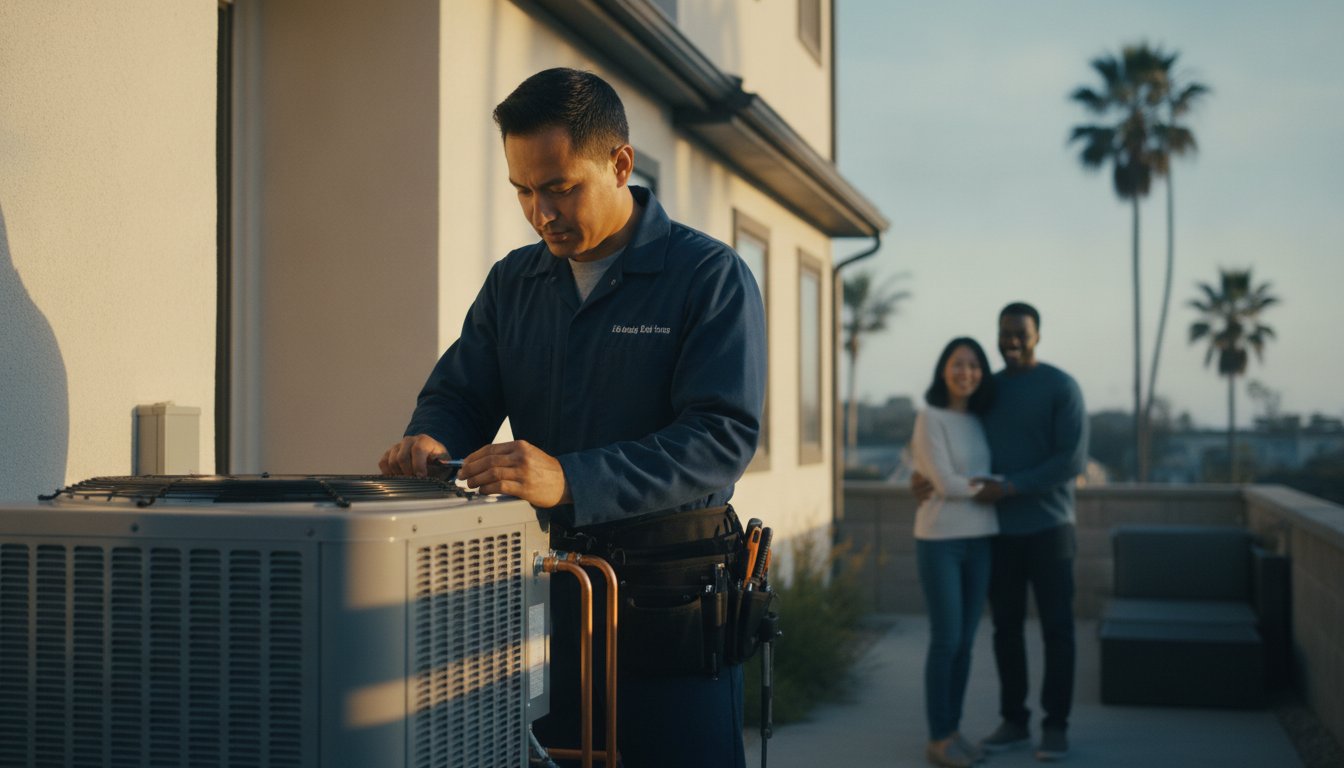
We believe in transparent pricing and neighborly warmth in every interaction. You will never encounter high-pressure sales tactics or hidden fees when you work with us. Our technicians take immense pride in their craftsmanship and follow a "no mess left behind" guarantee. We use floor runners and protective booties to ensure your home remains exactly as we found it, minus the temperature issues. We understand that inviting a contractor into your home requires trust, and we work hard to earn that trust through honesty and a strong work ethic.
Whether you are looking for a long-term maintenance partner or a specialist to guide you through a complex system replacement, we are here to help. We don't offer generic solutions because we know every Long Beach home has its own personality and requirements. If you are ready to start a conversation about your home’s efficiency and comfort, schedule your Long Beach home comfort consultation today!
Secure Your Home’s Long-Term Comfort
Selecting a system that survives the coastal humidity while meeting the strict 2026 energy standards doesn't have to be a stressful experience. When you prioritize technical qualifications like NATE certification and a valid C-20 license, you're investing in the future of your property. A truly reliable residential HVAC contractor Long Beach homeowners can trust will always prioritize your specific needs over a high-pressure sale. Whether you are navigating the new SEER2 regulations or looking for a way to lower those monthly utility bills, the right local partner makes all the difference.
Nice and Cool Inc. has been a dedicated part of this community since 2005. Our NATE-certified technicians are committed to providing the craftsmanship and dependability you deserve. From our proactive Nice and Cool Club Maintenance Plan to our specialized focus on residential excellence, we're here to ensure your system runs smoothly for years to come. Ready to upgrade your home's efficiency? Book Your Residential HVAC Consultation in Long Beach today. We look forward to helping you stay comfortable in every season.
Frequently Asked Questions
How do I know if a Long Beach HVAC contractor is licensed?
You can verify a contractor's status by visiting the California State Contractors License Board (CSLB) website and searching for their specific C-20 license number. Every legitimate residential HVAC contractor Long Beach homeowners hire should also possess an active Long Beach Business License. If a contractor cannot provide these numbers or if the name on the license doesn't match their company name, you should look for a different provider to protect your home.
What is the average lifespan of an AC unit in a coastal city like Long Beach?
In a coastal environment like ours, a standard air conditioning unit typically lasts between 10 and 15 years. Proximity to the ocean means salt air corrosion can shorten this lifespan significantly if the unit isn't properly maintained or treated with anti-corrosion coatings. Regular rinsing of the outdoor coils and joining a maintenance plan can help you get the maximum possible life out of your equipment despite the humidity.
Are there specific Long Beach city permits required for AC installation?
Yes, a mechanical permit from the Long Beach Development Services department is required for all new HVAC installations and equipment replacements. This permit ensures that your system is inspected for safety and compliance with the latest 2026 building codes. The estimated fee for this permit usually falls between $200 and $600, depending on the specific scope of your residential project and the equipment being installed.
What is the difference between SEER and SEER2 for 2026 systems?
SEER2 is the updated version of the Seasonal Energy Efficiency Ratio that uses more rigorous testing conditions to reflect real-world duct pressure. While SEER was the previous industry standard, SEER2 ratings represent a more accurate measurement of how a system performs in your actual home. For 2026, all new installations in the Southwest region must meet these higher SEER2 minimums to be legally compliant with California energy regulations.
Can a heat pump really replace both my furnace and my air conditioner?
A heat pump is designed to handle both heating and cooling by moving heat into or out of your home. In the mild Long Beach climate, these systems are incredibly efficient because they don't have to work against extreme freezing temperatures. By switching to a heat pump, you can eliminate the need for a separate gas furnace entirely, which simplifies your home’s mechanical systems and aligns with the state's latest electrification goals.
How often should I have my HVAC system serviced in Long Beach?
You should have your system professionally serviced at least twice a year, once before the summer cooling season and once before the winter heating months. This is especially important for a residential HVAC contractor Long Beach specialist to check for salt air damage and clear out any debris from the coastal winds. Regular maintenance through a program like our Nice and Cool Club helps catch small issues before they turn into expensive emergency repairs.
Do Long Beach utilities offer rebates for energy-efficient HVAC systems?
Yes, Southern California Edison (SCE) and SoCalGas offer several active rebates for 2026. For example, SCE provides a rebate of $667 per ton for ducted central heat pumps that meet specific efficiency ratings. If you're installing a high-efficiency gas furnace, SoCalGas offers rebates that can reach approximately $2,000 for units with a 97% AFUE rating or higher, helping to offset your initial investment costs.
What should I do if my AC stops blowing cold air during a Long Beach heatwave?
First, check your thermostat settings and ensure your air filter isn't clogged, as restricted airflow is a common culprit for cooling issues. If those aren't the problem, check your circuit breaker to see if the unit has tripped due to the heavy load. If the system still isn't cooling, turn it off immediately to prevent further damage and call a professional technician to inspect the refrigerant levels and electrical components.
Frequently Asked Questions
Our city's proximity to the Port of Long Beach and the Pacific Ocean creates a unique environment that is notoriously tough on mechanical equipment. If you live near the coast, salt air is a constant presence. This salt air accelerates corrosion, which can eat through standard outdoor condenser fins in just a few years. A local residential HVAC contractor Long Beach specialist knows how to select units with factory-applied anti-corrosion coatings to extend the life of your investment. We also deal with "June Gloom," that thick marine layer that drives up humidity levels. Without a properly sized system, your indoor evaporator coils can struggle to pull moisture from the air, leading to a clammy feeling indoors and potential mold growth.